Event submissions
Published
This submission belongs to the session S6. Synthesis, Characterization, and Properties of Nanomaterials of the event The 5th International Online Conference on Nanomaterials
Published date
19 Sep, 2025
Academic Editor
'%3e%3cpath%20d='M12.6657%2010.9104C12.4185%2010.325%2012.0599%209.79327%2011.6097%209.34482C11.1609%208.89508%2010.6293%208.5365%2010.0442%208.28888C10.0389%208.28626%2010.0337%208.28495%2010.0285%208.28233C10.8446%207.69279%2011.3752%206.73249%2011.3752%205.64904C11.3752%203.8542%209.92103%202.39999%208.1262%202.39999C6.33136%202.39999%204.87715%203.8542%204.87715%205.64904C4.87715%206.73249%205.40774%207.69279%206.22393%208.28364C6.21869%208.28626%206.21345%208.28757%206.20821%208.29019C5.62129%208.5378%205.09463%208.89284%204.64265%209.34613C4.1929%209.79493%203.83432%2010.3266%203.58671%2010.9117C3.34345%2011.4845%203.21226%2012.0987%203.20023%2012.7209C3.19988%2012.7349%203.20233%2012.7488%203.20744%2012.7619C3.21255%2012.7749%203.22022%2012.7867%203.22998%2012.7968C3.23975%2012.8068%203.25142%2012.8147%203.26431%2012.8202C3.2772%2012.8256%203.29105%2012.8284%203.30504%2012.8284H4.09109C4.14874%2012.8284%204.19459%2012.7825%204.1959%2012.7262C4.2221%2011.7148%204.62823%2010.7676%205.34617%2010.0497C6.08899%209.30683%207.0755%208.89808%208.1262%208.89808C9.17689%208.89808%2010.1634%209.30683%2010.9062%2010.0497C11.6242%2010.7676%2012.0303%2011.7148%2012.0565%2012.7262C12.0578%2012.7838%2012.1037%2012.8284%2012.1613%2012.8284H12.9474C12.9613%2012.8284%2012.9752%2012.8256%2012.9881%2012.8202C13.001%2012.8147%2013.0126%2012.8068%2013.0224%2012.7968C13.0322%2012.7867%2013.0398%2012.7749%2013.0449%2012.7619C13.0501%2012.7488%2013.0525%2012.7349%2013.0522%2012.7209C13.0391%2012.0947%2012.9094%2011.4855%2012.6657%2010.9104ZM8.1262%207.9024C7.52486%207.9024%206.9589%207.6679%206.53312%207.24211C6.10733%206.81633%205.87283%206.25037%205.87283%205.64904C5.87283%205.0477%206.10733%204.48174%206.53312%204.05596C6.9589%203.63018%207.52486%203.39567%208.1262%203.39567C8.72753%203.39567%209.29349%203.63018%209.71927%204.05596C10.1451%204.48174%2010.3796%205.0477%2010.3796%205.64904C10.3796%206.25037%2010.1451%206.81633%209.71927%207.24211C9.29349%207.6679%208.72753%207.9024%208.1262%207.9024Z'%20fill='%235D1EE1'/%3e%3c/g%3e%3c/svg%3e) José Luis Arias Mediano
José Luis Arias MedianoCitation
Daria Akhmadullina, Ekaterina Chikanova, The characteristics of nanocrystalline hydroxyapatite doped with ions of the rare earth elements - Pr³⁺, Sm³⁺, and Gd³⁺, in Proceedings of The 5th International Online Conference on Nanomaterials, 22 September–24 September 2025, MDPI: Basel, Switzerland
Share
Email
Facebook
Twitter
LinkedIn
The characteristics of nanocrystalline hydroxyapatite doped with ions of the rare earth elements - Pr3+, Sm3+, and Gd3+
'%3e%3cpath%20d='M12.6647%2010.9104C12.4176%2010.325%2012.0589%209.7933%2011.6088%209.34485C11.16%208.89511%2010.6283%208.53653%2010.0432%208.28891C10.038%208.28629%2010.0327%208.28498%2010.0275%208.28236C10.8437%207.69282%2011.3743%206.73252%2011.3743%205.64907C11.3743%203.85423%209.92005%202.40002%208.12522%202.40002C6.33038%202.40002%204.87618%203.85423%204.87618%205.64907C4.87618%206.73252%205.40677%207.69282%206.22296%208.28367C6.21772%208.28629%206.21248%208.2876%206.20724%208.29022C5.62031%208.53783%205.09365%208.89287%204.64167%209.34616C4.19192%209.79496%203.83334%2010.3266%203.58573%2010.9117C3.34247%2011.4846%203.21128%2012.0987%203.19925%2012.721C3.1989%2012.735%203.20135%2012.7489%203.20646%2012.7619C3.21157%2012.7749%203.21924%2012.7868%203.22901%2012.7968C3.23877%2012.8068%203.25045%2012.8148%203.26334%2012.8202C3.27623%2012.8256%203.29007%2012.8284%203.30406%2012.8284H4.09012C4.14776%2012.8284%204.19362%2012.7825%204.19493%2012.7262C4.22113%2011.7148%204.62726%2010.7676%205.34519%2010.0497C6.08802%209.30686%207.07452%208.89811%208.12522%208.89811C9.17592%208.89811%2010.1624%209.30686%2010.9052%2010.0497C11.6232%2010.7676%2012.0293%2011.7148%2012.0555%2012.7262C12.0568%2012.7839%2012.1027%2012.8284%2012.1603%2012.8284H12.9464C12.9604%2012.8284%2012.9742%2012.8256%2012.9871%2012.8202C13%2012.8148%2013.0117%2012.8068%2013.0214%2012.7968C13.0312%2012.7868%2013.0389%2012.7749%2013.044%2012.7619C13.0491%2012.7489%2013.0515%2012.735%2013.0512%2012.721C13.0381%2012.0947%2012.9084%2011.4856%2012.6647%2010.9104ZM8.12522%207.90243C7.52388%207.90243%206.95792%207.66793%206.53214%207.24215C6.10636%206.81636%205.87185%206.2504%205.87185%205.64907C5.87185%205.04773%206.10636%204.48177%206.53214%204.05599C6.95792%203.63021%207.52388%203.3957%208.12522%203.3957C8.72655%203.3957%209.29252%203.63021%209.7183%204.05599C10.1441%204.48177%2010.3786%205.04773%2010.3786%205.64907C10.3786%206.2504%2010.1441%206.81636%209.7183%207.24215C9.29252%207.66793%208.72655%207.90243%208.12522%207.90243Z'%20fill='%235D1EE1'/%3e%3c/g%3e%3c/svg%3e)
Daria Akhmadullina 1
Ekaterina Chikanova 2
1. National University of Science and Technology MISiS, Leninsky Prospekt 4, Moscow, 119049, Russia.
2. Department of General and Inorganic Chemistry, National University of Science and Technology MISiS, Leninsky Prospekt 4, Moscow, 119049, Russia.
Abstract
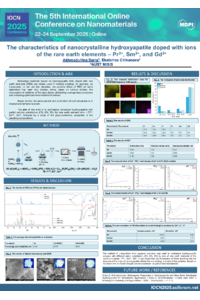
Nowadays, the number of publications containing the keyword "hydroxyapatite" for the 2024-2025 period is more than 10,000 (according to ScienceDirect) due to the extensive use of this material. Hydroxyapatite is the main component in the framework for effective bone tissue regeneration because of its high biocompatibility and unique microstructure. Partial cationic substitution with rare earth elements (REEs) improves the characteristics of the original material and stimulates osteogenesis processes.
In this work, synthesis of Sm3+-, Pr3+-, and Gd3+-doped HA (with 6%/9% REEs) was performed. The solid phase was obtained through precipitation from aqueous solutions of calcium and REE nitrates, (NH4)2HPO4. The powders were synthesized at a temperature of 70°C and a constant pH=11; dried at 100 °C; and calcined at 800 °C for 1 hour. The obtained materials were analyzed using IR–Fourier spectroscopy and XRD. The surface morphology and elemental composition were studied using SEM and EDS. The specific surface area indices were obtained using the BET method. The degradation of the materials in isotonic and tris-buffer solutions was also studied.
As a result of the investigation of the physicochemical properties, the materials were identified as a pure HA phase. They were nanosized particles connected in aggregates with many interaggregate pores. The IR spectra of the samples revealed bands of vibrations of carbonate and phosphate groups and vibrations of water in the structure. According to EDX, a decrease in the characteristic Ca/P ratio was noted, which confirmed cationic substitution in the Ca2+ positions.
Consequently, nanocrystalline hydroxyapatite doped with REE ions was synthesized through precipitation from aqueous solutions. It was found that the introduction of Pr3+, Sm3+, and Gd3+ affected the morphology and size of the particles. This system can be considered as a prospective biomaterial.
Keywords
hydroxyapatite
samarium
gadolinium
praseodymium
degradation
rare earth elements
Poster
IOCN2025_Poster_AkhmadullinaD.R..pdf
Functionalization of Multi-Walled Carbon Nanotubes (MWNTs) for Polyether Ether Ketone (PEEK) and Sulfonated Polyether Ether Ketone (SPEEK)/MWNT Composite Elaboration
Preparation of LaFeO3 Perovskite Nanoparticles using the Nitrate Method (from Nitrate Precursors)