Event submissions
Published
This submission belongs to the session S6. Synthesis, Characterization, and Properties of Nanomaterials of the event The 5th International Online Conference on Nanomaterials
Published date
19 Sep, 2025
Academic Editor
'%3e%3cpath%20d='M12.6657%2010.9104C12.4185%2010.325%2012.0599%209.79327%2011.6097%209.34482C11.1609%208.89508%2010.6293%208.5365%2010.0442%208.28888C10.0389%208.28626%2010.0337%208.28495%2010.0285%208.28233C10.8446%207.69279%2011.3752%206.73249%2011.3752%205.64904C11.3752%203.8542%209.92103%202.39999%208.1262%202.39999C6.33136%202.39999%204.87715%203.8542%204.87715%205.64904C4.87715%206.73249%205.40774%207.69279%206.22393%208.28364C6.21869%208.28626%206.21345%208.28757%206.20821%208.29019C5.62129%208.5378%205.09463%208.89284%204.64265%209.34613C4.1929%209.79493%203.83432%2010.3266%203.58671%2010.9117C3.34345%2011.4845%203.21226%2012.0987%203.20023%2012.7209C3.19988%2012.7349%203.20233%2012.7488%203.20744%2012.7619C3.21255%2012.7749%203.22022%2012.7867%203.22998%2012.7968C3.23975%2012.8068%203.25142%2012.8147%203.26431%2012.8202C3.2772%2012.8256%203.29105%2012.8284%203.30504%2012.8284H4.09109C4.14874%2012.8284%204.19459%2012.7825%204.1959%2012.7262C4.2221%2011.7148%204.62823%2010.7676%205.34617%2010.0497C6.08899%209.30683%207.0755%208.89808%208.1262%208.89808C9.17689%208.89808%2010.1634%209.30683%2010.9062%2010.0497C11.6242%2010.7676%2012.0303%2011.7148%2012.0565%2012.7262C12.0578%2012.7838%2012.1037%2012.8284%2012.1613%2012.8284H12.9474C12.9613%2012.8284%2012.9752%2012.8256%2012.9881%2012.8202C13.001%2012.8147%2013.0126%2012.8068%2013.0224%2012.7968C13.0322%2012.7867%2013.0398%2012.7749%2013.0449%2012.7619C13.0501%2012.7488%2013.0525%2012.7349%2013.0522%2012.7209C13.0391%2012.0947%2012.9094%2011.4855%2012.6657%2010.9104ZM8.1262%207.9024C7.52486%207.9024%206.9589%207.6679%206.53312%207.24211C6.10733%206.81633%205.87283%206.25037%205.87283%205.64904C5.87283%205.0477%206.10733%204.48174%206.53312%204.05596C6.9589%203.63018%207.52486%203.39567%208.1262%203.39567C8.72753%203.39567%209.29349%203.63018%209.71927%204.05596C10.1451%204.48174%2010.3796%205.0477%2010.3796%205.64904C10.3796%206.25037%2010.1451%206.81633%209.71927%207.24211C9.29349%207.6679%208.72753%207.9024%208.1262%207.9024Z'%20fill='%235D1EE1'/%3e%3c/g%3e%3c/svg%3e) Catalin-Daniel CONSTANTINESCU
Catalin-Daniel CONSTANTINESCUCitation
Anastasia Teplova, Asya Afzal, Ivan Ponomarev, Elena Trusova, Nanostructured composite powders based on oxygen-free graphene and Zr/Ce oxides for advanced ceramics, in Proceedings of The 5th International Online Conference on Nanomaterials, 22 September–24 September 2025, MDPI: Basel, Switzerland
Share
Email
Facebook
Twitter
LinkedIn
Nanostructured composite powders based on oxygen-free graphene and Zr/Ce oxides for advanced ceramics
'%3e%3cpath%20d='M12.6647%2010.9104C12.4176%2010.325%2012.0589%209.7933%2011.6088%209.34485C11.16%208.89511%2010.6283%208.53653%2010.0432%208.28891C10.038%208.28629%2010.0327%208.28498%2010.0275%208.28236C10.8437%207.69282%2011.3743%206.73252%2011.3743%205.64907C11.3743%203.85423%209.92005%202.40002%208.12522%202.40002C6.33038%202.40002%204.87618%203.85423%204.87618%205.64907C4.87618%206.73252%205.40677%207.69282%206.22296%208.28367C6.21772%208.28629%206.21248%208.2876%206.20724%208.29022C5.62031%208.53783%205.09365%208.89287%204.64167%209.34616C4.19192%209.79496%203.83334%2010.3266%203.58573%2010.9117C3.34247%2011.4846%203.21128%2012.0987%203.19925%2012.721C3.1989%2012.735%203.20135%2012.7489%203.20646%2012.7619C3.21157%2012.7749%203.21924%2012.7868%203.22901%2012.7968C3.23877%2012.8068%203.25045%2012.8148%203.26334%2012.8202C3.27623%2012.8256%203.29007%2012.8284%203.30406%2012.8284H4.09012C4.14776%2012.8284%204.19362%2012.7825%204.19493%2012.7262C4.22113%2011.7148%204.62726%2010.7676%205.34519%2010.0497C6.08802%209.30686%207.07452%208.89811%208.12522%208.89811C9.17592%208.89811%2010.1624%209.30686%2010.9052%2010.0497C11.6232%2010.7676%2012.0293%2011.7148%2012.0555%2012.7262C12.0568%2012.7839%2012.1027%2012.8284%2012.1603%2012.8284H12.9464C12.9604%2012.8284%2012.9742%2012.8256%2012.9871%2012.8202C13%2012.8148%2013.0117%2012.8068%2013.0214%2012.7968C13.0312%2012.7868%2013.0389%2012.7749%2013.044%2012.7619C13.0491%2012.7489%2013.0515%2012.735%2013.0512%2012.721C13.0381%2012.0947%2012.9084%2011.4856%2012.6647%2010.9104ZM8.12522%207.90243C7.52388%207.90243%206.95792%207.66793%206.53214%207.24215C6.10636%206.81636%205.87185%206.2504%205.87185%205.64907C5.87185%205.04773%206.10636%204.48177%206.53214%204.05599C6.95792%203.63021%207.52388%203.3957%208.12522%203.3957C8.72655%203.3957%209.29252%203.63021%209.7183%204.05599C10.1441%204.48177%2010.3786%205.04773%2010.3786%205.64907C10.3786%206.2504%2010.1441%206.81636%209.7183%207.24215C9.29252%207.66793%208.72655%207.90243%208.12522%207.90243Z'%20fill='%235D1EE1'/%3e%3c/g%3e%3c/svg%3e)
Anastasia Teplova 1,2
Asya Afzal 2
Ivan Ponomarev 2
Elena Trusova 2
1. Peoples’ Friendship University of Russia named after Patrice Lumumba, RUDN University, 6 Miklukho-Maklaya st., Moscow, 117198, Russia
2. A.A. Baikov Institute of Metallurgy and Materials Science of Russian Academy of Sciences, IMET RAS, 49 Leninsky prospect, Moscow, 119334, Russia
Abstract
Composites based on Ce or Zr oxides (MeO2) are highly demanded materials for energy, electronics, catalysis, and nanophotonics, but their development is hampered by high energy costs, difficulties in synthesis, and the lack of sound pressing and sintering modes for nanostructured powders. In this study, a method for producing composite powders based on oxygen-free graphene and MeO2 for ceramics with a wide range of applications is proposed. The method is a combination of sol–gel and sonochemical techniques, allowing for the synthesis of hybrid structures with a uniform distribution of components in volume at the nanolevel. The developed hybrid structures consist of ceria or zirconia crystallites with dimensions of 6-14 nm, incorporated into graphene sheets several nm thick. Theoretically substantiated mechanisms for the formation of graphene suspensions, graphene–MeO2 composites, and sintering of nanostructured hybrid powders are proposed based on the obtained experimental data. The positive effect of graphene on the microstructure of ceramics was determined: the use of a hybrid graphene–ZrO2 powder makes it possible to obtain dense (98%), fine-grained ceramics with high structural homogeneity using the SPS method. It was shown that oxygen-free graphene on the surface of MeO2 crystallites promotes the acceleration of surface exchange processes involving oxygen, which makes the developed composites promising raw materials for new electrical devices and catalysts. It was determined that graphene sheets and the method of their inclusion in the hybrid structure affect the activation energy of sintering and the mass transfer mechanism. The results of this study can be used as a basis for a technological process covering all stages, from obtaining initial solutions and colloids to sintered ceramics.
Keywords
nanopowders
fine-grained ceramics
sol-gel technique
graphene based hybrid nanostructures
graphene-zirconia composites
graphene-ceria composites
oxygen-free graphene
Poster
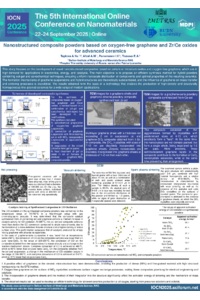
poster_IOCN_2025_Teplova A..pdf
Preparation of LaFeO3 Perovskite Nanoparticles using the Nitrate Method (from Nitrate Precursors)
The various methods of melamine thermolysis