Event submissions
Published
This submission belongs to the session S5. Environmental Nanoscience and Nanotechnology of the event The 5th International Online Conference on Nanomaterials
Published date
19 Sep, 2025
Academic Editor
'%3e%3cpath%20d='M12.6657%2010.9104C12.4185%2010.325%2012.0599%209.79327%2011.6097%209.34482C11.1609%208.89508%2010.6293%208.5365%2010.0442%208.28888C10.0389%208.28626%2010.0337%208.28495%2010.0285%208.28233C10.8446%207.69279%2011.3752%206.73249%2011.3752%205.64904C11.3752%203.8542%209.92103%202.39999%208.1262%202.39999C6.33136%202.39999%204.87715%203.8542%204.87715%205.64904C4.87715%206.73249%205.40774%207.69279%206.22393%208.28364C6.21869%208.28626%206.21345%208.28757%206.20821%208.29019C5.62129%208.5378%205.09463%208.89284%204.64265%209.34613C4.1929%209.79493%203.83432%2010.3266%203.58671%2010.9117C3.34345%2011.4845%203.21226%2012.0987%203.20023%2012.7209C3.19988%2012.7349%203.20233%2012.7488%203.20744%2012.7619C3.21255%2012.7749%203.22022%2012.7867%203.22998%2012.7968C3.23975%2012.8068%203.25142%2012.8147%203.26431%2012.8202C3.2772%2012.8256%203.29105%2012.8284%203.30504%2012.8284H4.09109C4.14874%2012.8284%204.19459%2012.7825%204.1959%2012.7262C4.2221%2011.7148%204.62823%2010.7676%205.34617%2010.0497C6.08899%209.30683%207.0755%208.89808%208.1262%208.89808C9.17689%208.89808%2010.1634%209.30683%2010.9062%2010.0497C11.6242%2010.7676%2012.0303%2011.7148%2012.0565%2012.7262C12.0578%2012.7838%2012.1037%2012.8284%2012.1613%2012.8284H12.9474C12.9613%2012.8284%2012.9752%2012.8256%2012.9881%2012.8202C13.001%2012.8147%2013.0126%2012.8068%2013.0224%2012.7968C13.0322%2012.7867%2013.0398%2012.7749%2013.0449%2012.7619C13.0501%2012.7488%2013.0525%2012.7349%2013.0522%2012.7209C13.0391%2012.0947%2012.9094%2011.4855%2012.6657%2010.9104ZM8.1262%207.9024C7.52486%207.9024%206.9589%207.6679%206.53312%207.24211C6.10733%206.81633%205.87283%206.25037%205.87283%205.64904C5.87283%205.0477%206.10733%204.48174%206.53312%204.05596C6.9589%203.63018%207.52486%203.39567%208.1262%203.39567C8.72753%203.39567%209.29349%203.63018%209.71927%204.05596C10.1451%204.48174%2010.3796%205.0477%2010.3796%205.64904C10.3796%206.25037%2010.1451%206.81633%209.71927%207.24211C9.29349%207.6679%208.72753%207.9024%208.1262%207.9024Z'%20fill='%235D1EE1'/%3e%3c/g%3e%3c/svg%3e) Marco Stoller
Marco StollerCitation
SEPIDEH DADASHI, Gabriele Giancane, Giuseppe Mele, Coffee Waste-Based Nanostructures: A Cost-Effective Fluorescent Probe for Ni²⁺ Detection in Water, in Proceedings of The 5th International Online Conference on Nanomaterials, 22 September–24 September 2025, MDPI: Basel, Switzerland
Share
Email
Facebook
Twitter
LinkedIn
Coffee Waste-Based Nanostructures: A Cost-Effective Fluorescent Probe for Ni²⁺ Detection in Water
'%3e%3cpath%20d='M12.6647%2010.9104C12.4176%2010.325%2012.0589%209.7933%2011.6088%209.34485C11.16%208.89511%2010.6283%208.53653%2010.0432%208.28891C10.038%208.28629%2010.0327%208.28498%2010.0275%208.28236C10.8437%207.69282%2011.3743%206.73252%2011.3743%205.64907C11.3743%203.85423%209.92005%202.40002%208.12522%202.40002C6.33038%202.40002%204.87618%203.85423%204.87618%205.64907C4.87618%206.73252%205.40677%207.69282%206.22296%208.28367C6.21772%208.28629%206.21248%208.2876%206.20724%208.29022C5.62031%208.53783%205.09365%208.89287%204.64167%209.34616C4.19192%209.79496%203.83334%2010.3266%203.58573%2010.9117C3.34247%2011.4846%203.21128%2012.0987%203.19925%2012.721C3.1989%2012.735%203.20135%2012.7489%203.20646%2012.7619C3.21157%2012.7749%203.21924%2012.7868%203.22901%2012.7968C3.23877%2012.8068%203.25045%2012.8148%203.26334%2012.8202C3.27623%2012.8256%203.29007%2012.8284%203.30406%2012.8284H4.09012C4.14776%2012.8284%204.19362%2012.7825%204.19493%2012.7262C4.22113%2011.7148%204.62726%2010.7676%205.34519%2010.0497C6.08802%209.30686%207.07452%208.89811%208.12522%208.89811C9.17592%208.89811%2010.1624%209.30686%2010.9052%2010.0497C11.6232%2010.7676%2012.0293%2011.7148%2012.0555%2012.7262C12.0568%2012.7839%2012.1027%2012.8284%2012.1603%2012.8284H12.9464C12.9604%2012.8284%2012.9742%2012.8256%2012.9871%2012.8202C13%2012.8148%2013.0117%2012.8068%2013.0214%2012.7968C13.0312%2012.7868%2013.0389%2012.7749%2013.044%2012.7619C13.0491%2012.7489%2013.0515%2012.735%2013.0512%2012.721C13.0381%2012.0947%2012.9084%2011.4856%2012.6647%2010.9104ZM8.12522%207.90243C7.52388%207.90243%206.95792%207.66793%206.53214%207.24215C6.10636%206.81636%205.87185%206.2504%205.87185%205.64907C5.87185%205.04773%206.10636%204.48177%206.53214%204.05599C6.95792%203.63021%207.52388%203.3957%208.12522%203.3957C8.72655%203.3957%209.29252%203.63021%209.7183%204.05599C10.1441%204.48177%2010.3786%205.04773%2010.3786%205.64907C10.3786%206.2504%2010.1441%206.81636%209.7183%207.24215C9.29252%207.66793%208.72655%207.90243%208.12522%207.90243Z'%20fill='%235D1EE1'/%3e%3c/g%3e%3c/svg%3e)
SEPIDEH DADASHI 1

Gabriele Giancane 2

Giuseppe Mele 1
1. Department of Engineering for Innovation, University of Salento, 73100, Lecce, Italy
2. Department of Cultural Heritage, University of Salento, Lecce,73100, Italy
Abstract
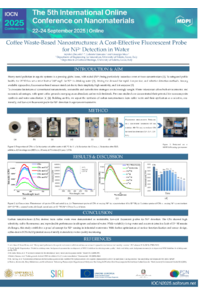
Water contamination by heavy metals, especially nickel ions (Ni²⁺), poses serious risks to public health and the environment due to their toxicity and persistence in aquatic systems. Traditional detection methods often struggle to monitor Ni²⁺ efficiently at trace levels. This study develops a sustainable, cost-effective fluorescence-based sensor using carbon nanostructures (CNs) derived from coffee waste for selective Ni²⁺ detection. CNs were synthesized by green pyrolysis of coffee waste at 600 °C for one hour and characterized by FTIR spectroscopy, zeta potential, and particle size analysis. Fluorescence spectroscopy evaluated CNs interactions with Co²⁺, Cu²⁺, Cd²⁺, and Ni²⁺ ions in ultrapure water. CNs displayed distinct fluorescence responses to various metal ions, with Cu²⁺ causing quenching, Co²⁺ enhancing fluorescence, Cd²⁺ having minimal impact, and Ni²⁺ inducing pronounced fluorescence quenching. Ni²⁺ detection was further tested in ultrapure, tap, and mineral water across concentrations from 10⁻⁸ to 10⁻³ M. Stability tests over six hours identified optimal sensing conditions. Fluorescence intensity decreased progressively with increasing Ni²⁺ concentration, indicating high sensitivity and selectivity. Detection limits reached 10⁻⁴ M. Stability studies revealed an initial drop in fluorescence, a recovery peak at one hour, followed by a gradual decline, establishing one hour as the ideal detection time. Tap water exhibited some variability due to matrix effects, while mineral water showed consistent quenching, confirming the CNs sensor's robustness across water types. This work highlights coffee waste–derived CNs as effective, eco-friendly fluorescent probes for Ni²⁺ detection. The platform enables sensitive, selective monitoring of nickel ions in diverse water matrices, combining heavy metal detection with sustainable waste valorization and supporting circular economy goals. Acknowledgment: This project was conducted with the support of S.D. through a Doctoral Fellowship funded by the National Operational Programme Research and Innovation 2014-2020 (grant CCI2014IT16M2OP005).
Keywords
Fluorescence emission
Nickel ion
Heavy metals ions
Carbon nanostructures
Coffee waste.
Poster
Poster-IOCN 2025-SD.pdf
Investigation of Hydrothermally Synthesized Cu-SnO2 and Zn-SnO2 Nanocomposites for Catalytic Reduction of Para-nitrophenol
Hybrid materials based on functionalized MWCNTs and ionically imprinted polymers with potential application for REE ion recovery