Event submissions
Published
This submission belongs to the session S5. Environmental Nanoscience and Nanotechnology of the event The 5th International Online Conference on Nanomaterials
Published date
19 Sep, 2025
Academic Editor
'%3e%3cpath%20d='M12.6657%2010.9104C12.4185%2010.325%2012.0599%209.79327%2011.6097%209.34482C11.1609%208.89508%2010.6293%208.5365%2010.0442%208.28888C10.0389%208.28626%2010.0337%208.28495%2010.0285%208.28233C10.8446%207.69279%2011.3752%206.73249%2011.3752%205.64904C11.3752%203.8542%209.92103%202.39999%208.1262%202.39999C6.33136%202.39999%204.87715%203.8542%204.87715%205.64904C4.87715%206.73249%205.40774%207.69279%206.22393%208.28364C6.21869%208.28626%206.21345%208.28757%206.20821%208.29019C5.62129%208.5378%205.09463%208.89284%204.64265%209.34613C4.1929%209.79493%203.83432%2010.3266%203.58671%2010.9117C3.34345%2011.4845%203.21226%2012.0987%203.20023%2012.7209C3.19988%2012.7349%203.20233%2012.7488%203.20744%2012.7619C3.21255%2012.7749%203.22022%2012.7867%203.22998%2012.7968C3.23975%2012.8068%203.25142%2012.8147%203.26431%2012.8202C3.2772%2012.8256%203.29105%2012.8284%203.30504%2012.8284H4.09109C4.14874%2012.8284%204.19459%2012.7825%204.1959%2012.7262C4.2221%2011.7148%204.62823%2010.7676%205.34617%2010.0497C6.08899%209.30683%207.0755%208.89808%208.1262%208.89808C9.17689%208.89808%2010.1634%209.30683%2010.9062%2010.0497C11.6242%2010.7676%2012.0303%2011.7148%2012.0565%2012.7262C12.0578%2012.7838%2012.1037%2012.8284%2012.1613%2012.8284H12.9474C12.9613%2012.8284%2012.9752%2012.8256%2012.9881%2012.8202C13.001%2012.8147%2013.0126%2012.8068%2013.0224%2012.7968C13.0322%2012.7867%2013.0398%2012.7749%2013.0449%2012.7619C13.0501%2012.7488%2013.0525%2012.7349%2013.0522%2012.7209C13.0391%2012.0947%2012.9094%2011.4855%2012.6657%2010.9104ZM8.1262%207.9024C7.52486%207.9024%206.9589%207.6679%206.53312%207.24211C6.10733%206.81633%205.87283%206.25037%205.87283%205.64904C5.87283%205.0477%206.10733%204.48174%206.53312%204.05596C6.9589%203.63018%207.52486%203.39567%208.1262%203.39567C8.72753%203.39567%209.29349%203.63018%209.71927%204.05596C10.1451%204.48174%2010.3796%205.0477%2010.3796%205.64904C10.3796%206.25037%2010.1451%206.81633%209.71927%207.24211C9.29349%207.6679%208.72753%207.9024%208.1262%207.9024Z'%20fill='%235D1EE1'/%3e%3c/g%3e%3c/svg%3e) Marco Stoller
Marco StollerCitation
Mariangela Oggianu, Fabio Manna, Maria Laura Mercuri, Norberto Masciocchi, An Ultramicroporous Metal–Organic Framework for CO₂ uptake and conversion, in Proceedings of The 5th International Online Conference on Nanomaterials, 22 September–24 September 2025, MDPI: Basel, Switzerland
Share
Email
Facebook
Twitter
LinkedIn
An Ultramicroporous Metal–Organic Framework for CO2 uptake and conversion
'%3e%3cpath%20d='M12.6647%2010.9104C12.4176%2010.325%2012.0589%209.7933%2011.6088%209.34485C11.16%208.89511%2010.6283%208.53653%2010.0432%208.28891C10.038%208.28629%2010.0327%208.28498%2010.0275%208.28236C10.8437%207.69282%2011.3743%206.73252%2011.3743%205.64907C11.3743%203.85423%209.92005%202.40002%208.12522%202.40002C6.33038%202.40002%204.87618%203.85423%204.87618%205.64907C4.87618%206.73252%205.40677%207.69282%206.22296%208.28367C6.21772%208.28629%206.21248%208.2876%206.20724%208.29022C5.62031%208.53783%205.09365%208.89287%204.64167%209.34616C4.19192%209.79496%203.83334%2010.3266%203.58573%2010.9117C3.34247%2011.4846%203.21128%2012.0987%203.19925%2012.721C3.1989%2012.735%203.20135%2012.7489%203.20646%2012.7619C3.21157%2012.7749%203.21924%2012.7868%203.22901%2012.7968C3.23877%2012.8068%203.25045%2012.8148%203.26334%2012.8202C3.27623%2012.8256%203.29007%2012.8284%203.30406%2012.8284H4.09012C4.14776%2012.8284%204.19362%2012.7825%204.19493%2012.7262C4.22113%2011.7148%204.62726%2010.7676%205.34519%2010.0497C6.08802%209.30686%207.07452%208.89811%208.12522%208.89811C9.17592%208.89811%2010.1624%209.30686%2010.9052%2010.0497C11.6232%2010.7676%2012.0293%2011.7148%2012.0555%2012.7262C12.0568%2012.7839%2012.1027%2012.8284%2012.1603%2012.8284H12.9464C12.9604%2012.8284%2012.9742%2012.8256%2012.9871%2012.8202C13%2012.8148%2013.0117%2012.8068%2013.0214%2012.7968C13.0312%2012.7868%2013.0389%2012.7749%2013.044%2012.7619C13.0491%2012.7489%2013.0515%2012.735%2013.0512%2012.721C13.0381%2012.0947%2012.9084%2011.4856%2012.6647%2010.9104ZM8.12522%207.90243C7.52388%207.90243%206.95792%207.66793%206.53214%207.24215C6.10636%206.81636%205.87185%206.2504%205.87185%205.64907C5.87185%205.04773%206.10636%204.48177%206.53214%204.05599C6.95792%203.63021%207.52388%203.3957%208.12522%203.3957C8.72655%203.3957%209.29252%203.63021%209.7183%204.05599C10.1441%204.48177%2010.3786%205.04773%2010.3786%205.64907C10.3786%206.2504%2010.1441%206.81636%209.7183%207.24215C9.29252%207.66793%208.72655%207.90243%208.12522%207.90243Z'%20fill='%235D1EE1'/%3e%3c/g%3e%3c/svg%3e)
Mariangela Oggianu 1
Fabio Manna 2

Maria Laura Mercuri 2
Norberto Masciocchi 3
1. University of Cagliari, Via Università 40, 09124 Cagliari, Italy
2. Department of Chemical and Geological Sciences, University of Cagliari, Cittadella Universitaria, S.P. Monserrato-Sestu Km 0.700, 09042 Monserrato, Cagliari, Italy
3. Department of Science and High Technology, University of Insubria, Via Valleggio 11, 22100 Como, Italy
Abstract
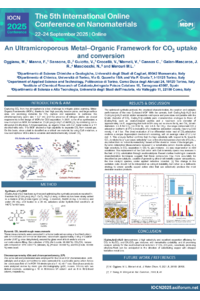
Capturing CO2 from the atmosphere represents a key challenge, since CO2 has been recognized as the primary anthropogenic greenhouse contributor to the increase in Earth’s average temperature. Their high porosity, tunable pore size, and large surface area make Metal–Organic Frameworks (MOFs) promising candidates to uptake and separate CO2 from gaseous mixtures. In particular, the ultramicroporosity (pore size < 0,7 nm) and the presence of nitrogen atoms are crucial requirements in the design of MOFs for CO2 separation. In 2021, some of us synthesized a new microporous MOF, formulated as [Co(trz2An)]n·3H2O (CAMOF1), by combining 3, 6-N-ditriazolyl-2,5-dihydroxy-1,4-benzoquinone (trz2An), as an organic linker, with CoII meta nodes in a 1:1 stoichiometric ratio. This MOF showed a high capability to separate CO2 from natural gas. On this basis, since cobalt is classified as a critical raw material, by using CuII metal ions, a new isomorphous, robust, chemical, and thermally stable MOF, formulated as [Cu(trz2An)]· 2.5H2O (CAMOF2), was obtained. The synthesis performed by the hydrothermal approach was optimized in order to scale-up the reaction mixture by ten times. CAMOF2 is formed by cubic cavities with a void volume of 30 % due to the coordination to the N atom in the 4-position of the triazole ring, which induces an alternate orientation of Cu-anilate chains. Static and dynamic adsorption measurements revealed i) a remarkable carbon dioxide uptake, ii) a high selectivity in CO2 separation in CO2:N2 gas mixtures, and iii) easy regeneration in mild conditions. Furthermore, preliminary CO2 electroreduction studies show a good CAMOF2 capability to convert carbon dioxide to ethylene. In conclusion, by replacing the metal node in the MOF structure, a new microporous biocompatible multifunctional MOF has been obtained, with CO2 adsorption and reduction capabilities.
Keywords
MOFs
CO2 Separation
SC-Xray Diffraction,
Poster
sciforum_133617_Slides_Mariangela.pdf
Impact of plastic nanoparticles on ecology and human life
Sustainable Strategy for Upcycling Organic Waste into Highly Luminescent Carbon Dots