Event submissions
Published
This submission belongs to the session S5. Environmental Nanoscience and Nanotechnology of the event The 5th International Online Conference on Nanomaterials
Published date
19 Sep, 2025
Academic Editor
'%3e%3cpath%20d='M12.6657%2010.9104C12.4185%2010.325%2012.0599%209.79327%2011.6097%209.34482C11.1609%208.89508%2010.6293%208.5365%2010.0442%208.28888C10.0389%208.28626%2010.0337%208.28495%2010.0285%208.28233C10.8446%207.69279%2011.3752%206.73249%2011.3752%205.64904C11.3752%203.8542%209.92103%202.39999%208.1262%202.39999C6.33136%202.39999%204.87715%203.8542%204.87715%205.64904C4.87715%206.73249%205.40774%207.69279%206.22393%208.28364C6.21869%208.28626%206.21345%208.28757%206.20821%208.29019C5.62129%208.5378%205.09463%208.89284%204.64265%209.34613C4.1929%209.79493%203.83432%2010.3266%203.58671%2010.9117C3.34345%2011.4845%203.21226%2012.0987%203.20023%2012.7209C3.19988%2012.7349%203.20233%2012.7488%203.20744%2012.7619C3.21255%2012.7749%203.22022%2012.7867%203.22998%2012.7968C3.23975%2012.8068%203.25142%2012.8147%203.26431%2012.8202C3.2772%2012.8256%203.29105%2012.8284%203.30504%2012.8284H4.09109C4.14874%2012.8284%204.19459%2012.7825%204.1959%2012.7262C4.2221%2011.7148%204.62823%2010.7676%205.34617%2010.0497C6.08899%209.30683%207.0755%208.89808%208.1262%208.89808C9.17689%208.89808%2010.1634%209.30683%2010.9062%2010.0497C11.6242%2010.7676%2012.0303%2011.7148%2012.0565%2012.7262C12.0578%2012.7838%2012.1037%2012.8284%2012.1613%2012.8284H12.9474C12.9613%2012.8284%2012.9752%2012.8256%2012.9881%2012.8202C13.001%2012.8147%2013.0126%2012.8068%2013.0224%2012.7968C13.0322%2012.7867%2013.0398%2012.7749%2013.0449%2012.7619C13.0501%2012.7488%2013.0525%2012.7349%2013.0522%2012.7209C13.0391%2012.0947%2012.9094%2011.4855%2012.6657%2010.9104ZM8.1262%207.9024C7.52486%207.9024%206.9589%207.6679%206.53312%207.24211C6.10733%206.81633%205.87283%206.25037%205.87283%205.64904C5.87283%205.0477%206.10733%204.48174%206.53312%204.05596C6.9589%203.63018%207.52486%203.39567%208.1262%203.39567C8.72753%203.39567%209.29349%203.63018%209.71927%204.05596C10.1451%204.48174%2010.3796%205.0477%2010.3796%205.64904C10.3796%206.25037%2010.1451%206.81633%209.71927%207.24211C9.29349%207.6679%208.72753%207.9024%208.1262%207.9024Z'%20fill='%235D1EE1'/%3e%3c/g%3e%3c/svg%3e) Marco Stoller
Marco StollerCitation
Sónia Fernandes, Joaquim C. G. Esteves da Silva, Luís Pinto da Silva, Sustainable Strategy for Upcycling Organic Waste into Highly Luminescent Carbon Dots, in Proceedings of The 5th International Online Conference on Nanomaterials, 22 September–24 September 2025, MDPI: Basel, Switzerland
Share
Email
Facebook
Twitter
LinkedIn
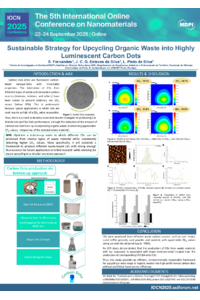
Sustainable Strategy for Upcycling Organic Waste into Highly Luminescent Carbon Dots
'%3e%3cpath%20d='M12.6647%2010.9104C12.4176%2010.325%2012.0589%209.7933%2011.6088%209.34485C11.16%208.89511%2010.6283%208.53653%2010.0432%208.28891C10.038%208.28629%2010.0327%208.28498%2010.0275%208.28236C10.8437%207.69282%2011.3743%206.73252%2011.3743%205.64907C11.3743%203.85423%209.92005%202.40002%208.12522%202.40002C6.33038%202.40002%204.87618%203.85423%204.87618%205.64907C4.87618%206.73252%205.40677%207.69282%206.22296%208.28367C6.21772%208.28629%206.21248%208.2876%206.20724%208.29022C5.62031%208.53783%205.09365%208.89287%204.64167%209.34616C4.19192%209.79496%203.83334%2010.3266%203.58573%2010.9117C3.34247%2011.4846%203.21128%2012.0987%203.19925%2012.721C3.1989%2012.735%203.20135%2012.7489%203.20646%2012.7619C3.21157%2012.7749%203.21924%2012.7868%203.22901%2012.7968C3.23877%2012.8068%203.25045%2012.8148%203.26334%2012.8202C3.27623%2012.8256%203.29007%2012.8284%203.30406%2012.8284H4.09012C4.14776%2012.8284%204.19362%2012.7825%204.19493%2012.7262C4.22113%2011.7148%204.62726%2010.7676%205.34519%2010.0497C6.08802%209.30686%207.07452%208.89811%208.12522%208.89811C9.17592%208.89811%2010.1624%209.30686%2010.9052%2010.0497C11.6232%2010.7676%2012.0293%2011.7148%2012.0555%2012.7262C12.0568%2012.7839%2012.1027%2012.8284%2012.1603%2012.8284H12.9464C12.9604%2012.8284%2012.9742%2012.8256%2012.9871%2012.8202C13%2012.8148%2013.0117%2012.8068%2013.0214%2012.7968C13.0312%2012.7868%2013.0389%2012.7749%2013.044%2012.7619C13.0491%2012.7489%2013.0515%2012.735%2013.0512%2012.721C13.0381%2012.0947%2012.9084%2011.4856%2012.6647%2010.9104ZM8.12522%207.90243C7.52388%207.90243%206.95792%207.66793%206.53214%207.24215C6.10636%206.81636%205.87185%206.2504%205.87185%205.64907C5.87185%205.04773%206.10636%204.48177%206.53214%204.05599C6.95792%203.63021%207.52388%203.3957%208.12522%203.3957C8.72655%203.3957%209.29252%203.63021%209.7183%204.05599C10.1441%204.48177%2010.3786%205.04773%2010.3786%205.64907C10.3786%206.2504%2010.1441%206.81636%209.7183%207.24215C9.29252%207.66793%208.72655%207.90243%208.12522%207.90243Z'%20fill='%235D1EE1'/%3e%3c/g%3e%3c/svg%3e)
Sónia Fernandes 1

Joaquim C. G. Esteves da Silva 1

Luís Pinto da Silva 1
1. Centro de Investigação em Química (CIQUP), Instituto de Ciências Moleculares (IMS), Departamento de Geociências, Ambiente e Ordenamento do Território, Faculdade de Ciências, Universidade do Porto, R. Campo Alegre s/n, 4169-007 Porto, Portugal.
Abstract
Carbon dots (CDs) emerged as a new class of carbon nanomaterials recognized for their exceptional water solubility, (photo)chemical stability, biocompatibility, and low toxicity. The versatility of fluorescent carbon-based nanomaterials underpins their deployment in light-emitting devices, photocatalysis, bioimaging, and sensing. In these applications, a high fluorescence quantum yield (QYFL) is critical for achieving optimal performance. Notably, CDs can be produced from a wide variety of carbon sources, where converting organic waste into CDs offers a true circular-economy route. However, waste-based CDs typically exhibit QYFL values below 20%, which severely limits their practical utility. Thus, a robust and reproducible synthesis procedure is required to deliver consistently high QYFL, regardless of the waste precursor.
This study aimed to establish a simple upcycling strategy for transforming diverse organic waste into brightly fluorescent CDs via hydrothermal treatment. This procedure considers waste materials and citric acid as carbon precursors and ethylenediamine (EDA) as a nitrogen dopant. Optimization at 200 °C for 8 h using corn stover (CS-CDs8h) set the core parameters. We then validated the procedure on spent coffee grounds, cork powder, and sawdust, which showed CDs with appreciable QYFL, reaching up to ~40%. CDs were thoroughly characterized by AFM, XPS, FTIR, XRD, fluorescence, and UV–Vis spectroscopy. It is worth mentioning that these CDs displayed compatibility with human cell lines. Finally, a Life Cycle Assessment (LCA) demonstrated that these waste-based CDs are associated with lower environmental impacts when compared with CDs from commercial reagents. Thus, this study provides an efficient, environmentally responsible framework for upcycling a wide range of organic wastes into high-performance carbon dots without sacrificing fluorescence efficiency.
Acknowledgments
We thank the “Fundação para a Ciência e Tecnologia” (FCT, Portugal) for the following funding: UIDB/00081/2020 (CIQUP), LA/P/0056/2020 (IMS), project 2023.13127.PEX, and 2021.05479.BD (Sónia Fernandes PhD grant).
Keywords
Carbon Dots
Organic waste
Fluorescence quantum yield
Life Cycle Assessment
Poster
IOCN 2025 Poster_Sónia Fernandes.pdf
An Ultramicroporous Metal–Organic Framework for CO2 uptake and conversion
Addressing As(III) and As(V) contamination in water through iron oxyhydroxide-based materials