Event submissions
Published
This submission belongs to the session S5. Environmental Nanoscience and Nanotechnology of the event The 5th International Online Conference on Nanomaterials
Published date
19 Sep, 2025
Academic Editor
'%3e%3cpath%20d='M12.6657%2010.9104C12.4185%2010.325%2012.0599%209.79327%2011.6097%209.34482C11.1609%208.89508%2010.6293%208.5365%2010.0442%208.28888C10.0389%208.28626%2010.0337%208.28495%2010.0285%208.28233C10.8446%207.69279%2011.3752%206.73249%2011.3752%205.64904C11.3752%203.8542%209.92103%202.39999%208.1262%202.39999C6.33136%202.39999%204.87715%203.8542%204.87715%205.64904C4.87715%206.73249%205.40774%207.69279%206.22393%208.28364C6.21869%208.28626%206.21345%208.28757%206.20821%208.29019C5.62129%208.5378%205.09463%208.89284%204.64265%209.34613C4.1929%209.79493%203.83432%2010.3266%203.58671%2010.9117C3.34345%2011.4845%203.21226%2012.0987%203.20023%2012.7209C3.19988%2012.7349%203.20233%2012.7488%203.20744%2012.7619C3.21255%2012.7749%203.22022%2012.7867%203.22998%2012.7968C3.23975%2012.8068%203.25142%2012.8147%203.26431%2012.8202C3.2772%2012.8256%203.29105%2012.8284%203.30504%2012.8284H4.09109C4.14874%2012.8284%204.19459%2012.7825%204.1959%2012.7262C4.2221%2011.7148%204.62823%2010.7676%205.34617%2010.0497C6.08899%209.30683%207.0755%208.89808%208.1262%208.89808C9.17689%208.89808%2010.1634%209.30683%2010.9062%2010.0497C11.6242%2010.7676%2012.0303%2011.7148%2012.0565%2012.7262C12.0578%2012.7838%2012.1037%2012.8284%2012.1613%2012.8284H12.9474C12.9613%2012.8284%2012.9752%2012.8256%2012.9881%2012.8202C13.001%2012.8147%2013.0126%2012.8068%2013.0224%2012.7968C13.0322%2012.7867%2013.0398%2012.7749%2013.0449%2012.7619C13.0501%2012.7488%2013.0525%2012.7349%2013.0522%2012.7209C13.0391%2012.0947%2012.9094%2011.4855%2012.6657%2010.9104ZM8.1262%207.9024C7.52486%207.9024%206.9589%207.6679%206.53312%207.24211C6.10733%206.81633%205.87283%206.25037%205.87283%205.64904C5.87283%205.0477%206.10733%204.48174%206.53312%204.05596C6.9589%203.63018%207.52486%203.39567%208.1262%203.39567C8.72753%203.39567%209.29349%203.63018%209.71927%204.05596C10.1451%204.48174%2010.3796%205.0477%2010.3796%205.64904C10.3796%206.25037%2010.1451%206.81633%209.71927%207.24211C9.29349%207.6679%208.72753%207.9024%208.1262%207.9024Z'%20fill='%235D1EE1'/%3e%3c/g%3e%3c/svg%3e) Marco Stoller
Marco StollerCitation
Xenia Mikhailovna Shipenok, Aliya Maksimovna Mazhikenova, Tatiana Grigorievna Khonina, Anna Borisovna Shipovskaya, Use of biologically active sol–gel precursors to form chitosan aspartate shell nanoparticles, in Proceedings of The 5th International Online Conference on Nanomaterials, 22 September–24 September 2025, MDPI: Basel, Switzerland
Share
Email
Facebook
Twitter
LinkedIn
Use of biologically active sol–gel precursors to form chitosan aspartate shell nanoparticles
'%3e%3cpath%20d='M12.6647%2010.9104C12.4176%2010.325%2012.0589%209.7933%2011.6088%209.34485C11.16%208.89511%2010.6283%208.53653%2010.0432%208.28891C10.038%208.28629%2010.0327%208.28498%2010.0275%208.28236C10.8437%207.69282%2011.3743%206.73252%2011.3743%205.64907C11.3743%203.85423%209.92005%202.40002%208.12522%202.40002C6.33038%202.40002%204.87618%203.85423%204.87618%205.64907C4.87618%206.73252%205.40677%207.69282%206.22296%208.28367C6.21772%208.28629%206.21248%208.2876%206.20724%208.29022C5.62031%208.53783%205.09365%208.89287%204.64167%209.34616C4.19192%209.79496%203.83334%2010.3266%203.58573%2010.9117C3.34247%2011.4846%203.21128%2012.0987%203.19925%2012.721C3.1989%2012.735%203.20135%2012.7489%203.20646%2012.7619C3.21157%2012.7749%203.21924%2012.7868%203.22901%2012.7968C3.23877%2012.8068%203.25045%2012.8148%203.26334%2012.8202C3.27623%2012.8256%203.29007%2012.8284%203.30406%2012.8284H4.09012C4.14776%2012.8284%204.19362%2012.7825%204.19493%2012.7262C4.22113%2011.7148%204.62726%2010.7676%205.34519%2010.0497C6.08802%209.30686%207.07452%208.89811%208.12522%208.89811C9.17592%208.89811%2010.1624%209.30686%2010.9052%2010.0497C11.6232%2010.7676%2012.0293%2011.7148%2012.0555%2012.7262C12.0568%2012.7839%2012.1027%2012.8284%2012.1603%2012.8284H12.9464C12.9604%2012.8284%2012.9742%2012.8256%2012.9871%2012.8202C13%2012.8148%2013.0117%2012.8068%2013.0214%2012.7968C13.0312%2012.7868%2013.0389%2012.7749%2013.044%2012.7619C13.0491%2012.7489%2013.0515%2012.735%2013.0512%2012.721C13.0381%2012.0947%2012.9084%2011.4856%2012.6647%2010.9104ZM8.12522%207.90243C7.52388%207.90243%206.95792%207.66793%206.53214%207.24215C6.10636%206.81636%205.87185%206.2504%205.87185%205.64907C5.87185%205.04773%206.10636%204.48177%206.53214%204.05599C6.95792%203.63021%207.52388%203.3957%208.12522%203.3957C8.72655%203.3957%209.29252%203.63021%209.7183%204.05599C10.1441%204.48177%2010.3786%205.04773%2010.3786%205.64907C10.3786%206.2504%2010.1441%206.81636%209.7183%207.24215C9.29252%207.66793%208.72655%207.90243%208.12522%207.90243Z'%20fill='%235D1EE1'/%3e%3c/g%3e%3c/svg%3e)
Xenia Mikhailovna Shipenok 1
Aliya Maksimovna Mazhikenova 1
Tatiana Grigorievna Khonina 2

Anna Borisovna Shipovskaya 1
1. Saratov National Research State University named after N. G. Chernyshevsky, Moskovskaya st., 155, 410012 Saratov, Russia
2. Postovsky Institute of Organic Synthesis, Ural Branch of the Russian Academy of Sciences, S. Kovalevskaya str., 22, 620990 Yekaterinburg, Russia
Abstract
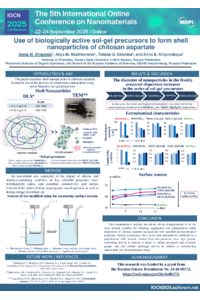
The paper examines chitosan aspartate shell nanoparticles formed in situ in the process of counterion condensation using novel bioactive sol–gel precursors: silicon methyltriglycerolate (MeSi(OGly)3), silicon dimethyldiglycerolate (Me2Si(OGly)2), silicon tetraglycerolate (Si(OGly)4), and silicon tetrapolyethylene glycolate (Si[O(C2H4O)9H]), as well as titanium tetrapolyethylene glycolate (Ti[O(C2H4O)9H]). The diameter of nanoparticles in the freshly prepared dispersion increases in the series of sol–gel precursors Me2Si(OGly)2→Si[O(C2H4O)9H]→MeSi(OGly)3→Si(OGly)4→Ti[O(C2H4O)9H], with the lowest polydispersity for Si(OGly)4 and the highest for Ti[O(C2H4O)9H]. Si- or Ti- coated nanoparticles (excluding Me2Si(OGly)2) correspond to kinetically stable nanodispersions: the electrokinetic potential was within 35‒40 mV and the conductivity was 0.58‒0.73 mS/cm. Modification with Me2Si(OGly)2 led to abnormally high values of the ζ-potential of the nanoparticles and the conductivity of the system. It was found that dispersions of chitosan aspartate nanoparticles with a sol–gel shell exhibited surface activity. During two-year storage, Si(OGly)4 -stabilized dispersions maintained stable size and stable electrochemical and surface properties. A slight decrease in particle size and an increase in polydispersity were observed during storage of the samples functionalized with the sol–gel precursor Si[O(C2H4O)9H]; a significant decrease in the size and ζ-potential of particles were observed for Ti[O(C2H4O)9H], while a significant increase in size, polydispersity, and surface tension were noted for MeSi(OGly)3 and Me2Si(OGly)2. Silicon tetraglycerolate was identified as the optimal modifier for stable chitosan aspartate nanoparticles, with the resulting polysiloxane-stabilized particles exhibiting dual bioactivity: plant growth stimulation across taxa and antifungal action against soil pathogens.
Acknowledgment
This research was funded by a grant from the Russian Science Foundation No. 24-16-00172, https://rscf.ru/project/24-16-00172/.
Keywords
chitosan aspartate
nanoparticles
sol–gel precursors
aggregative and sedimentation stability
Poster
IOCN 2025 Poster Shipenok.pdf
Coffee waste-based nanostructures improve the Cryptosporidium inactivation by solar water disinfection
Nanostructured Polymer Adsorbents Synthesized via Inverse Pickering Emulsion Polymerization Technology for Heavy Metal Ion Removal from Wastewater