Event submissions
Published
This submission belongs to the session S5. Environmental Nanoscience and Nanotechnology of the event The 5th International Online Conference on Nanomaterials
Published date
19 Sep, 2025
Academic Editor
'%3e%3cpath%20d='M12.6657%2010.9104C12.4185%2010.325%2012.0599%209.79327%2011.6097%209.34482C11.1609%208.89508%2010.6293%208.5365%2010.0442%208.28888C10.0389%208.28626%2010.0337%208.28495%2010.0285%208.28233C10.8446%207.69279%2011.3752%206.73249%2011.3752%205.64904C11.3752%203.8542%209.92103%202.39999%208.1262%202.39999C6.33136%202.39999%204.87715%203.8542%204.87715%205.64904C4.87715%206.73249%205.40774%207.69279%206.22393%208.28364C6.21869%208.28626%206.21345%208.28757%206.20821%208.29019C5.62129%208.5378%205.09463%208.89284%204.64265%209.34613C4.1929%209.79493%203.83432%2010.3266%203.58671%2010.9117C3.34345%2011.4845%203.21226%2012.0987%203.20023%2012.7209C3.19988%2012.7349%203.20233%2012.7488%203.20744%2012.7619C3.21255%2012.7749%203.22022%2012.7867%203.22998%2012.7968C3.23975%2012.8068%203.25142%2012.8147%203.26431%2012.8202C3.2772%2012.8256%203.29105%2012.8284%203.30504%2012.8284H4.09109C4.14874%2012.8284%204.19459%2012.7825%204.1959%2012.7262C4.2221%2011.7148%204.62823%2010.7676%205.34617%2010.0497C6.08899%209.30683%207.0755%208.89808%208.1262%208.89808C9.17689%208.89808%2010.1634%209.30683%2010.9062%2010.0497C11.6242%2010.7676%2012.0303%2011.7148%2012.0565%2012.7262C12.0578%2012.7838%2012.1037%2012.8284%2012.1613%2012.8284H12.9474C12.9613%2012.8284%2012.9752%2012.8256%2012.9881%2012.8202C13.001%2012.8147%2013.0126%2012.8068%2013.0224%2012.7968C13.0322%2012.7867%2013.0398%2012.7749%2013.0449%2012.7619C13.0501%2012.7488%2013.0525%2012.7349%2013.0522%2012.7209C13.0391%2012.0947%2012.9094%2011.4855%2012.6657%2010.9104ZM8.1262%207.9024C7.52486%207.9024%206.9589%207.6679%206.53312%207.24211C6.10733%206.81633%205.87283%206.25037%205.87283%205.64904C5.87283%205.0477%206.10733%204.48174%206.53312%204.05596C6.9589%203.63018%207.52486%203.39567%208.1262%203.39567C8.72753%203.39567%209.29349%203.63018%209.71927%204.05596C10.1451%204.48174%2010.3796%205.0477%2010.3796%205.64904C10.3796%206.25037%2010.1451%206.81633%209.71927%207.24211C9.29349%207.6679%208.72753%207.9024%208.1262%207.9024Z'%20fill='%235D1EE1'/%3e%3c/g%3e%3c/svg%3e) Marco Stoller
Marco StollerCitation
Adriana Loredana Smarandache, Andra Dinache, Ionut-Relu Andrei, Mihai Boni, Iuliana Urzica, Angela Staicu, Environmental Nanotechnology for Microplastic Removal: Insights into Laser-Induced Photodegradation, in Proceedings of The 5th International Online Conference on Nanomaterials, 22 September–24 September 2025, MDPI: Basel, Switzerland
Share
Email
Facebook
Twitter
LinkedIn
Environmental Nanotechnology for Microplastic Removal: Insights into Laser-Induced Photodegradation
'%3e%3cpath%20d='M12.6647%2010.9104C12.4176%2010.325%2012.0589%209.7933%2011.6088%209.34485C11.16%208.89511%2010.6283%208.53653%2010.0432%208.28891C10.038%208.28629%2010.0327%208.28498%2010.0275%208.28236C10.8437%207.69282%2011.3743%206.73252%2011.3743%205.64907C11.3743%203.85423%209.92005%202.40002%208.12522%202.40002C6.33038%202.40002%204.87618%203.85423%204.87618%205.64907C4.87618%206.73252%205.40677%207.69282%206.22296%208.28367C6.21772%208.28629%206.21248%208.2876%206.20724%208.29022C5.62031%208.53783%205.09365%208.89287%204.64167%209.34616C4.19192%209.79496%203.83334%2010.3266%203.58573%2010.9117C3.34247%2011.4846%203.21128%2012.0987%203.19925%2012.721C3.1989%2012.735%203.20135%2012.7489%203.20646%2012.7619C3.21157%2012.7749%203.21924%2012.7868%203.22901%2012.7968C3.23877%2012.8068%203.25045%2012.8148%203.26334%2012.8202C3.27623%2012.8256%203.29007%2012.8284%203.30406%2012.8284H4.09012C4.14776%2012.8284%204.19362%2012.7825%204.19493%2012.7262C4.22113%2011.7148%204.62726%2010.7676%205.34519%2010.0497C6.08802%209.30686%207.07452%208.89811%208.12522%208.89811C9.17592%208.89811%2010.1624%209.30686%2010.9052%2010.0497C11.6232%2010.7676%2012.0293%2011.7148%2012.0555%2012.7262C12.0568%2012.7839%2012.1027%2012.8284%2012.1603%2012.8284H12.9464C12.9604%2012.8284%2012.9742%2012.8256%2012.9871%2012.8202C13%2012.8148%2013.0117%2012.8068%2013.0214%2012.7968C13.0312%2012.7868%2013.0389%2012.7749%2013.044%2012.7619C13.0491%2012.7489%2013.0515%2012.735%2013.0512%2012.721C13.0381%2012.0947%2012.9084%2011.4856%2012.6647%2010.9104ZM8.12522%207.90243C7.52388%207.90243%206.95792%207.66793%206.53214%207.24215C6.10636%206.81636%205.87185%206.2504%205.87185%205.64907C5.87185%205.04773%206.10636%204.48177%206.53214%204.05599C6.95792%203.63021%207.52388%203.3957%208.12522%203.3957C8.72655%203.3957%209.29252%203.63021%209.7183%204.05599C10.1441%204.48177%2010.3786%205.04773%2010.3786%205.64907C10.3786%206.2504%2010.1441%206.81636%209.7183%207.24215C9.29252%207.66793%208.72655%207.90243%208.12522%207.90243Z'%20fill='%235D1EE1'/%3e%3c/g%3e%3c/svg%3e)
Adriana Loredana Smarandache 1
Andra Dinache 1
Ionut-Relu Andrei 1
Mihai Boni 1
Iuliana Urzica 1
Angela Staicu 1
1. National Institute for Laser, Plasma and Radiation Physics, Laser Dept., Magurele 077125, Romania
Abstract
Microplastic (MP) pollution is a growing environmental concern due to the durability and widespread use of plastic materials. These small polymer particles are not effectively removed by conventional wastewater treatment, leading to persistent ecological and economic impacts [1].
Laser-induced photodegradation offers a sustainable method for MP removal by enabling their breakdown into CO₂, H₂O, or potentially valuable byproducts [2]. This study explores the effects of UV laser irradiation on poly(methyl methacrylate) (PMMA) and polystyrene (PS) microparticles in water to evaluate their degradation potential.
Using a pulsed Nd:YAG laser (λ=266 nm, E=6.5–12 mJ), polymethyl methacrylate (PMMA) and polystyrene (PS) microparticles were irradiated in distilled water. After 4 h at 12 mJ, PMMA (10 µm, 0.1% w/v) showed significant degradation due to C=O bond cleavage. PS degradation followed a different path, involving peroxide formation and chain scission, producing carbonyl-containing compounds.
To monitor these changes, we employed optical microscopy, SEM, DLS, UV-VIS, FTIR spectroscopy, and dynamic interfacial tension (DIT) measurements. The DIT analysis indicated that degradation starts at the particle surface and progresses inward via diffusion and structural reorganization. Microscopy and SEM revealed the formation of smaller micro- and nanoparticles post-irradiation.
Research into effective laser photodegradation of MPs is still in its early stages. During laser irradiation of MPs, various byproducts are formed, whose characteristics might exhibit significant levels of pollution and toxicity. Recycling these offers pollution control and resource reuse. However, the environmental impacts must be assessed to avoid harm. Sustainable, greener conversion methods are essential for truly effective and eco-friendly MP management.
Acknowledgements: This research was funded by the Ministry of Research, Innovation and Digitization, CNCS-UEFISCDI (project PN-IV-P2-2.1-TE-2023-1686) and the Nucleu Program LAPLAS VII—contract no. 30N/2023.
References:
[1] Wong et al., Sci. Total Environ. 719 (2020)
[2] Paiman et al., Chem. Eng. J. 467 (2023)
Keywords
Microplastic
environment
laser
photodegradation
Poster
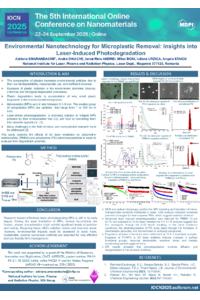
POSTER_ID sciforum-123581_ADRIANA SMARANDACHE.pdf
Revealing Interfacial Interactions in PFOA Adsorption on Dolomite: A Molecular and Experimental Investigation for Advanced Water Treatment
Investigation of the rejection of mixed salt solutions using a g-C3N4 functionalized nanofiltration membrane