Event submissions
Published
This submission belongs to the session S5. Environmental Nanoscience and Nanotechnology of the event The 5th International Online Conference on Nanomaterials
Published date
19 Sep, 2025
Academic Editor
'%3e%3cpath%20d='M12.6657%2010.9104C12.4185%2010.325%2012.0599%209.79327%2011.6097%209.34482C11.1609%208.89508%2010.6293%208.5365%2010.0442%208.28888C10.0389%208.28626%2010.0337%208.28495%2010.0285%208.28233C10.8446%207.69279%2011.3752%206.73249%2011.3752%205.64904C11.3752%203.8542%209.92103%202.39999%208.1262%202.39999C6.33136%202.39999%204.87715%203.8542%204.87715%205.64904C4.87715%206.73249%205.40774%207.69279%206.22393%208.28364C6.21869%208.28626%206.21345%208.28757%206.20821%208.29019C5.62129%208.5378%205.09463%208.89284%204.64265%209.34613C4.1929%209.79493%203.83432%2010.3266%203.58671%2010.9117C3.34345%2011.4845%203.21226%2012.0987%203.20023%2012.7209C3.19988%2012.7349%203.20233%2012.7488%203.20744%2012.7619C3.21255%2012.7749%203.22022%2012.7867%203.22998%2012.7968C3.23975%2012.8068%203.25142%2012.8147%203.26431%2012.8202C3.2772%2012.8256%203.29105%2012.8284%203.30504%2012.8284H4.09109C4.14874%2012.8284%204.19459%2012.7825%204.1959%2012.7262C4.2221%2011.7148%204.62823%2010.7676%205.34617%2010.0497C6.08899%209.30683%207.0755%208.89808%208.1262%208.89808C9.17689%208.89808%2010.1634%209.30683%2010.9062%2010.0497C11.6242%2010.7676%2012.0303%2011.7148%2012.0565%2012.7262C12.0578%2012.7838%2012.1037%2012.8284%2012.1613%2012.8284H12.9474C12.9613%2012.8284%2012.9752%2012.8256%2012.9881%2012.8202C13.001%2012.8147%2013.0126%2012.8068%2013.0224%2012.7968C13.0322%2012.7867%2013.0398%2012.7749%2013.0449%2012.7619C13.0501%2012.7488%2013.0525%2012.7349%2013.0522%2012.7209C13.0391%2012.0947%2012.9094%2011.4855%2012.6657%2010.9104ZM8.1262%207.9024C7.52486%207.9024%206.9589%207.6679%206.53312%207.24211C6.10733%206.81633%205.87283%206.25037%205.87283%205.64904C5.87283%205.0477%206.10733%204.48174%206.53312%204.05596C6.9589%203.63018%207.52486%203.39567%208.1262%203.39567C8.72753%203.39567%209.29349%203.63018%209.71927%204.05596C10.1451%204.48174%2010.3796%205.0477%2010.3796%205.64904C10.3796%206.25037%2010.1451%206.81633%209.71927%207.24211C9.29349%207.6679%208.72753%207.9024%208.1262%207.9024Z'%20fill='%235D1EE1'/%3e%3c/g%3e%3c/svg%3e) Marco Stoller
Marco StollerCitation
Seungyeol Lee, High-Precision Crystal Structure Determination of Fine-Grained Minerals Using Integrated Synchrotron HRPD and Total Scattering PDF Analysis, in Proceedings of The 5th International Online Conference on Nanomaterials, 22 September–24 September 2025, MDPI: Basel, Switzerland
Share
Email
Facebook
Twitter
LinkedIn
High-Precision Crystal Structure Determination of Fine-Grained Minerals Using Integrated Synchrotron HRPD and Total Scattering PDF Analysis

Seungyeol Lee 1
1. Department of Earth and Environmental Sciences, Chungbuk National University, 1 Chungdae-ro, Seowon-gu, Cheongju-si, Chungcheongbuk-do 28644, South Korea
Abstract
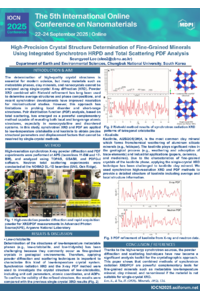
Acquiring high-precision crystal structure information represents a key challenge in advanced scientific and technological research. Traditionally, Single Crystal X-ray Diffraction (SC-XRD) analysis has been effectively employed to elucidate crystal structures, providing details such as unit cell parameters, bond lengths and angles, atomic ordering, and Atomic Displacement Parameters (ADPs). However, obtaining single crystals of sufficient size required for SC-XRD analysis is often challenging for many crystalline materials and minerals. To overcome this limitation, the integrated application of synchrotron High-Resolution Powder Diffraction (HRPD) and total scattering Pair Distribution Function (PDF) analysis offers a highly valuable complementary approach. Herein, we present three case studies applying this integrated analytical method to determine the structures of (1) opal, (2) kaolinite, and (3) low-temperature cristobalite. Our results confirm that the combined HRPD and PDF analysis is a highly effective tool for elucidating the structures of fine-grained minerals—including metastable low-temperature phases, clay minerals, and nanominerals—for which conventional SC-XRD analysis is difficult. Specifically, Rietveld refinement of HRPD data accurately provides information on the average crystal structure, while X-ray and neutron PDF analyses effectively yield details on the local structure and precise atomic ADP values. Furthermore, the crystal structure parameters derived from this study show good agreement with those reported from previous SC-XRD analyses where available. These findings suggest that this integrated method can be effectively applied to characterize poorly crystalline or nanoscale minerals present in diverse geological environments. Moreover, combining this powerful technique with other analytical methods, such as Transmission Electron Microscopy (TEM), Raman spectroscopy, Nuclear Magnetic Resonance (NMR) spectroscopy, Mössbauer spectroscopy, Extended X-ray Absorption Fine Structure (EXAFS) analysis, and theoretical calculations, is expected to significantly broaden the scope of research on fine-grained crystalline materials.
Keywords
High-Resolution Powder Diffraction
Pair Distribution Function
nanominerals
Atomic Displacement Parameters
Poster
sciforum_124563_S5_slides_IOCN_2025_Poster_SLee.pdf
Engineering the structural memory of Zn-based LDH to boost the plasmonic responses of AuNP/LDH dual catalysts
A novel unit poly-ion complex-type siRNA delivery platform which utilizes inherent neomycin-B-RNA binding