Event submissions
Published
This submission belongs to the session S1. Nanomedicine and Bionanotechnology of the event The 5th International Online Conference on Nanomaterials
Published date
19 Sep, 2025
Academic Editor
'%3e%3cpath%20d='M12.6657%2010.9104C12.4185%2010.325%2012.0599%209.79327%2011.6097%209.34482C11.1609%208.89508%2010.6293%208.5365%2010.0442%208.28888C10.0389%208.28626%2010.0337%208.28495%2010.0285%208.28233C10.8446%207.69279%2011.3752%206.73249%2011.3752%205.64904C11.3752%203.8542%209.92103%202.39999%208.1262%202.39999C6.33136%202.39999%204.87715%203.8542%204.87715%205.64904C4.87715%206.73249%205.40774%207.69279%206.22393%208.28364C6.21869%208.28626%206.21345%208.28757%206.20821%208.29019C5.62129%208.5378%205.09463%208.89284%204.64265%209.34613C4.1929%209.79493%203.83432%2010.3266%203.58671%2010.9117C3.34345%2011.4845%203.21226%2012.0987%203.20023%2012.7209C3.19988%2012.7349%203.20233%2012.7488%203.20744%2012.7619C3.21255%2012.7749%203.22022%2012.7867%203.22998%2012.7968C3.23975%2012.8068%203.25142%2012.8147%203.26431%2012.8202C3.2772%2012.8256%203.29105%2012.8284%203.30504%2012.8284H4.09109C4.14874%2012.8284%204.19459%2012.7825%204.1959%2012.7262C4.2221%2011.7148%204.62823%2010.7676%205.34617%2010.0497C6.08899%209.30683%207.0755%208.89808%208.1262%208.89808C9.17689%208.89808%2010.1634%209.30683%2010.9062%2010.0497C11.6242%2010.7676%2012.0303%2011.7148%2012.0565%2012.7262C12.0578%2012.7838%2012.1037%2012.8284%2012.1613%2012.8284H12.9474C12.9613%2012.8284%2012.9752%2012.8256%2012.9881%2012.8202C13.001%2012.8147%2013.0126%2012.8068%2013.0224%2012.7968C13.0322%2012.7867%2013.0398%2012.7749%2013.0449%2012.7619C13.0501%2012.7488%2013.0525%2012.7349%2013.0522%2012.7209C13.0391%2012.0947%2012.9094%2011.4855%2012.6657%2010.9104ZM8.1262%207.9024C7.52486%207.9024%206.9589%207.6679%206.53312%207.24211C6.10733%206.81633%205.87283%206.25037%205.87283%205.64904C5.87283%205.0477%206.10733%204.48174%206.53312%204.05596C6.9589%203.63018%207.52486%203.39567%208.1262%203.39567C8.72753%203.39567%209.29349%203.63018%209.71927%204.05596C10.1451%204.48174%2010.3796%205.0477%2010.3796%205.64904C10.3796%206.25037%2010.1451%206.81633%209.71927%207.24211C9.29349%207.6679%208.72753%207.9024%208.1262%207.9024Z'%20fill='%235D1EE1'/%3e%3c/g%3e%3c/svg%3e) Maria Pilar Vinardell
Maria Pilar VinardellCitation
West Kristian Paraiso, Sabina Quader, Kotaro Hayashi, Kazuko Toh, Shigeto Fukushima, Kazunori Kataoka, A novel unit poly-ion complex-type siRNA delivery platform which utilizes inherent neomycin-B-RNA binding, in Proceedings of The 5th International Online Conference on Nanomaterials, 22 September–24 September 2025, MDPI: Basel, Switzerland
Share
Email
Facebook
Twitter
LinkedIn
A novel unit poly-ion complex-type siRNA delivery platform which utilizes inherent neomycin-B-RNA binding
'%3e%3cpath%20d='M12.6647%2010.9104C12.4176%2010.325%2012.0589%209.7933%2011.6088%209.34485C11.16%208.89511%2010.6283%208.53653%2010.0432%208.28891C10.038%208.28629%2010.0327%208.28498%2010.0275%208.28236C10.8437%207.69282%2011.3743%206.73252%2011.3743%205.64907C11.3743%203.85423%209.92005%202.40002%208.12522%202.40002C6.33038%202.40002%204.87618%203.85423%204.87618%205.64907C4.87618%206.73252%205.40677%207.69282%206.22296%208.28367C6.21772%208.28629%206.21248%208.2876%206.20724%208.29022C5.62031%208.53783%205.09365%208.89287%204.64167%209.34616C4.19192%209.79496%203.83334%2010.3266%203.58573%2010.9117C3.34247%2011.4846%203.21128%2012.0987%203.19925%2012.721C3.1989%2012.735%203.20135%2012.7489%203.20646%2012.7619C3.21157%2012.7749%203.21924%2012.7868%203.22901%2012.7968C3.23877%2012.8068%203.25045%2012.8148%203.26334%2012.8202C3.27623%2012.8256%203.29007%2012.8284%203.30406%2012.8284H4.09012C4.14776%2012.8284%204.19362%2012.7825%204.19493%2012.7262C4.22113%2011.7148%204.62726%2010.7676%205.34519%2010.0497C6.08802%209.30686%207.07452%208.89811%208.12522%208.89811C9.17592%208.89811%2010.1624%209.30686%2010.9052%2010.0497C11.6232%2010.7676%2012.0293%2011.7148%2012.0555%2012.7262C12.0568%2012.7839%2012.1027%2012.8284%2012.1603%2012.8284H12.9464C12.9604%2012.8284%2012.9742%2012.8256%2012.9871%2012.8202C13%2012.8148%2013.0117%2012.8068%2013.0214%2012.7968C13.0312%2012.7868%2013.0389%2012.7749%2013.044%2012.7619C13.0491%2012.7489%2013.0515%2012.735%2013.0512%2012.721C13.0381%2012.0947%2012.9084%2011.4856%2012.6647%2010.9104ZM8.12522%207.90243C7.52388%207.90243%206.95792%207.66793%206.53214%207.24215C6.10636%206.81636%205.87185%206.2504%205.87185%205.64907C5.87185%205.04773%206.10636%204.48177%206.53214%204.05599C6.95792%203.63021%207.52388%203.3957%208.12522%203.3957C8.72655%203.3957%209.29252%203.63021%209.7183%204.05599C10.1441%204.48177%2010.3786%205.04773%2010.3786%205.64907C10.3786%206.2504%2010.1441%206.81636%209.7183%207.24215C9.29252%207.66793%208.72655%207.90243%208.12522%207.90243Z'%20fill='%235D1EE1'/%3e%3c/g%3e%3c/svg%3e)
West Kristian Paraiso 1,2

Sabina Quader 2
Kotaro Hayashi 2
Kazuko Toh 2
Shigeto Fukushima 2
Kazunori Kataoka 2
1. Department of Biomedical Sciences, Faculty of Medicine and Health Sciences Universitat Internacional de Catalunya Carrer Josep Trueta s/n, Sant Cugat del Vallès, Barcelona 08195, Spain
2. Innovation Center of Nanomedicine Kawasaki Institute of Industrial Promotion 3-25-14 Tonomachi, Kawasaki Ward, Kawasaki City 210-0821, Japan
Abstract
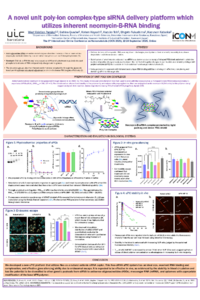
Even with its vast potential, small interfering RNA (siRNA) therapeutics are faced with many impediments including instability in biological fluids and moderate cellular internalization/endosomal escape activities. Numerous lipid- and polymer-based nanocarriers were developed to address these issues, with the challenge of keeping the balance between stable complexation and endosomal escape. A pragmatic answer might lie within natural RNA binders such as neomycin B (Neo), a potent aminoglycoside antibiotic that is well-known for binding to various RNAs motifs. Neo contains six amines which are mostly ionized at physiological pH to facilitate electrostatic interaction with the anionic phosphates of RNAs. The perplexing versatility seen in Neo-RNA binding can be credited to its conformational flexibility arising from glycosidic bonds, an important part of Neo structure. In addition, the amino groups of Neo possess a wide range of pKas (5.4 to 8.8), which supplement its ability to achieve this intricate balance between complexation and effectual endosomal escape of siRNA in the target cells. We report the development of a novel Neo-derived unit poly-ion complex (uPIC), formed by electrostatic interactions between a single siRNA strand and two defined charge-regulated binary polyethylene glycol (PEG)-block-polycation copolymer chains wherein Neo operates as a cationic siRNA captor. This Neo-siRNA uPIC has a small size (around 20 nm) and presents excellent RNA binding and complexation, effective endosomal escape, and sustained blood circulation, suggesting the massive scope of utilizing Neo as a capable component of future PIC-type siRNA and other therapeutic nucleic acid delivery platforms.
Keywords
siRNA
nucleic acid delivery
poly-ion complexes
aminoglycoside
click chemistry
Poster
Poster_siRNA_A0_West Paraiso.pdf
High-Precision Crystal Structure Determination of Fine-Grained Minerals Using Integrated Synchrotron HRPD and Total Scattering PDF Analysis
Hierarchical Bimodal Nanoporous Gold (hbNPG)-Modified GCE (Glassy Carbon Electrode) for Sensitive Detection of Emerging Contaminants