Event submissions
Published
This submission belongs to the session S5. Environmental Nanoscience and Nanotechnology of the event The 5th International Online Conference on Nanomaterials
Published date
19 Sep, 2025
Academic Editor
'%3e%3cpath%20d='M12.6657%2010.9104C12.4185%2010.325%2012.0599%209.79327%2011.6097%209.34482C11.1609%208.89508%2010.6293%208.5365%2010.0442%208.28888C10.0389%208.28626%2010.0337%208.28495%2010.0285%208.28233C10.8446%207.69279%2011.3752%206.73249%2011.3752%205.64904C11.3752%203.8542%209.92103%202.39999%208.1262%202.39999C6.33136%202.39999%204.87715%203.8542%204.87715%205.64904C4.87715%206.73249%205.40774%207.69279%206.22393%208.28364C6.21869%208.28626%206.21345%208.28757%206.20821%208.29019C5.62129%208.5378%205.09463%208.89284%204.64265%209.34613C4.1929%209.79493%203.83432%2010.3266%203.58671%2010.9117C3.34345%2011.4845%203.21226%2012.0987%203.20023%2012.7209C3.19988%2012.7349%203.20233%2012.7488%203.20744%2012.7619C3.21255%2012.7749%203.22022%2012.7867%203.22998%2012.7968C3.23975%2012.8068%203.25142%2012.8147%203.26431%2012.8202C3.2772%2012.8256%203.29105%2012.8284%203.30504%2012.8284H4.09109C4.14874%2012.8284%204.19459%2012.7825%204.1959%2012.7262C4.2221%2011.7148%204.62823%2010.7676%205.34617%2010.0497C6.08899%209.30683%207.0755%208.89808%208.1262%208.89808C9.17689%208.89808%2010.1634%209.30683%2010.9062%2010.0497C11.6242%2010.7676%2012.0303%2011.7148%2012.0565%2012.7262C12.0578%2012.7838%2012.1037%2012.8284%2012.1613%2012.8284H12.9474C12.9613%2012.8284%2012.9752%2012.8256%2012.9881%2012.8202C13.001%2012.8147%2013.0126%2012.8068%2013.0224%2012.7968C13.0322%2012.7867%2013.0398%2012.7749%2013.0449%2012.7619C13.0501%2012.7488%2013.0525%2012.7349%2013.0522%2012.7209C13.0391%2012.0947%2012.9094%2011.4855%2012.6657%2010.9104ZM8.1262%207.9024C7.52486%207.9024%206.9589%207.6679%206.53312%207.24211C6.10733%206.81633%205.87283%206.25037%205.87283%205.64904C5.87283%205.0477%206.10733%204.48174%206.53312%204.05596C6.9589%203.63018%207.52486%203.39567%208.1262%203.39567C8.72753%203.39567%209.29349%203.63018%209.71927%204.05596C10.1451%204.48174%2010.3796%205.0477%2010.3796%205.64904C10.3796%206.25037%2010.1451%206.81633%209.71927%207.24211C9.29349%207.6679%208.72753%207.9024%208.1262%207.9024Z'%20fill='%235D1EE1'/%3e%3c/g%3e%3c/svg%3e) Marco Stoller
Marco StollerCitation
Hadi Taghavian, Akshay Kulkarni, Masoud Khalegiabbasabadi, Tomas Dufek, Lukas Dvorak, Hybrid Photocatalytic Ultrafiltration Membranes: A Scalable Solution for CEC Removal, in Proceedings of The 5th International Online Conference on Nanomaterials, 22 September–24 September 2025, MDPI: Basel, Switzerland
Share
Email
Facebook
Twitter
LinkedIn
Hybrid Photocatalytic Ultrafiltration Membranes: A Scalable Solution for CEC Removal
'%3e%3cpath%20d='M12.6647%2010.9104C12.4176%2010.325%2012.0589%209.7933%2011.6088%209.34485C11.16%208.89511%2010.6283%208.53653%2010.0432%208.28891C10.038%208.28629%2010.0327%208.28498%2010.0275%208.28236C10.8437%207.69282%2011.3743%206.73252%2011.3743%205.64907C11.3743%203.85423%209.92005%202.40002%208.12522%202.40002C6.33038%202.40002%204.87618%203.85423%204.87618%205.64907C4.87618%206.73252%205.40677%207.69282%206.22296%208.28367C6.21772%208.28629%206.21248%208.2876%206.20724%208.29022C5.62031%208.53783%205.09365%208.89287%204.64167%209.34616C4.19192%209.79496%203.83334%2010.3266%203.58573%2010.9117C3.34247%2011.4846%203.21128%2012.0987%203.19925%2012.721C3.1989%2012.735%203.20135%2012.7489%203.20646%2012.7619C3.21157%2012.7749%203.21924%2012.7868%203.22901%2012.7968C3.23877%2012.8068%203.25045%2012.8148%203.26334%2012.8202C3.27623%2012.8256%203.29007%2012.8284%203.30406%2012.8284H4.09012C4.14776%2012.8284%204.19362%2012.7825%204.19493%2012.7262C4.22113%2011.7148%204.62726%2010.7676%205.34519%2010.0497C6.08802%209.30686%207.07452%208.89811%208.12522%208.89811C9.17592%208.89811%2010.1624%209.30686%2010.9052%2010.0497C11.6232%2010.7676%2012.0293%2011.7148%2012.0555%2012.7262C12.0568%2012.7839%2012.1027%2012.8284%2012.1603%2012.8284H12.9464C12.9604%2012.8284%2012.9742%2012.8256%2012.9871%2012.8202C13%2012.8148%2013.0117%2012.8068%2013.0214%2012.7968C13.0312%2012.7868%2013.0389%2012.7749%2013.044%2012.7619C13.0491%2012.7489%2013.0515%2012.735%2013.0512%2012.721C13.0381%2012.0947%2012.9084%2011.4856%2012.6647%2010.9104ZM8.12522%207.90243C7.52388%207.90243%206.95792%207.66793%206.53214%207.24215C6.10636%206.81636%205.87185%206.2504%205.87185%205.64907C5.87185%205.04773%206.10636%204.48177%206.53214%204.05599C6.95792%203.63021%207.52388%203.3957%208.12522%203.3957C8.72655%203.3957%209.29252%203.63021%209.7183%204.05599C10.1441%204.48177%2010.3786%205.04773%2010.3786%205.64907C10.3786%206.2504%2010.1441%206.81636%209.7183%207.24215C9.29252%207.66793%208.72655%207.90243%208.12522%207.90243Z'%20fill='%235D1EE1'/%3e%3c/g%3e%3c/svg%3e)
Hadi Taghavian 1,2
Akshay Kulkarni 3

Masoud Khalegiabbasabadi 1,2
Tomas Dufek 1,2
Lukas Dvorak 2
1. Technical University of Liberec, Studentská 1402/2, 461 17 Liberec, Czech Republic
2. Institute for Nanomaterials, Advanced Technologies, and Innovation, Technical University of Liberec, Liberec, 461 17 Czech Republic
3. Leibniz Institute of Polymer Research Dresden, Hohe Straße 6, D-01069 Dresden, Germany
Abstract
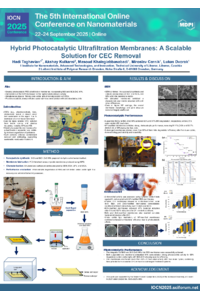
Contaminants of Emerging Concern (CECs), including pharmaceuticals, dyes, and plasticizers, persist in aquatic environments due to the limitations of conventional wastewater treatment technologies [1]. In Czechia, where industries such as textile dyeing and plastics manufacturing are prominent, persistent pollutants like Bisphenol A (BPA) and Rose Bengal (RB) have been detected at concerning levels [2]. This project introduces an innovative solution by developing a photocatalytic ultrafiltration membrane system capable of simultaneous degradation and separation of CECs under visible-light irradiation.
BiOI and BiOI-ZnO nanoparticles (NPs) were synthesized using a hydro-solvothermal method and incorporated into polyethersulfone (PES) flat-sheet membranes via the non-solvent-induced phase-separation (NIPS) technique. These nanocomposite membranes were integrated into a transparent cross-flow filtration module equipped with visible LED light sources to activate the photocatalysts. Membrane morphology, surface roughness, and hydrophilicity were characterized using SEM, EDX, AFM, and water contact angle measurements. Functional performance was evaluated through UV-Vis spectrophotometry, flux recovery tests, and antimicrobial assays.
The results demonstrated effective incorporation of NPs into the PES matrix, with BiOI and BiOI-ZnO showing strong photocatalytic degradation of BPA and RB under visible light. Colorimetric analysis revealed that the ZnO-modified membranes had the highest ΔE*, indicating enhanced dye removal efficiency. Additionally, all NP-modified membranes exhibited substantial antimicrobial activity against E. coli and Staphylococcus spp., even in dark conditions.
This hybrid membrane system offers a scalable, energy-efficient quaternary treatment solution, providing enhanced contaminant removal and antifouling capabilities. Its application has the potential to significantly improve wastewater treatment outcomes, particularly in regions facing high CEC loads, supporting sustainable water management practices.
Acknowledgements: This work was partly supported by the Student Grant Scheme at the Technical University of Liberec through project nr. SGS-2025-3580.
Keywords
polyethersulfone
ultrafiltration membrane
photocatalytic nanoparticles
biofouling resistivity
Poster
sciforum_123816_S5_slides_Hadi_Taghavian_poster_1.pdf
A Sustainable Route to Iron Oxide Nanoparticles: A Plant-Based Approach Using Spinach
Adsorption of Sr from waste effluents using Taiwan Zhi-Shin bentonite