Event submissions
Published
This submission belongs to the session S5. Environmental Nanoscience and Nanotechnology of the event The 5th International Online Conference on Nanomaterials
Published date
19 Sep, 2025
Academic Editor
'%3e%3cpath%20d='M12.6657%2010.9104C12.4185%2010.325%2012.0599%209.79327%2011.6097%209.34482C11.1609%208.89508%2010.6293%208.5365%2010.0442%208.28888C10.0389%208.28626%2010.0337%208.28495%2010.0285%208.28233C10.8446%207.69279%2011.3752%206.73249%2011.3752%205.64904C11.3752%203.8542%209.92103%202.39999%208.1262%202.39999C6.33136%202.39999%204.87715%203.8542%204.87715%205.64904C4.87715%206.73249%205.40774%207.69279%206.22393%208.28364C6.21869%208.28626%206.21345%208.28757%206.20821%208.29019C5.62129%208.5378%205.09463%208.89284%204.64265%209.34613C4.1929%209.79493%203.83432%2010.3266%203.58671%2010.9117C3.34345%2011.4845%203.21226%2012.0987%203.20023%2012.7209C3.19988%2012.7349%203.20233%2012.7488%203.20744%2012.7619C3.21255%2012.7749%203.22022%2012.7867%203.22998%2012.7968C3.23975%2012.8068%203.25142%2012.8147%203.26431%2012.8202C3.2772%2012.8256%203.29105%2012.8284%203.30504%2012.8284H4.09109C4.14874%2012.8284%204.19459%2012.7825%204.1959%2012.7262C4.2221%2011.7148%204.62823%2010.7676%205.34617%2010.0497C6.08899%209.30683%207.0755%208.89808%208.1262%208.89808C9.17689%208.89808%2010.1634%209.30683%2010.9062%2010.0497C11.6242%2010.7676%2012.0303%2011.7148%2012.0565%2012.7262C12.0578%2012.7838%2012.1037%2012.8284%2012.1613%2012.8284H12.9474C12.9613%2012.8284%2012.9752%2012.8256%2012.9881%2012.8202C13.001%2012.8147%2013.0126%2012.8068%2013.0224%2012.7968C13.0322%2012.7867%2013.0398%2012.7749%2013.0449%2012.7619C13.0501%2012.7488%2013.0525%2012.7349%2013.0522%2012.7209C13.0391%2012.0947%2012.9094%2011.4855%2012.6657%2010.9104ZM8.1262%207.9024C7.52486%207.9024%206.9589%207.6679%206.53312%207.24211C6.10733%206.81633%205.87283%206.25037%205.87283%205.64904C5.87283%205.0477%206.10733%204.48174%206.53312%204.05596C6.9589%203.63018%207.52486%203.39567%208.1262%203.39567C8.72753%203.39567%209.29349%203.63018%209.71927%204.05596C10.1451%204.48174%2010.3796%205.0477%2010.3796%205.64904C10.3796%206.25037%2010.1451%206.81633%209.71927%207.24211C9.29349%207.6679%208.72753%207.9024%208.1262%207.9024Z'%20fill='%235D1EE1'/%3e%3c/g%3e%3c/svg%3e) Marco Stoller
Marco StollerCitation
Yating Yang, Yuhan Li, Po-Hsiang Chang, Adsorption of Sr from waste effluents using Taiwan Zhi-Shin bentonite, in Proceedings of The 5th International Online Conference on Nanomaterials, 22 September–24 September 2025, MDPI: Basel, Switzerland
Share
Email
Facebook
Twitter
LinkedIn
Adsorption of Sr from waste effluents using Taiwan Zhi-Shin bentonite
'%3e%3cpath%20d='M12.6647%2010.9104C12.4176%2010.325%2012.0589%209.7933%2011.6088%209.34485C11.16%208.89511%2010.6283%208.53653%2010.0432%208.28891C10.038%208.28629%2010.0327%208.28498%2010.0275%208.28236C10.8437%207.69282%2011.3743%206.73252%2011.3743%205.64907C11.3743%203.85423%209.92005%202.40002%208.12522%202.40002C6.33038%202.40002%204.87618%203.85423%204.87618%205.64907C4.87618%206.73252%205.40677%207.69282%206.22296%208.28367C6.21772%208.28629%206.21248%208.2876%206.20724%208.29022C5.62031%208.53783%205.09365%208.89287%204.64167%209.34616C4.19192%209.79496%203.83334%2010.3266%203.58573%2010.9117C3.34247%2011.4846%203.21128%2012.0987%203.19925%2012.721C3.1989%2012.735%203.20135%2012.7489%203.20646%2012.7619C3.21157%2012.7749%203.21924%2012.7868%203.22901%2012.7968C3.23877%2012.8068%203.25045%2012.8148%203.26334%2012.8202C3.27623%2012.8256%203.29007%2012.8284%203.30406%2012.8284H4.09012C4.14776%2012.8284%204.19362%2012.7825%204.19493%2012.7262C4.22113%2011.7148%204.62726%2010.7676%205.34519%2010.0497C6.08802%209.30686%207.07452%208.89811%208.12522%208.89811C9.17592%208.89811%2010.1624%209.30686%2010.9052%2010.0497C11.6232%2010.7676%2012.0293%2011.7148%2012.0555%2012.7262C12.0568%2012.7839%2012.1027%2012.8284%2012.1603%2012.8284H12.9464C12.9604%2012.8284%2012.9742%2012.8256%2012.9871%2012.8202C13%2012.8148%2013.0117%2012.8068%2013.0214%2012.7968C13.0312%2012.7868%2013.0389%2012.7749%2013.044%2012.7619C13.0491%2012.7489%2013.0515%2012.735%2013.0512%2012.721C13.0381%2012.0947%2012.9084%2011.4856%2012.6647%2010.9104ZM8.12522%207.90243C7.52388%207.90243%206.95792%207.66793%206.53214%207.24215C6.10636%206.81636%205.87185%206.2504%205.87185%205.64907C5.87185%205.04773%206.10636%204.48177%206.53214%204.05599C6.95792%203.63021%207.52388%203.3957%208.12522%203.3957C8.72655%203.3957%209.29252%203.63021%209.7183%204.05599C10.1441%204.48177%2010.3786%205.04773%2010.3786%205.64907C10.3786%206.2504%2010.1441%206.81636%209.7183%207.24215C9.29252%207.66793%208.72655%207.90243%208.12522%207.90243Z'%20fill='%235D1EE1'/%3e%3c/g%3e%3c/svg%3e)
Yating Yang 1
Yuhan Li 1

Po-Hsiang Chang 1
1. College of Resources and Environment, Fujian Agriculture and Forestry University, Fuzhou, Fujian 350000, China.
Abstract
Strontium (Sr²⁺), a hazardous radionuclide in nuclear waste, requires efficient adsorption for pollution control. Taiwan’s Zhangyuan bentonite, with high cation exchange capacity (CEC: 80–86 meq/100 g), offers potential for Sr²⁺ removal. This study systematically investigated its adsorption performance and mechanisms under diverse conditions, aiming to develop an eco-friendly and cost-effective solution for radioactive wastewater treatment.
Batch adsorption experiments evaluated the effects of time, Sr²⁺ concentration, temperature, pH, and Na⁺ levels. Adsorption kinetics and isotherms were modeled using pseudo-second-order and Freundlich equations. XRD analyzed interlayer spacing (d001) to track Sr²⁺ intercalation. Cation desorption quantified exchange mechanisms, while ab initio molecular dynamics (AIMD) simulations elucidated Sr²⁺-Ca²⁺ interactions via water bridge networks.
Taiwan bentonite achieved 95% Sr²⁺ removal within 5 minutes, with a maximum capacity of 0.28 mmol/g (56 meq/100 g, 65% of CEC). Cation exchange dominated (84% contribution), primarily displacing Ca²⁺ (60.4% desorbed ions). XRD confirmed Sr²⁺ intercalation, expanding d001 from 14.71 Å to 15.6 Å. Alkaline conditions (pH >9) enhanced adsorption by strengthening electrostatic attraction and suppressing Ca²⁺ competition. Na⁺ reduced capacity, validating exchange priority. AIMD revealed Sr²⁺ formed hydrogen bonds with bentonite oxygen via bilayer hydration (adsorption energy: -15.3 eV), while water bridges between Sr²⁺ and Ca²⁺ stabilized adsorption sites.
Taiwan bentonite emerges as a promising material for emergency Sr²⁺ treatment in nuclear wastewater, offering rapid kinetics (5-minute equilibrium), high capacity, and pH adaptability (optimized at pH >9). Its natural abundance, low cost, and resistance to ion interference (e.g., 65% CEC utilization under Na⁺ competition) surpass synthetic alternatives. The dual mechanism—cation exchange and surface complexation—provides a theoretical basis for enhancing bentonite’s swelling properties and long-term stability. This study advances the application of natural minerals in nuclear waste disposal, highlighting their practicality in large-scale environmental remediation.
Keywords
Strontium
Taiwan Bentonite
Adsorption Mechanism
Cation Exchange
Waste Liquid Treatment
Poster
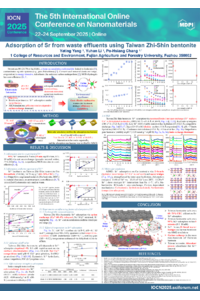
Sr_poster-8.25.pdf
Hybrid Photocatalytic Ultrafiltration Membranes: A Scalable Solution for CEC Removal
The most practical, economical solution to overcome environmental disasters, fires, and frost cycles with the most sustainable, durable, and green concrete structures.