Event submissions
Published
This submission belongs to the session S1. Nanomedicine and Bionanotechnology of the event The 5th International Online Conference on Nanomaterials
Published date
19 Sep, 2025
Academic Editor
'%3e%3cpath%20d='M12.6657%2010.9104C12.4185%2010.325%2012.0599%209.79327%2011.6097%209.34482C11.1609%208.89508%2010.6293%208.5365%2010.0442%208.28888C10.0389%208.28626%2010.0337%208.28495%2010.0285%208.28233C10.8446%207.69279%2011.3752%206.73249%2011.3752%205.64904C11.3752%203.8542%209.92103%202.39999%208.1262%202.39999C6.33136%202.39999%204.87715%203.8542%204.87715%205.64904C4.87715%206.73249%205.40774%207.69279%206.22393%208.28364C6.21869%208.28626%206.21345%208.28757%206.20821%208.29019C5.62129%208.5378%205.09463%208.89284%204.64265%209.34613C4.1929%209.79493%203.83432%2010.3266%203.58671%2010.9117C3.34345%2011.4845%203.21226%2012.0987%203.20023%2012.7209C3.19988%2012.7349%203.20233%2012.7488%203.20744%2012.7619C3.21255%2012.7749%203.22022%2012.7867%203.22998%2012.7968C3.23975%2012.8068%203.25142%2012.8147%203.26431%2012.8202C3.2772%2012.8256%203.29105%2012.8284%203.30504%2012.8284H4.09109C4.14874%2012.8284%204.19459%2012.7825%204.1959%2012.7262C4.2221%2011.7148%204.62823%2010.7676%205.34617%2010.0497C6.08899%209.30683%207.0755%208.89808%208.1262%208.89808C9.17689%208.89808%2010.1634%209.30683%2010.9062%2010.0497C11.6242%2010.7676%2012.0303%2011.7148%2012.0565%2012.7262C12.0578%2012.7838%2012.1037%2012.8284%2012.1613%2012.8284H12.9474C12.9613%2012.8284%2012.9752%2012.8256%2012.9881%2012.8202C13.001%2012.8147%2013.0126%2012.8068%2013.0224%2012.7968C13.0322%2012.7867%2013.0398%2012.7749%2013.0449%2012.7619C13.0501%2012.7488%2013.0525%2012.7349%2013.0522%2012.7209C13.0391%2012.0947%2012.9094%2011.4855%2012.6657%2010.9104ZM8.1262%207.9024C7.52486%207.9024%206.9589%207.6679%206.53312%207.24211C6.10733%206.81633%205.87283%206.25037%205.87283%205.64904C5.87283%205.0477%206.10733%204.48174%206.53312%204.05596C6.9589%203.63018%207.52486%203.39567%208.1262%203.39567C8.72753%203.39567%209.29349%203.63018%209.71927%204.05596C10.1451%204.48174%2010.3796%205.0477%2010.3796%205.64904C10.3796%206.25037%2010.1451%206.81633%209.71927%207.24211C9.29349%207.6679%208.72753%207.9024%208.1262%207.9024Z'%20fill='%235D1EE1'/%3e%3c/g%3e%3c/svg%3e) Bogdan Stefan Vasile
Bogdan Stefan VasileCitation
Ana-Maria Roman, Gheorghe Bădărău, Nicanor Cimpoeșu, Ramona Cimpoeșu, Romeu Chelariu, Mihai-Adrian Bernevig, Adrian Alexandru, Mihai Axinte, Nanoscale characterization of the corrosion products of a biodegradable FeMnSi alloy: An in vitro study in simulated body fluid (SBF), in Proceedings of The 5th International Online Conference on Nanomaterials, 22 September–24 September 2025, MDPI: Basel, Switzerland
Share
Email
Facebook
Twitter
LinkedIn
Nanoscale characterization of the corrosion products of a biodegradable FeMnSi alloy: An in vitro study in simulated body fluid (SBF)
'%3e%3cpath%20d='M12.6647%2010.9104C12.4176%2010.325%2012.0589%209.7933%2011.6088%209.34485C11.16%208.89511%2010.6283%208.53653%2010.0432%208.28891C10.038%208.28629%2010.0327%208.28498%2010.0275%208.28236C10.8437%207.69282%2011.3743%206.73252%2011.3743%205.64907C11.3743%203.85423%209.92005%202.40002%208.12522%202.40002C6.33038%202.40002%204.87618%203.85423%204.87618%205.64907C4.87618%206.73252%205.40677%207.69282%206.22296%208.28367C6.21772%208.28629%206.21248%208.2876%206.20724%208.29022C5.62031%208.53783%205.09365%208.89287%204.64167%209.34616C4.19192%209.79496%203.83334%2010.3266%203.58573%2010.9117C3.34247%2011.4846%203.21128%2012.0987%203.19925%2012.721C3.1989%2012.735%203.20135%2012.7489%203.20646%2012.7619C3.21157%2012.7749%203.21924%2012.7868%203.22901%2012.7968C3.23877%2012.8068%203.25045%2012.8148%203.26334%2012.8202C3.27623%2012.8256%203.29007%2012.8284%203.30406%2012.8284H4.09012C4.14776%2012.8284%204.19362%2012.7825%204.19493%2012.7262C4.22113%2011.7148%204.62726%2010.7676%205.34519%2010.0497C6.08802%209.30686%207.07452%208.89811%208.12522%208.89811C9.17592%208.89811%2010.1624%209.30686%2010.9052%2010.0497C11.6232%2010.7676%2012.0293%2011.7148%2012.0555%2012.7262C12.0568%2012.7839%2012.1027%2012.8284%2012.1603%2012.8284H12.9464C12.9604%2012.8284%2012.9742%2012.8256%2012.9871%2012.8202C13%2012.8148%2013.0117%2012.8068%2013.0214%2012.7968C13.0312%2012.7868%2013.0389%2012.7749%2013.044%2012.7619C13.0491%2012.7489%2013.0515%2012.735%2013.0512%2012.721C13.0381%2012.0947%2012.9084%2011.4856%2012.6647%2010.9104ZM8.12522%207.90243C7.52388%207.90243%206.95792%207.66793%206.53214%207.24215C6.10636%206.81636%205.87185%206.2504%205.87185%205.64907C5.87185%205.04773%206.10636%204.48177%206.53214%204.05599C6.95792%203.63021%207.52388%203.3957%208.12522%203.3957C8.72655%203.3957%209.29252%203.63021%209.7183%204.05599C10.1441%204.48177%2010.3786%205.04773%2010.3786%205.64907C10.3786%206.2504%2010.1441%206.81636%209.7183%207.24215C9.29252%207.66793%208.72655%207.90243%208.12522%207.90243Z'%20fill='%235D1EE1'/%3e%3c/g%3e%3c/svg%3e)
Ana-Maria Roman 1
Gheorghe Bădărău 1

Nicanor Cimpoeșu 1

Ramona Cimpoeșu 1
Romeu Chelariu 1
Mihai-Adrian Bernevig 2
Adrian Alexandru 1
Mihai Axinte 1
1. Department of Materials Science, Faculty of Materials Science and Engineering, “Gheorghe Asachi” Technical University of Iasi, 41 Prof. Dimitrie Mangeron Blvd., 700050 Iasi, Romania
2. Department of Materials Engineering and Industrial Safety, Faculty of Materials Science and Engineering, “Gheorghe Asachi” Technical University of Iasi, 67 Prof. Dimitrie Mangeron Blvd., 700050 Iasi, Romania
Abstract
Introduction:
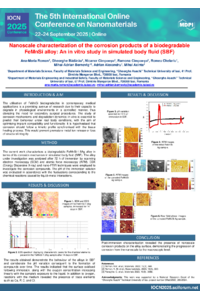
The utilisation of FeMnSi biodegradables in contemporary medical applications is a promising avenue of research due to their capacity to degrade in physiological environments in a controlled manner, thus obviating the need for secondary surgical procedures. The study of corrosion mechanisms and degradation dynamics in vitro is essential to predict their behaviour under real body conditions, with the aim of optimising implant compatibility and functionality. It is hypothesised that corrosion should follow a kinetic profile synchronised with the tissue healing process. This would prevent premature metal ion release or loss of structural integrity.
Methods:
The current work characterises a biodegradable FeMnSi alloy in terms of its corrosion mechanism in simulated body fluid (SBF). The alloy under investigation was analysed after 72 h of immersion by scanning electron microscopy (SEM) and atomic force microscopy (AFM). EDX (Energy Dispersive X-ray) and nano-FTIR techniques were employed to investigate the corrosion compounds. The pH of the immersion solution was evaluated in accordance with the fluctuations corresponding to the chemical reactions caused by liquid–metal interactions.
Results and discussion:
The results obtained demonstrate the behaviour of the alloys in SBF and corroborate the pH variation consequent to the formation of compounds over time. The results indicated that the surface oxidised following immersion, along with the oxygen (O) concentration increasing linearly with the sample's exposure to the liquid. In addition to oxygen, reactions with the medium revealed the presence of trace elements such as calcium (Ca), phosphorous (P), carbon (C), and chlorine (Cl).
Conclusions:
Post-immersion characterisation revealed the presence of nanoscale corrosion products on the alloy surface, demonstrating the progression of corrosion from the nanoscale to the macroscopic level.
Keywords
FeMnSi biodegradable alloys
corrosion
nano-FTIR
SBF
Poster
sciforum-123701_Poster.pdf
Synthesis of decasubstituted pillar[5]arene derivatives containing L-alanine fragments: self-assembly, cytotoxicity, clonogenic assay and gene expression
Vesicle-Associated Membrane Proteins ( VAMPs)-3 and 7, Crucial Membrane Proteins Instrumental In Constitutive And Regulated Secretion In Cells, Are Not Involved In Exocytosis Of PLGA Nanoparticles