Event submissions
Published
This submission belongs to the session S1. Nanomedicine and Bionanotechnology of the event The 5th International Online Conference on Nanomaterials
Published date
19 Sep, 2025
Academic Editor
'%3e%3cpath%20d='M12.6657%2010.9104C12.4185%2010.325%2012.0599%209.79327%2011.6097%209.34482C11.1609%208.89508%2010.6293%208.5365%2010.0442%208.28888C10.0389%208.28626%2010.0337%208.28495%2010.0285%208.28233C10.8446%207.69279%2011.3752%206.73249%2011.3752%205.64904C11.3752%203.8542%209.92103%202.39999%208.1262%202.39999C6.33136%202.39999%204.87715%203.8542%204.87715%205.64904C4.87715%206.73249%205.40774%207.69279%206.22393%208.28364C6.21869%208.28626%206.21345%208.28757%206.20821%208.29019C5.62129%208.5378%205.09463%208.89284%204.64265%209.34613C4.1929%209.79493%203.83432%2010.3266%203.58671%2010.9117C3.34345%2011.4845%203.21226%2012.0987%203.20023%2012.7209C3.19988%2012.7349%203.20233%2012.7488%203.20744%2012.7619C3.21255%2012.7749%203.22022%2012.7867%203.22998%2012.7968C3.23975%2012.8068%203.25142%2012.8147%203.26431%2012.8202C3.2772%2012.8256%203.29105%2012.8284%203.30504%2012.8284H4.09109C4.14874%2012.8284%204.19459%2012.7825%204.1959%2012.7262C4.2221%2011.7148%204.62823%2010.7676%205.34617%2010.0497C6.08899%209.30683%207.0755%208.89808%208.1262%208.89808C9.17689%208.89808%2010.1634%209.30683%2010.9062%2010.0497C11.6242%2010.7676%2012.0303%2011.7148%2012.0565%2012.7262C12.0578%2012.7838%2012.1037%2012.8284%2012.1613%2012.8284H12.9474C12.9613%2012.8284%2012.9752%2012.8256%2012.9881%2012.8202C13.001%2012.8147%2013.0126%2012.8068%2013.0224%2012.7968C13.0322%2012.7867%2013.0398%2012.7749%2013.0449%2012.7619C13.0501%2012.7488%2013.0525%2012.7349%2013.0522%2012.7209C13.0391%2012.0947%2012.9094%2011.4855%2012.6657%2010.9104ZM8.1262%207.9024C7.52486%207.9024%206.9589%207.6679%206.53312%207.24211C6.10733%206.81633%205.87283%206.25037%205.87283%205.64904C5.87283%205.0477%206.10733%204.48174%206.53312%204.05596C6.9589%203.63018%207.52486%203.39567%208.1262%203.39567C8.72753%203.39567%209.29349%203.63018%209.71927%204.05596C10.1451%204.48174%2010.3796%205.0477%2010.3796%205.64904C10.3796%206.25037%2010.1451%206.81633%209.71927%207.24211C9.29349%207.6679%208.72753%207.9024%208.1262%207.9024Z'%20fill='%235D1EE1'/%3e%3c/g%3e%3c/svg%3e) Wan-liang Lu
Wan-liang LuCitation
Qi Jia, Kristina Djanashvili, Magnetic Element Doping of Iron Oxide Nanoparticles for Enhanced Performance in Cancer Thermo-Radiotherapy, in Proceedings of The 5th International Online Conference on Nanomaterials, 22 September–24 September 2025, MDPI: Basel, Switzerland
Share
Email
Facebook
Twitter
LinkedIn
Magnetic Element Doping of Iron Oxide Nanoparticles for Enhanced Performance in Cancer Thermo-Radiotherapy
'%3e%3cpath%20d='M12.6647%2010.9104C12.4176%2010.325%2012.0589%209.7933%2011.6088%209.34485C11.16%208.89511%2010.6283%208.53653%2010.0432%208.28891C10.038%208.28629%2010.0327%208.28498%2010.0275%208.28236C10.8437%207.69282%2011.3743%206.73252%2011.3743%205.64907C11.3743%203.85423%209.92005%202.40002%208.12522%202.40002C6.33038%202.40002%204.87618%203.85423%204.87618%205.64907C4.87618%206.73252%205.40677%207.69282%206.22296%208.28367C6.21772%208.28629%206.21248%208.2876%206.20724%208.29022C5.62031%208.53783%205.09365%208.89287%204.64167%209.34616C4.19192%209.79496%203.83334%2010.3266%203.58573%2010.9117C3.34247%2011.4846%203.21128%2012.0987%203.19925%2012.721C3.1989%2012.735%203.20135%2012.7489%203.20646%2012.7619C3.21157%2012.7749%203.21924%2012.7868%203.22901%2012.7968C3.23877%2012.8068%203.25045%2012.8148%203.26334%2012.8202C3.27623%2012.8256%203.29007%2012.8284%203.30406%2012.8284H4.09012C4.14776%2012.8284%204.19362%2012.7825%204.19493%2012.7262C4.22113%2011.7148%204.62726%2010.7676%205.34519%2010.0497C6.08802%209.30686%207.07452%208.89811%208.12522%208.89811C9.17592%208.89811%2010.1624%209.30686%2010.9052%2010.0497C11.6232%2010.7676%2012.0293%2011.7148%2012.0555%2012.7262C12.0568%2012.7839%2012.1027%2012.8284%2012.1603%2012.8284H12.9464C12.9604%2012.8284%2012.9742%2012.8256%2012.9871%2012.8202C13%2012.8148%2013.0117%2012.8068%2013.0214%2012.7968C13.0312%2012.7868%2013.0389%2012.7749%2013.044%2012.7619C13.0491%2012.7489%2013.0515%2012.735%2013.0512%2012.721C13.0381%2012.0947%2012.9084%2011.4856%2012.6647%2010.9104ZM8.12522%207.90243C7.52388%207.90243%206.95792%207.66793%206.53214%207.24215C6.10636%206.81636%205.87185%206.2504%205.87185%205.64907C5.87185%205.04773%206.10636%204.48177%206.53214%204.05599C6.95792%203.63021%207.52388%203.3957%208.12522%203.3957C8.72655%203.3957%209.29252%203.63021%209.7183%204.05599C10.1441%204.48177%2010.3786%205.04773%2010.3786%205.64907C10.3786%206.2504%2010.1441%206.81636%209.7183%207.24215C9.29252%207.66793%208.72655%207.90243%208.12522%207.90243Z'%20fill='%235D1EE1'/%3e%3c/g%3e%3c/svg%3e)
Qi Jia 1,2

Kristina Djanashvili 1,2
1. Department of Biotechnology, Delft University of Technology, Delft, 2629 HZ, The Netherlands
2. Department of Radiation Science and Technology, Delft University of Technology, Delft, 2629 JB, The Netherlands
Abstract
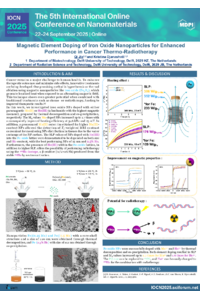
Thermotherapy in the form of hyperthermia (42-50°C) is often added to cancer treatments to increase the tumor’s sensitivity to adjuvant (chemo)radiotherapy. Magnetic nanoparticles (MNPs) are promising tools for such applications, as they have the capacity to generate heat upon exposure to an alternating magnetic field and simultaneously deliver a radiotherapeutic dose. Optimization of this multifunctional performance implies morphological fine-tuning of MNPs, aiming at high magnetization saturation (MS) values and, hence, high specific loss power (SLP), while incorporating a suitable radiotherapeutic isotope.
In this work, we investigated iron oxide NPs doped with two elements: paramagnetic Mn(II) and lanthanide Ho(III) with a high magnetic moment, prepared by thermal decomposition and co-precipitation, respectively, resulting in MS values that increased by up to 1.7 times and improved heating efficiency at 346 kHz and 23 mT. In addition, a pronounced Mn(II) outer rim obtained for higher Mn(II)-content NPs allowed the detection of T1-weighted MRI contrast convenient for monitoring NPs distribution in tissues due to the water exchange at the NPs' surface. The SLP values of NPs doped with Ho(III) into the Fe-oxide lattice were demonstrated to be dependent on both size and Ho content, with the best-performing NPs being 12 nm with 2.5% Ho. Furthermore, the presence of Ho(III) within the Fe-oxide lattice, in addition to higher SLP, offers the opportunity to perform radiotherapy using the 166Ho-isotope, a b-emitter (t1/2=27h) produced by the stable 165Ho via neutron activation.
These findings demonstrate that Fe-oxide NPs containing magnetic elements with additional functionalities provide the basis for the further development of hybrid materials with enhanced thermotherapeutic performance in combination with radiotherapy.
Keywords
Magnetic hyperthermia
iron oxide
element doping
Poster
IOCN 2025 Poster Qi Jia.pdf
Polymeric nanomicelles encapsulating aggregation-induced emission (AIE) natural molecules
Research on Improving the Efficiency of aquaculture Using Self-Powered Triboelectric Nanogenerators and Microfluidic Technology