Event submissions
Published
This submission belongs to the session S1. Nanomedicine and Bionanotechnology of the event The 5th International Online Conference on Nanomaterials
Published date
19 Sep, 2025
Academic Editor
'%3e%3cpath%20d='M12.6657%2010.9104C12.4185%2010.325%2012.0599%209.79327%2011.6097%209.34482C11.1609%208.89508%2010.6293%208.5365%2010.0442%208.28888C10.0389%208.28626%2010.0337%208.28495%2010.0285%208.28233C10.8446%207.69279%2011.3752%206.73249%2011.3752%205.64904C11.3752%203.8542%209.92103%202.39999%208.1262%202.39999C6.33136%202.39999%204.87715%203.8542%204.87715%205.64904C4.87715%206.73249%205.40774%207.69279%206.22393%208.28364C6.21869%208.28626%206.21345%208.28757%206.20821%208.29019C5.62129%208.5378%205.09463%208.89284%204.64265%209.34613C4.1929%209.79493%203.83432%2010.3266%203.58671%2010.9117C3.34345%2011.4845%203.21226%2012.0987%203.20023%2012.7209C3.19988%2012.7349%203.20233%2012.7488%203.20744%2012.7619C3.21255%2012.7749%203.22022%2012.7867%203.22998%2012.7968C3.23975%2012.8068%203.25142%2012.8147%203.26431%2012.8202C3.2772%2012.8256%203.29105%2012.8284%203.30504%2012.8284H4.09109C4.14874%2012.8284%204.19459%2012.7825%204.1959%2012.7262C4.2221%2011.7148%204.62823%2010.7676%205.34617%2010.0497C6.08899%209.30683%207.0755%208.89808%208.1262%208.89808C9.17689%208.89808%2010.1634%209.30683%2010.9062%2010.0497C11.6242%2010.7676%2012.0303%2011.7148%2012.0565%2012.7262C12.0578%2012.7838%2012.1037%2012.8284%2012.1613%2012.8284H12.9474C12.9613%2012.8284%2012.9752%2012.8256%2012.9881%2012.8202C13.001%2012.8147%2013.0126%2012.8068%2013.0224%2012.7968C13.0322%2012.7867%2013.0398%2012.7749%2013.0449%2012.7619C13.0501%2012.7488%2013.0525%2012.7349%2013.0522%2012.7209C13.0391%2012.0947%2012.9094%2011.4855%2012.6657%2010.9104ZM8.1262%207.9024C7.52486%207.9024%206.9589%207.6679%206.53312%207.24211C6.10733%206.81633%205.87283%206.25037%205.87283%205.64904C5.87283%205.0477%206.10733%204.48174%206.53312%204.05596C6.9589%203.63018%207.52486%203.39567%208.1262%203.39567C8.72753%203.39567%209.29349%203.63018%209.71927%204.05596C10.1451%204.48174%2010.3796%205.0477%2010.3796%205.64904C10.3796%206.25037%2010.1451%206.81633%209.71927%207.24211C9.29349%207.6679%208.72753%207.9024%208.1262%207.9024Z'%20fill='%235D1EE1'/%3e%3c/g%3e%3c/svg%3e) Bogdan Stefan Vasile
Bogdan Stefan VasileCitation
Krishnaveni Manubolu, RAVEESHA PEERIGA, Formulation and Therapeutic Evaluation of Beta vulgaris-Mediated Zinc Nanoparticles for the Management of Inflammatory Disorders, in Proceedings of The 5th International Online Conference on Nanomaterials, 22 September–24 September 2025, MDPI: Basel, Switzerland
Share
Email
Facebook
Twitter
LinkedIn
Formulation and Therapeutic Evaluation of Beta vulgaris-Mediated Zinc Nanoparticles for the Management of Inflammatory Disorders

Krishnaveni Manubolu 1
'%3e%3cpath%20d='M12.6647%2010.9104C12.4176%2010.325%2012.0589%209.7933%2011.6088%209.34485C11.16%208.89511%2010.6283%208.53653%2010.0432%208.28891C10.038%208.28629%2010.0327%208.28498%2010.0275%208.28236C10.8437%207.69282%2011.3743%206.73252%2011.3743%205.64907C11.3743%203.85423%209.92005%202.40002%208.12522%202.40002C6.33038%202.40002%204.87618%203.85423%204.87618%205.64907C4.87618%206.73252%205.40677%207.69282%206.22296%208.28367C6.21772%208.28629%206.21248%208.2876%206.20724%208.29022C5.62031%208.53783%205.09365%208.89287%204.64167%209.34616C4.19192%209.79496%203.83334%2010.3266%203.58573%2010.9117C3.34247%2011.4846%203.21128%2012.0987%203.19925%2012.721C3.1989%2012.735%203.20135%2012.7489%203.20646%2012.7619C3.21157%2012.7749%203.21924%2012.7868%203.22901%2012.7968C3.23877%2012.8068%203.25045%2012.8148%203.26334%2012.8202C3.27623%2012.8256%203.29007%2012.8284%203.30406%2012.8284H4.09012C4.14776%2012.8284%204.19362%2012.7825%204.19493%2012.7262C4.22113%2011.7148%204.62726%2010.7676%205.34519%2010.0497C6.08802%209.30686%207.07452%208.89811%208.12522%208.89811C9.17592%208.89811%2010.1624%209.30686%2010.9052%2010.0497C11.6232%2010.7676%2012.0293%2011.7148%2012.0555%2012.7262C12.0568%2012.7839%2012.1027%2012.8284%2012.1603%2012.8284H12.9464C12.9604%2012.8284%2012.9742%2012.8256%2012.9871%2012.8202C13%2012.8148%2013.0117%2012.8068%2013.0214%2012.7968C13.0312%2012.7868%2013.0389%2012.7749%2013.044%2012.7619C13.0491%2012.7489%2013.0515%2012.735%2013.0512%2012.721C13.0381%2012.0947%2012.9084%2011.4856%2012.6647%2010.9104ZM8.12522%207.90243C7.52388%207.90243%206.95792%207.66793%206.53214%207.24215C6.10636%206.81636%205.87185%206.2504%205.87185%205.64907C5.87185%205.04773%206.10636%204.48177%206.53214%204.05599C6.95792%203.63021%207.52388%203.3957%208.12522%203.3957C8.72655%203.3957%209.29252%203.63021%209.7183%204.05599C10.1441%204.48177%2010.3786%205.04773%2010.3786%205.64907C10.3786%206.2504%2010.1441%206.81636%209.7183%207.24215C9.29252%207.66793%208.72655%207.90243%208.12522%207.90243Z'%20fill='%235D1EE1'/%3e%3c/g%3e%3c/svg%3e)
RAVEESHA PEERIGA 1
1. Department of Pharmacognosy, Vallabhaneni Venkatadri Institute Of Pharmaceutical Sciences, Gudlavalleru, Krishna Dist, 521356 Andhra Pradesh, India
Abstract
Abstract (200–300 words):
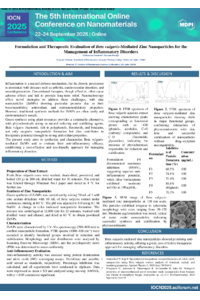
The increasing demand for sustainable, biocompatible nanotherapeutics has drawn attention to green synthesis methods using plant-based resources. Beta vulgaris (beetroot), known for its rich polyphenolic and antioxidant content, presents great potential as a natural reducing and stabilizing agent in nanoparticle production. This study explores the green synthesis, characterization, and anti-inflammatory evaluation of zinc nanoparticles (ZnNPs) mediated by Beta vulgaris extract.
ZnNPs were synthesized using aqueous root extracts of Beta vulgaris via a bottom-up approach. The phytochemicals in the extract facilitated an efficient reduction in zinc ions and stabilization of the nanoparticles. Reaction parameters such as pH, temperature, and extract concentration were optimized to ensure reproducibility and product quality. The resulting colloidal suspension remained stable without visible aggregation for several weeks.
Comprehensive characterization was carried out using UV-Vis spectroscopy, FTIR and SEM. SEM analysis showed an average particle size of 68 ± 5 nm with a polydispersity index (PDI) of <0.3, indicating excellent homogeneity. SEM images confirmed spherical morphology with particle sizes ranging from 50 to 80 nm. FTIR spectra confirmed no drug-excipient incompatibility in nanoparticle stabilization.
Anti-inflammatory activity was evaluated using protein denaturation and nitric oxide scavenging assays, revealing potent effects comparable to standard drugs. The observed activity may be due to the synergistic antioxidant effects of Beta vulgaris and the immunomodulatory properties of zinc, potentially through NF-κB pathway inhibition.
This study highlights a green, cost-effective route for synthesizing stable and bioactive ZnNPs with promising pharmaceutical applications for managing inflammatory disorders.
Keywords
Beta vulgaris
zinc nanoparticles
green synthesis
inflammation
nanomedicine
Poster
IOCN 2025 Poster beta.pdf
Research on Improving the Efficiency of aquaculture Using Self-Powered Triboelectric Nanogenerators and Microfluidic Technology
Bio-Nanotechnology-Enhanced Nasal Prophylaxis: A Computational Approach for Targeting SARS-CoV-2 Variants