Event submissions
Published
This submission belongs to the session S1. Nanomedicine and Bionanotechnology of the event The 5th International Online Conference on Nanomaterials
Published date
19 Sep, 2025
Academic Editor
'%3e%3cpath%20d='M12.6657%2010.9104C12.4185%2010.325%2012.0599%209.79327%2011.6097%209.34482C11.1609%208.89508%2010.6293%208.5365%2010.0442%208.28888C10.0389%208.28626%2010.0337%208.28495%2010.0285%208.28233C10.8446%207.69279%2011.3752%206.73249%2011.3752%205.64904C11.3752%203.8542%209.92103%202.39999%208.1262%202.39999C6.33136%202.39999%204.87715%203.8542%204.87715%205.64904C4.87715%206.73249%205.40774%207.69279%206.22393%208.28364C6.21869%208.28626%206.21345%208.28757%206.20821%208.29019C5.62129%208.5378%205.09463%208.89284%204.64265%209.34613C4.1929%209.79493%203.83432%2010.3266%203.58671%2010.9117C3.34345%2011.4845%203.21226%2012.0987%203.20023%2012.7209C3.19988%2012.7349%203.20233%2012.7488%203.20744%2012.7619C3.21255%2012.7749%203.22022%2012.7867%203.22998%2012.7968C3.23975%2012.8068%203.25142%2012.8147%203.26431%2012.8202C3.2772%2012.8256%203.29105%2012.8284%203.30504%2012.8284H4.09109C4.14874%2012.8284%204.19459%2012.7825%204.1959%2012.7262C4.2221%2011.7148%204.62823%2010.7676%205.34617%2010.0497C6.08899%209.30683%207.0755%208.89808%208.1262%208.89808C9.17689%208.89808%2010.1634%209.30683%2010.9062%2010.0497C11.6242%2010.7676%2012.0303%2011.7148%2012.0565%2012.7262C12.0578%2012.7838%2012.1037%2012.8284%2012.1613%2012.8284H12.9474C12.9613%2012.8284%2012.9752%2012.8256%2012.9881%2012.8202C13.001%2012.8147%2013.0126%2012.8068%2013.0224%2012.7968C13.0322%2012.7867%2013.0398%2012.7749%2013.0449%2012.7619C13.0501%2012.7488%2013.0525%2012.7349%2013.0522%2012.7209C13.0391%2012.0947%2012.9094%2011.4855%2012.6657%2010.9104ZM8.1262%207.9024C7.52486%207.9024%206.9589%207.6679%206.53312%207.24211C6.10733%206.81633%205.87283%206.25037%205.87283%205.64904C5.87283%205.0477%206.10733%204.48174%206.53312%204.05596C6.9589%203.63018%207.52486%203.39567%208.1262%203.39567C8.72753%203.39567%209.29349%203.63018%209.71927%204.05596C10.1451%204.48174%2010.3796%205.0477%2010.3796%205.64904C10.3796%206.25037%2010.1451%206.81633%209.71927%207.24211C9.29349%207.6679%208.72753%207.9024%208.1262%207.9024Z'%20fill='%235D1EE1'/%3e%3c/g%3e%3c/svg%3e) Bogdan Stefan Vasile
Bogdan Stefan VasileCitation
Ilyes Zatla, Lamia Boublenza, Bio-Nanotechnology-Enhanced Nasal Prophylaxis: A Computational Approach for Targeting SARS-CoV-2 Variants, in Proceedings of The 5th International Online Conference on Nanomaterials, 22 September–24 September 2025, MDPI: Basel, Switzerland
Share
Email
Facebook
Twitter
LinkedIn
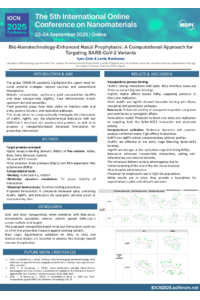
Bio-Nanotechnology-Enhanced Nasal Prophylaxis: A Computational Approach for Targeting SARS-CoV-2 Variants
'%3e%3cpath%20d='M12.6647%2010.9104C12.4176%2010.325%2012.0589%209.7933%2011.6088%209.34485C11.16%208.89511%2010.6283%208.53653%2010.0432%208.28891C10.038%208.28629%2010.0327%208.28498%2010.0275%208.28236C10.8437%207.69282%2011.3743%206.73252%2011.3743%205.64907C11.3743%203.85423%209.92005%202.40002%208.12522%202.40002C6.33038%202.40002%204.87618%203.85423%204.87618%205.64907C4.87618%206.73252%205.40677%207.69282%206.22296%208.28367C6.21772%208.28629%206.21248%208.2876%206.20724%208.29022C5.62031%208.53783%205.09365%208.89287%204.64167%209.34616C4.19192%209.79496%203.83334%2010.3266%203.58573%2010.9117C3.34247%2011.4846%203.21128%2012.0987%203.19925%2012.721C3.1989%2012.735%203.20135%2012.7489%203.20646%2012.7619C3.21157%2012.7749%203.21924%2012.7868%203.22901%2012.7968C3.23877%2012.8068%203.25045%2012.8148%203.26334%2012.8202C3.27623%2012.8256%203.29007%2012.8284%203.30406%2012.8284H4.09012C4.14776%2012.8284%204.19362%2012.7825%204.19493%2012.7262C4.22113%2011.7148%204.62726%2010.7676%205.34519%2010.0497C6.08802%209.30686%207.07452%208.89811%208.12522%208.89811C9.17592%208.89811%2010.1624%209.30686%2010.9052%2010.0497C11.6232%2010.7676%2012.0293%2011.7148%2012.0555%2012.7262C12.0568%2012.7839%2012.1027%2012.8284%2012.1603%2012.8284H12.9464C12.9604%2012.8284%2012.9742%2012.8256%2012.9871%2012.8202C13%2012.8148%2013.0117%2012.8068%2013.0214%2012.7968C13.0312%2012.7868%2013.0389%2012.7749%2013.044%2012.7619C13.0491%2012.7489%2013.0515%2012.735%2013.0512%2012.721C13.0381%2012.0947%2012.9084%2011.4856%2012.6647%2010.9104ZM8.12522%207.90243C7.52388%207.90243%206.95792%207.66793%206.53214%207.24215C6.10636%206.81636%205.87185%206.2504%205.87185%205.64907C5.87185%205.04773%206.10636%204.48177%206.53214%204.05599C6.95792%203.63021%207.52388%203.3957%208.12522%203.3957C8.72655%203.3957%209.29252%203.63021%209.7183%204.05599C10.1441%204.48177%2010.3786%205.04773%2010.3786%205.64907C10.3786%206.2504%2010.1441%206.81636%209.7183%207.24215C9.29252%207.66793%208.72655%207.90243%208.12522%207.90243Z'%20fill='%235D1EE1'/%3e%3c/g%3e%3c/svg%3e)
Ilyes Zatla 1
Lamia Boublenza 1
1. Laboratory of Microbiology applied to the Food industry, Biomedical and the Environment, Faculty of Natural and Life Sciences, Earth and Universe Sciences, Department of Biology, University of Tlemcen, Tlemcen 13000, Algeria
Abstract
The global spread of COVID-19 has sparked an urgent demand for innovative antiviral strategies beyond conventional therapeutics. Among emerging approaches, metallic nanoparticles—specifically those composed of gold (AuNPs) and silver (AgNPs)—have shown considerable promise due to their broad-spectrum antiviral capabilities. In this research, we focused on dissecting the interaction dynamics between these nanoparticles and several critical SARS-CoV-2 components. We initially modeled the receptor binding domains (RBDs) of five distinct viral variants—Alpha, Beta, Delta, Omicron, and Gamma—in conjunction with the human ACE2 receptor. Subsequent docking studies explored the potential of AuNPs, AgNPs, and the phytochemical Beta-escin to disrupt or modulate these protein–protein interactions. In parallel, we assessed the binding potential of these nanomaterials against two essential viral enzymes: the main protease (Mpro) and the RNA-dependent RNA polymerase (RdRp). Computational tools, including AutoDock 4.2 and HDOCK, were employed for structure-based virtual screening. The simulations revealed favorable binding interactions between both nanoparticles and Mpro, while AgNPs exhibited notably higher affinity for RdRp. In contrast, AuNPs showed preferential targeting of the Spike protein interface, particularly in complexes involving the Omicron variant, which demonstrated the tightest binding to ACE2. Furthermore, the study presents a theoretical model for a nanoparticle-based intranasal formulation combining AuNPs, AgNPs, and Beta-escin. This delivery system is designed to leverage synergistic molecular interactions at mucosal entry points to prevent viral attachment and replication. Advanced in silico methods, including molecular dynamics simulations and quantum-level analysis, supported the enhanced antiviral profile of the proposed composite. These computational findings lay the groundwork for future experimental validation and position this novel formulation as a potential front-line preventive agent against evolving SARS-CoV-2 variants.
Keywords
SARS-CoV-2
ACE2 receptor
Metallic nanoparticles
B-escin
Molecular docking.
Poster
Ily.Zat.3.pdf
Formulation and Therapeutic Evaluation of Beta vulgaris-Mediated Zinc Nanoparticles for the Management of Inflammatory Disorders
Integration of automated image processing via a smartphone application with multicolor Rapid Tests for cutting-edge liquid biopsy applications