Event submissions
Published
This submission belongs to the session S5. Computational Antibody Engineering of the event The 1st International Online Conference by Antibodies
Published date
07 Oct, 2025
Academic Editor
'%3e%3cpath%20d='M12.6657%2010.9104C12.4185%2010.325%2012.0599%209.79327%2011.6097%209.34482C11.1609%208.89508%2010.6293%208.5365%2010.0442%208.28888C10.0389%208.28626%2010.0337%208.28495%2010.0285%208.28233C10.8446%207.69279%2011.3752%206.73249%2011.3752%205.64904C11.3752%203.8542%209.92103%202.39999%208.1262%202.39999C6.33136%202.39999%204.87715%203.8542%204.87715%205.64904C4.87715%206.73249%205.40774%207.69279%206.22393%208.28364C6.21869%208.28626%206.21345%208.28757%206.20821%208.29019C5.62129%208.5378%205.09463%208.89284%204.64265%209.34613C4.1929%209.79493%203.83432%2010.3266%203.58671%2010.9117C3.34345%2011.4845%203.21226%2012.0987%203.20023%2012.7209C3.19988%2012.7349%203.20233%2012.7488%203.20744%2012.7619C3.21255%2012.7749%203.22022%2012.7867%203.22998%2012.7968C3.23975%2012.8068%203.25142%2012.8147%203.26431%2012.8202C3.2772%2012.8256%203.29105%2012.8284%203.30504%2012.8284H4.09109C4.14874%2012.8284%204.19459%2012.7825%204.1959%2012.7262C4.2221%2011.7148%204.62823%2010.7676%205.34617%2010.0497C6.08899%209.30683%207.0755%208.89808%208.1262%208.89808C9.17689%208.89808%2010.1634%209.30683%2010.9062%2010.0497C11.6242%2010.7676%2012.0303%2011.7148%2012.0565%2012.7262C12.0578%2012.7838%2012.1037%2012.8284%2012.1613%2012.8284H12.9474C12.9613%2012.8284%2012.9752%2012.8256%2012.9881%2012.8202C13.001%2012.8147%2013.0126%2012.8068%2013.0224%2012.7968C13.0322%2012.7867%2013.0398%2012.7749%2013.0449%2012.7619C13.0501%2012.7488%2013.0525%2012.7349%2013.0522%2012.7209C13.0391%2012.0947%2012.9094%2011.4855%2012.6657%2010.9104ZM8.1262%207.9024C7.52486%207.9024%206.9589%207.6679%206.53312%207.24211C6.10733%206.81633%205.87283%206.25037%205.87283%205.64904C5.87283%205.0477%206.10733%204.48174%206.53312%204.05596C6.9589%203.63018%207.52486%203.39567%208.1262%203.39567C8.72753%203.39567%209.29349%203.63018%209.71927%204.05596C10.1451%204.48174%2010.3796%205.0477%2010.3796%205.64904C10.3796%206.25037%2010.1451%206.81633%209.71927%207.24211C9.29349%207.6679%208.72753%207.9024%208.1262%207.9024Z'%20fill='%235D1EE1'/%3e%3c/g%3e%3c/svg%3e) Arne Skerra
Arne SkerraCitation
Zuleyha Basaran, Mehmet Emin Aygen, Tolga Mustafa Altin, Arzu Uyar, A Computational Workflow for The Prediction of Epitope/Paratope Regions and Antibody–Antigen Binding Poses, in Proceedings of The 1st International Online Conference by Antibodies, 13 October–14 October 2025, MDPI: Basel, Switzerland
Share
Email
Facebook
Twitter
LinkedIn
A Computational Workflow for The Prediction of Epitope/Paratope Regions and Antibody–Antigen Binding Poses

Zuleyha Basaran 1
'%3e%3cpath%20d='M12.6647%2010.9104C12.4176%2010.325%2012.0589%209.7933%2011.6088%209.34485C11.16%208.89511%2010.6283%208.53653%2010.0432%208.28891C10.038%208.28629%2010.0327%208.28498%2010.0275%208.28236C10.8437%207.69282%2011.3743%206.73252%2011.3743%205.64907C11.3743%203.85423%209.92005%202.40002%208.12522%202.40002C6.33038%202.40002%204.87618%203.85423%204.87618%205.64907C4.87618%206.73252%205.40677%207.69282%206.22296%208.28367C6.21772%208.28629%206.21248%208.2876%206.20724%208.29022C5.62031%208.53783%205.09365%208.89287%204.64167%209.34616C4.19192%209.79496%203.83334%2010.3266%203.58573%2010.9117C3.34247%2011.4846%203.21128%2012.0987%203.19925%2012.721C3.1989%2012.735%203.20135%2012.7489%203.20646%2012.7619C3.21157%2012.7749%203.21924%2012.7868%203.22901%2012.7968C3.23877%2012.8068%203.25045%2012.8148%203.26334%2012.8202C3.27623%2012.8256%203.29007%2012.8284%203.30406%2012.8284H4.09012C4.14776%2012.8284%204.19362%2012.7825%204.19493%2012.7262C4.22113%2011.7148%204.62726%2010.7676%205.34519%2010.0497C6.08802%209.30686%207.07452%208.89811%208.12522%208.89811C9.17592%208.89811%2010.1624%209.30686%2010.9052%2010.0497C11.6232%2010.7676%2012.0293%2011.7148%2012.0555%2012.7262C12.0568%2012.7839%2012.1027%2012.8284%2012.1603%2012.8284H12.9464C12.9604%2012.8284%2012.9742%2012.8256%2012.9871%2012.8202C13%2012.8148%2013.0117%2012.8068%2013.0214%2012.7968C13.0312%2012.7868%2013.0389%2012.7749%2013.044%2012.7619C13.0491%2012.7489%2013.0515%2012.735%2013.0512%2012.721C13.0381%2012.0947%2012.9084%2011.4856%2012.6647%2010.9104ZM8.12522%207.90243C7.52388%207.90243%206.95792%207.66793%206.53214%207.24215C6.10636%206.81636%205.87185%206.2504%205.87185%205.64907C5.87185%205.04773%206.10636%204.48177%206.53214%204.05599C6.95792%203.63021%207.52388%203.3957%208.12522%203.3957C8.72655%203.3957%209.29252%203.63021%209.7183%204.05599C10.1441%204.48177%2010.3786%205.04773%2010.3786%205.64907C10.3786%206.2504%2010.1441%206.81636%209.7183%207.24215C9.29252%207.66793%208.72655%207.90243%208.12522%207.90243Z'%20fill='%235D1EE1'/%3e%3c/g%3e%3c/svg%3e)
Mehmet Emin Aygen 1
Tolga Mustafa Altin 2

Arzu Uyar 1,3
1. Department of Bioengineering, Faculty of Engineering, Izmir Institute of Technology, 35430, Urla, Izmir, Türkiye
2. Department of Genetics and Bioengineering, Faculty of Engineering,
Izmir University of Economics, 35330, Balcova, Izmir, Türkiye
3. Computational Science and Engineering Program, Izmir Institute of Technology, 35430, Urla, Izmir, Türkiye
Abstract
Introduction: Predicting accurate binding poses in antibody–antigen complexes is challenging because some biological molecules might have more than one epitope. This study presents a computational workflow that integrates epitope/paratope prediction and protein–protein docking to predict accurate epitope and paratope residues, as well as antibody–antigen binding poses.
Methods: The computational workflow was applied to three different antibody–antigen systems: TNF-alpha, PD-L1, and IL-1 beta. First, Essential Site Scanning Analysis (ESSA), a fast and effective elastic network model-based method, was used to determine essential residues for binding in the studied antigens and antibodies. ESSA-detected essential residues in antigens were then clustered to determine epitopes as well as central epitope residues and epitope-forming residues. Each epitope and ESSA-detected essential residues in antibodies were used to guide antibody–antigen docking calculations. The LightDock was used to perform docking calculations with/without the antibody mode option, and the top three poses with the highest docking score for each case were used for further analysis. Additionally, for a fair comparison, two blind docking runs were also performed on the studied systems.
Results: Our results showed that ESSA can successfully detect different epitope regions in the antigens, and these residues significantly improve the accuracy of antibody–antigen pose prediction compared to those of blind docking. Interestingly, we observe that the antibodies tend to bind to the incorrect epitope with high docking scores, despite the dockings being performed in antibody mode. On the other hand, without the antibody mode, ESSA-guided dockings alone generate more accurate binding poses with the highest docking scores compared to those of blind dockings.
Conclusions: These findings show that ESSA-detected essential residues improve antibody–antigen docking calculations and accurately pinpoint the correct epitope region for a specific antibody. This integrative workflow offers a powerful tool for computational epitope mapping, a critical step in rational antibody design.
Keywords
epitope/paratope prediction
antibody-antigen binding
ESSA
LightDock
Poster
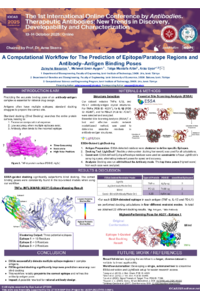
Züleyha_Başaran_et_al_Antibody_Conference_Poster.pdf
Multi-Objective Active Learning for Nanobody Development
Computational Nanobody Design for Amyloid-Beta 42 Octamer in Alzheimer’s Disease