Event submissions
Published
This submission belongs to the session S2. Antibody-based Therapeutics of the event The 1st International Online Conference by Antibodies
Published date
07 Oct, 2025
Academic Editor
'%3e%3cpath%20d='M12.6657%2010.9104C12.4185%2010.325%2012.0599%209.79327%2011.6097%209.34482C11.1609%208.89508%2010.6293%208.5365%2010.0442%208.28888C10.0389%208.28626%2010.0337%208.28495%2010.0285%208.28233C10.8446%207.69279%2011.3752%206.73249%2011.3752%205.64904C11.3752%203.8542%209.92103%202.39999%208.1262%202.39999C6.33136%202.39999%204.87715%203.8542%204.87715%205.64904C4.87715%206.73249%205.40774%207.69279%206.22393%208.28364C6.21869%208.28626%206.21345%208.28757%206.20821%208.29019C5.62129%208.5378%205.09463%208.89284%204.64265%209.34613C4.1929%209.79493%203.83432%2010.3266%203.58671%2010.9117C3.34345%2011.4845%203.21226%2012.0987%203.20023%2012.7209C3.19988%2012.7349%203.20233%2012.7488%203.20744%2012.7619C3.21255%2012.7749%203.22022%2012.7867%203.22998%2012.7968C3.23975%2012.8068%203.25142%2012.8147%203.26431%2012.8202C3.2772%2012.8256%203.29105%2012.8284%203.30504%2012.8284H4.09109C4.14874%2012.8284%204.19459%2012.7825%204.1959%2012.7262C4.2221%2011.7148%204.62823%2010.7676%205.34617%2010.0497C6.08899%209.30683%207.0755%208.89808%208.1262%208.89808C9.17689%208.89808%2010.1634%209.30683%2010.9062%2010.0497C11.6242%2010.7676%2012.0303%2011.7148%2012.0565%2012.7262C12.0578%2012.7838%2012.1037%2012.8284%2012.1613%2012.8284H12.9474C12.9613%2012.8284%2012.9752%2012.8256%2012.9881%2012.8202C13.001%2012.8147%2013.0126%2012.8068%2013.0224%2012.7968C13.0322%2012.7867%2013.0398%2012.7749%2013.0449%2012.7619C13.0501%2012.7488%2013.0525%2012.7349%2013.0522%2012.7209C13.0391%2012.0947%2012.9094%2011.4855%2012.6657%2010.9104ZM8.1262%207.9024C7.52486%207.9024%206.9589%207.6679%206.53312%207.24211C6.10733%206.81633%205.87283%206.25037%205.87283%205.64904C5.87283%205.0477%206.10733%204.48174%206.53312%204.05596C6.9589%203.63018%207.52486%203.39567%208.1262%203.39567C8.72753%203.39567%209.29349%203.63018%209.71927%204.05596C10.1451%204.48174%2010.3796%205.0477%2010.3796%205.64904C10.3796%206.25037%2010.1451%206.81633%209.71927%207.24211C9.29349%207.6679%208.72753%207.9024%208.1262%207.9024Z'%20fill='%235D1EE1'/%3e%3c/g%3e%3c/svg%3e) Patrick Chames
Patrick ChamesCitation
Rachaputi Prem Sai, RAVULA HARSHAVARDHAN, DASARI YASWANTH, The Art of Immune Suppression: An Antibody Perspective, in Proceedings of The 1st International Online Conference by Antibodies, 13 October–14 October 2025, MDPI: Basel, Switzerland
Share
Email
Facebook
Twitter
LinkedIn
The Art of Immune Suppression: An Antibody Perspective
'%3e%3cpath%20d='M12.6647%2010.9104C12.4176%2010.325%2012.0589%209.7933%2011.6088%209.34485C11.16%208.89511%2010.6283%208.53653%2010.0432%208.28891C10.038%208.28629%2010.0327%208.28498%2010.0275%208.28236C10.8437%207.69282%2011.3743%206.73252%2011.3743%205.64907C11.3743%203.85423%209.92005%202.40002%208.12522%202.40002C6.33038%202.40002%204.87618%203.85423%204.87618%205.64907C4.87618%206.73252%205.40677%207.69282%206.22296%208.28367C6.21772%208.28629%206.21248%208.2876%206.20724%208.29022C5.62031%208.53783%205.09365%208.89287%204.64167%209.34616C4.19192%209.79496%203.83334%2010.3266%203.58573%2010.9117C3.34247%2011.4846%203.21128%2012.0987%203.19925%2012.721C3.1989%2012.735%203.20135%2012.7489%203.20646%2012.7619C3.21157%2012.7749%203.21924%2012.7868%203.22901%2012.7968C3.23877%2012.8068%203.25045%2012.8148%203.26334%2012.8202C3.27623%2012.8256%203.29007%2012.8284%203.30406%2012.8284H4.09012C4.14776%2012.8284%204.19362%2012.7825%204.19493%2012.7262C4.22113%2011.7148%204.62726%2010.7676%205.34519%2010.0497C6.08802%209.30686%207.07452%208.89811%208.12522%208.89811C9.17592%208.89811%2010.1624%209.30686%2010.9052%2010.0497C11.6232%2010.7676%2012.0293%2011.7148%2012.0555%2012.7262C12.0568%2012.7839%2012.1027%2012.8284%2012.1603%2012.8284H12.9464C12.9604%2012.8284%2012.9742%2012.8256%2012.9871%2012.8202C13%2012.8148%2013.0117%2012.8068%2013.0214%2012.7968C13.0312%2012.7868%2013.0389%2012.7749%2013.044%2012.7619C13.0491%2012.7489%2013.0515%2012.735%2013.0512%2012.721C13.0381%2012.0947%2012.9084%2011.4856%2012.6647%2010.9104ZM8.12522%207.90243C7.52388%207.90243%206.95792%207.66793%206.53214%207.24215C6.10636%206.81636%205.87185%206.2504%205.87185%205.64907C5.87185%205.04773%206.10636%204.48177%206.53214%204.05599C6.95792%203.63021%207.52388%203.3957%208.12522%203.3957C8.72655%203.3957%209.29252%203.63021%209.7183%204.05599C10.1441%204.48177%2010.3786%205.04773%2010.3786%205.64907C10.3786%206.2504%2010.1441%206.81636%209.7183%207.24215C9.29252%207.66793%208.72655%207.90243%208.12522%207.90243Z'%20fill='%235D1EE1'/%3e%3c/g%3e%3c/svg%3e)
Rachaputi Prem Sai 1
RAVULA HARSHAVARDHAN 1
DASARI YASWANTH 1
1. B. PHARMACY 4TH YEAR STUDENT,, NARAYANA PHARMACY COLLEGE, NELLORE, INDIA-524003
Abstract
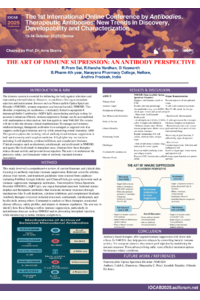
The immune system serves as the body’s defense mechanism against pathogens and abnormal cells. However, in autoimmune conditions or transplant scenarios, it becomes essential to suppress the immune response to prevent tissue damage or graft rejection. This delicate balance is achieved through targeted immunosuppressive therapies. Antibodies, particularly monoclonal and engineered types, have emerged as potent tools in this domain, offering precision in modulating immune activity while minimizing generalized immunosuppression.
In diseases such as Neuromyelitis Optica Spectrum Disorder (NMOSD), where the immune system mistakenly targets the aquaporin-4 water channels in the central nervous system, antibody-mediated immune suppression plays a pivotal role. Drugs like eculizumab, a complement inhibitor, and inebilizumab, an anti-CD19 monoclonal antibody, exemplify the effectiveness of tailored antibody therapies in mitigating disease progression while preserving general immune function.
The need for immune suppression arises not only in autoimmune conditions but also in organ transplantation, allergic reactions, and certain chronic inflammatory diseases. Traditional immunosuppressants affect multiple immune pathways, often leading to an increased risk of infections and malignancies. In contrast, antibody-based suppression provides a targeted approach—binding to specific immune cells, receptors, or cytokines to downregulate overactive responses.
However, concerns remain regarding long-term safety and immune compromise. The prolonged use of immune-suppressing antibodies can lead to opportunistic infections, diminished vaccine response, and the reactivation of latent diseases. Yet, with proper dosing, monitoring, and patient stratification, these risks can be significantly reduced. Clinical trials and post-marketing surveillance have shown that with correct protocols, antibody-based immune suppression does not inherently pose a major threat, especially when compared to conventional immunosuppressive regimens.
In conclusion, antibodies offer a sophisticated means to modulate the immune system, addressing critical medical needs with increasing safety and specificity. Their role in diseases like NMOSD showcases how targeted suppression can lead to improved outcomes without broadly compromising immune defense.
Keywords
Immune suppression
Antibody therapy
Neuromyelitis Optica Spectrum Disorder (NMOSD)
Monoclonal antibodies
Targeted immunomodulation
Eculizumab
Inebilizumab
Poster
df523e6c603391a5edd0dfbc6761120c (1) (1).pdf
Monoclonal Antibodies in Cervical Cancer: Advancing Targeted Immunotherapy
Advancements in Antibody Technology: From Bispecifics to AI-Driven Therapeutics