Event submissions
Published
This submission belongs to the session S4. Humoral Immunity of the event The 1st International Online Conference by Antibodies
Published date
07 Oct, 2025
Academic Editor
'%3e%3cpath%20d='M12.6657%2010.9104C12.4185%2010.325%2012.0599%209.79327%2011.6097%209.34482C11.1609%208.89508%2010.6293%208.5365%2010.0442%208.28888C10.0389%208.28626%2010.0337%208.28495%2010.0285%208.28233C10.8446%207.69279%2011.3752%206.73249%2011.3752%205.64904C11.3752%203.8542%209.92103%202.39999%208.1262%202.39999C6.33136%202.39999%204.87715%203.8542%204.87715%205.64904C4.87715%206.73249%205.40774%207.69279%206.22393%208.28364C6.21869%208.28626%206.21345%208.28757%206.20821%208.29019C5.62129%208.5378%205.09463%208.89284%204.64265%209.34613C4.1929%209.79493%203.83432%2010.3266%203.58671%2010.9117C3.34345%2011.4845%203.21226%2012.0987%203.20023%2012.7209C3.19988%2012.7349%203.20233%2012.7488%203.20744%2012.7619C3.21255%2012.7749%203.22022%2012.7867%203.22998%2012.7968C3.23975%2012.8068%203.25142%2012.8147%203.26431%2012.8202C3.2772%2012.8256%203.29105%2012.8284%203.30504%2012.8284H4.09109C4.14874%2012.8284%204.19459%2012.7825%204.1959%2012.7262C4.2221%2011.7148%204.62823%2010.7676%205.34617%2010.0497C6.08899%209.30683%207.0755%208.89808%208.1262%208.89808C9.17689%208.89808%2010.1634%209.30683%2010.9062%2010.0497C11.6242%2010.7676%2012.0303%2011.7148%2012.0565%2012.7262C12.0578%2012.7838%2012.1037%2012.8284%2012.1613%2012.8284H12.9474C12.9613%2012.8284%2012.9752%2012.8256%2012.9881%2012.8202C13.001%2012.8147%2013.0126%2012.8068%2013.0224%2012.7968C13.0322%2012.7867%2013.0398%2012.7749%2013.0449%2012.7619C13.0501%2012.7488%2013.0525%2012.7349%2013.0522%2012.7209C13.0391%2012.0947%2012.9094%2011.4855%2012.6657%2010.9104ZM8.1262%207.9024C7.52486%207.9024%206.9589%207.6679%206.53312%207.24211C6.10733%206.81633%205.87283%206.25037%205.87283%205.64904C5.87283%205.0477%206.10733%204.48174%206.53312%204.05596C6.9589%203.63018%207.52486%203.39567%208.1262%203.39567C8.72753%203.39567%209.29349%203.63018%209.71927%204.05596C10.1451%204.48174%2010.3796%205.0477%2010.3796%205.64904C10.3796%206.25037%2010.1451%206.81633%209.71927%207.24211C9.29349%207.6679%208.72753%207.9024%208.1262%207.9024Z'%20fill='%235D1EE1'/%3e%3c/g%3e%3c/svg%3e) Cecile King
Cecile KingCitation
Madalen Arribas Galarreta, Johana Torralba, Lara Herrera del Val, Ana del Pozo, Edurne Rujas, María Ángeles Jiménez, Alicia Rodríguez Gascón, Cristina Eguizabal, José Luis Nieva, María Ángeles Solinís, Beatriz Apellániz, A broad-spectrum SARS-CoV-2 immunization strategy targeting the highly conserved MPER of the Spike protein, in Proceedings of The 1st International Online Conference by Antibodies, 13 October–14 October 2025, MDPI: Basel, Switzerland
Share
Email
Facebook
Twitter
LinkedIn
A broad-spectrum SARS-CoV-2 immunization strategy targeting the highly conserved MPER of the Spike protein
'%3e%3cpath%20d='M12.6647%2010.9104C12.4176%2010.325%2012.0589%209.7933%2011.6088%209.34485C11.16%208.89511%2010.6283%208.53653%2010.0432%208.28891C10.038%208.28629%2010.0327%208.28498%2010.0275%208.28236C10.8437%207.69282%2011.3743%206.73252%2011.3743%205.64907C11.3743%203.85423%209.92005%202.40002%208.12522%202.40002C6.33038%202.40002%204.87618%203.85423%204.87618%205.64907C4.87618%206.73252%205.40677%207.69282%206.22296%208.28367C6.21772%208.28629%206.21248%208.2876%206.20724%208.29022C5.62031%208.53783%205.09365%208.89287%204.64167%209.34616C4.19192%209.79496%203.83334%2010.3266%203.58573%2010.9117C3.34247%2011.4846%203.21128%2012.0987%203.19925%2012.721C3.1989%2012.735%203.20135%2012.7489%203.20646%2012.7619C3.21157%2012.7749%203.21924%2012.7868%203.22901%2012.7968C3.23877%2012.8068%203.25045%2012.8148%203.26334%2012.8202C3.27623%2012.8256%203.29007%2012.8284%203.30406%2012.8284H4.09012C4.14776%2012.8284%204.19362%2012.7825%204.19493%2012.7262C4.22113%2011.7148%204.62726%2010.7676%205.34519%2010.0497C6.08802%209.30686%207.07452%208.89811%208.12522%208.89811C9.17592%208.89811%2010.1624%209.30686%2010.9052%2010.0497C11.6232%2010.7676%2012.0293%2011.7148%2012.0555%2012.7262C12.0568%2012.7839%2012.1027%2012.8284%2012.1603%2012.8284H12.9464C12.9604%2012.8284%2012.9742%2012.8256%2012.9871%2012.8202C13%2012.8148%2013.0117%2012.8068%2013.0214%2012.7968C13.0312%2012.7868%2013.0389%2012.7749%2013.044%2012.7619C13.0491%2012.7489%2013.0515%2012.735%2013.0512%2012.721C13.0381%2012.0947%2012.9084%2011.4856%2012.6647%2010.9104ZM8.12522%207.90243C7.52388%207.90243%206.95792%207.66793%206.53214%207.24215C6.10636%206.81636%205.87185%206.2504%205.87185%205.64907C5.87185%205.04773%206.10636%204.48177%206.53214%204.05599C6.95792%203.63021%207.52388%203.3957%208.12522%203.3957C8.72655%203.3957%209.29252%203.63021%209.7183%204.05599C10.1441%204.48177%2010.3786%205.04773%2010.3786%205.64907C10.3786%206.2504%2010.1441%206.81636%209.7183%207.24215C9.29252%207.66793%208.72655%207.90243%208.12522%207.90243Z'%20fill='%235D1EE1'/%3e%3c/g%3e%3c/svg%3e)
Madalen Arribas Galarreta 1,2
Johana Torralba 3
Lara Herrera del Val 4,5
Ana del Pozo 1,2
Edurne Rujas 1,2,3,6
María Ángeles Jiménez 7

Alicia Rodríguez Gascón 1,2
Cristina Eguizabal 4,5
José Luis Nieva 3,8
María Ángeles Solinís 1,2
Beatriz Apellániz 2,9
1. Pharmacokinetic, Nanotechnology and Gene Therapy Group, Faculty of Pharmacy, University of the Basque Country (UPV/EHU), 01006 Vitoria, Spain
2. Bioaraba, Microbiology, Infectious Disease, Antimicrobial Agents, and Gene Therapy, 01006 Vitoria-Gasteiz, Spain
3. Instituto Biofisika (CSIC-UPV/EHU), University of the Basque Country (UPV/EHU), 48080 Bilbao, Spain
4. Cell Therapy, Stem Cells and Tissues Group, Biobizkaia Health Research Institut, 48903 Barakaldo, Spain
5. Advanced Therapies Unit, Basque Centre for Blood Transfusion and Human Tissues, 48960 Galdakao, Spain
6. Ikerbasque, Basque Foundation for Science, Bilbao, Spain
7. Department of Biological Physical Chemistry, Blas Cabrera Physical Chemistry Institute (IQF),
Spanish National Research Council (CSIC), Madrid, Spain
8. Department of Biochemistry and Molecular Biology, University of the Basque Country UPV/EHU, 48080 Bilbao, Spain
9. Department of Physiology, Faculty of Pharmacy, University of the Basque Country UPV/EHU, 01006 Vitoria-Gasteiz, Spain
Abstract
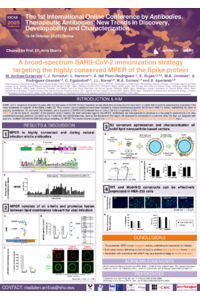
SARS-CoV-2 remains in circulation 5 years after the first cases of COVID-19 were reported, during which time several variants have been selected with mutations accumulating especially in the more accessible S1 subunit of the Spike protein (S). Consequently, current vaccine platforms have been updated to ensure effectiveness against the Omicron XBB.1.5 variant, highlighting the need for ongoing surveillance and updates of the antigens included in the immunization strategies. To overcome this limitation, we analyzed in a SARS-CoV-2-infected human cohort the immunogenicity of the highly conserved membrane-proximal external region (MPER) of the S2 subunit of the Spike, which is conserved across the Orthocoronavirinae subfamily. A portion of the patients, even if weakly, did elicit antibodies against the MPER. Additionally, we characterized its structure in a low-polarity environment and in lipid membranes, as well as showing its fusogenic potential, confirming its active involvement in the viral infection process. Therefore, we report the suitability of the MPER as a target for vaccination. Considering the impact that lipid membranes may have on the structure of this region, we assessed its expression in the membranes of eukaryotic cells. For that, we designed wild-type and modified S2-derived DNA sequences including the MPER. The results obtained support the feasibility of designing vaccines focused on the conserved MPER region.
Keywords
SARS-CoV-2
antiviral immunity
MPER
Poster
Poster IOCAB MA.pdf
From Disorder to Design: Ensemble-Based Computational Antibody Discovery for IDP Targets in Zika Virus
Predictive Biomarkers for Monoclonal Antibody Therapy Response in Oral Squamous Cell Carcinoma: A Systematic Review