Event submissions
Published
This submission belongs to the session S6. Microbial Metabolites with Novel Functions in Diseases and Health of the event The 4th International Electronic Conference on Metabolomics
Published date
10 Oct, 2025
Academic Editor
'%3e%3cpath%20d='M12.6657%2010.9104C12.4185%2010.325%2012.0599%209.79327%2011.6097%209.34482C11.1609%208.89508%2010.6293%208.5365%2010.0442%208.28888C10.0389%208.28626%2010.0337%208.28495%2010.0285%208.28233C10.8446%207.69279%2011.3752%206.73249%2011.3752%205.64904C11.3752%203.8542%209.92103%202.39999%208.1262%202.39999C6.33136%202.39999%204.87715%203.8542%204.87715%205.64904C4.87715%206.73249%205.40774%207.69279%206.22393%208.28364C6.21869%208.28626%206.21345%208.28757%206.20821%208.29019C5.62129%208.5378%205.09463%208.89284%204.64265%209.34613C4.1929%209.79493%203.83432%2010.3266%203.58671%2010.9117C3.34345%2011.4845%203.21226%2012.0987%203.20023%2012.7209C3.19988%2012.7349%203.20233%2012.7488%203.20744%2012.7619C3.21255%2012.7749%203.22022%2012.7867%203.22998%2012.7968C3.23975%2012.8068%203.25142%2012.8147%203.26431%2012.8202C3.2772%2012.8256%203.29105%2012.8284%203.30504%2012.8284H4.09109C4.14874%2012.8284%204.19459%2012.7825%204.1959%2012.7262C4.2221%2011.7148%204.62823%2010.7676%205.34617%2010.0497C6.08899%209.30683%207.0755%208.89808%208.1262%208.89808C9.17689%208.89808%2010.1634%209.30683%2010.9062%2010.0497C11.6242%2010.7676%2012.0303%2011.7148%2012.0565%2012.7262C12.0578%2012.7838%2012.1037%2012.8284%2012.1613%2012.8284H12.9474C12.9613%2012.8284%2012.9752%2012.8256%2012.9881%2012.8202C13.001%2012.8147%2013.0126%2012.8068%2013.0224%2012.7968C13.0322%2012.7867%2013.0398%2012.7749%2013.0449%2012.7619C13.0501%2012.7488%2013.0525%2012.7349%2013.0522%2012.7209C13.0391%2012.0947%2012.9094%2011.4855%2012.6657%2010.9104ZM8.1262%207.9024C7.52486%207.9024%206.9589%207.6679%206.53312%207.24211C6.10733%206.81633%205.87283%206.25037%205.87283%205.64904C5.87283%205.0477%206.10733%204.48174%206.53312%204.05596C6.9589%203.63018%207.52486%203.39567%208.1262%203.39567C8.72753%203.39567%209.29349%203.63018%209.71927%204.05596C10.1451%204.48174%2010.3796%205.0477%2010.3796%205.64904C10.3796%206.25037%2010.1451%206.81633%209.71927%207.24211C9.29349%207.6679%208.72753%207.9024%208.1262%207.9024Z'%20fill='%235D1EE1'/%3e%3c/g%3e%3c/svg%3e) Giovanni Ribaudo
Giovanni RibaudoCitation
Maria Getsina, Natalia Beloborodova, Sepsis-associated microbial metabolites as an indicator of complications during extracorporeal therapy in cases of sepsis and septic shock in children, in Proceedings of The 4th International Electronic Conference on Metabolomics, 13 October–15 October 2025, MDPI: Basel, Switzerland
Share
Email
Facebook
Twitter
LinkedIn
Sepsis-associated microbial metabolites as an indicator of complications during extracorporeal therapy in cases of sepsis and septic shock in children
'%3e%3cpath%20d='M12.6647%2010.9104C12.4176%2010.325%2012.0589%209.7933%2011.6088%209.34485C11.16%208.89511%2010.6283%208.53653%2010.0432%208.28891C10.038%208.28629%2010.0327%208.28498%2010.0275%208.28236C10.8437%207.69282%2011.3743%206.73252%2011.3743%205.64907C11.3743%203.85423%209.92005%202.40002%208.12522%202.40002C6.33038%202.40002%204.87618%203.85423%204.87618%205.64907C4.87618%206.73252%205.40677%207.69282%206.22296%208.28367C6.21772%208.28629%206.21248%208.2876%206.20724%208.29022C5.62031%208.53783%205.09365%208.89287%204.64167%209.34616C4.19192%209.79496%203.83334%2010.3266%203.58573%2010.9117C3.34247%2011.4846%203.21128%2012.0987%203.19925%2012.721C3.1989%2012.735%203.20135%2012.7489%203.20646%2012.7619C3.21157%2012.7749%203.21924%2012.7868%203.22901%2012.7968C3.23877%2012.8068%203.25045%2012.8148%203.26334%2012.8202C3.27623%2012.8256%203.29007%2012.8284%203.30406%2012.8284H4.09012C4.14776%2012.8284%204.19362%2012.7825%204.19493%2012.7262C4.22113%2011.7148%204.62726%2010.7676%205.34519%2010.0497C6.08802%209.30686%207.07452%208.89811%208.12522%208.89811C9.17592%208.89811%2010.1624%209.30686%2010.9052%2010.0497C11.6232%2010.7676%2012.0293%2011.7148%2012.0555%2012.7262C12.0568%2012.7839%2012.1027%2012.8284%2012.1603%2012.8284H12.9464C12.9604%2012.8284%2012.9742%2012.8256%2012.9871%2012.8202C13%2012.8148%2013.0117%2012.8068%2013.0214%2012.7968C13.0312%2012.7868%2013.0389%2012.7749%2013.044%2012.7619C13.0491%2012.7489%2013.0515%2012.735%2013.0512%2012.721C13.0381%2012.0947%2012.9084%2011.4856%2012.6647%2010.9104ZM8.12522%207.90243C7.52388%207.90243%206.95792%207.66793%206.53214%207.24215C6.10636%206.81636%205.87185%206.2504%205.87185%205.64907C5.87185%205.04773%206.10636%204.48177%206.53214%204.05599C6.95792%203.63021%207.52388%203.3957%208.12522%203.3957C8.72655%203.3957%209.29252%203.63021%209.7183%204.05599C10.1441%204.48177%2010.3786%205.04773%2010.3786%205.64907C10.3786%206.2504%2010.1441%206.81636%209.7183%207.24215C9.29252%207.66793%208.72655%207.90243%208.12522%207.90243Z'%20fill='%235D1EE1'/%3e%3c/g%3e%3c/svg%3e)
Maria Getsina 1
Natalia Beloborodova 1
1. Federal Research and Clinical Center of Intensive Care Medicine and Rehabilitology, 25-2 Petrovka Str., 107031 Moscow, Russia
Abstract
Introduction
Modern blood purification technologies are widely used in intensive care to treat patients with sepsis and septic shock. Mortality was significant and increased as organ failure progressed; therefore, further evaluation of the effectiveness of extracorporeal therapy for severe sepsis and septic shock in children is necessary.
Aim
This study aimed to evaluate the change in the concentration of sepsis-associated microbial metabolites when using the method of extracorporeal therapy of severe sepsis and septic shock in children.
Materials and methods
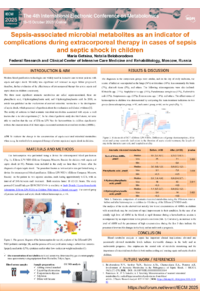
The hemosorption was performed using a device for extracorporeal blood purification, Efferon LPS NEO (Efferon Company, Moscow, Russia), for children with sepsis and septic shock (n=30). The study protocol is available at Study Details | Lipopolysaccharide Adsorption (Efferon LPS NEO) in Children With Sepsis | ClinicalTrials.gov. The level of sepsis-associated microbial metabolites in the blood serum of children with sepsis or septic shock was measured using the method of gas chromatography–mass spectrometry.
Results
The concentration of phenyllactic acid before hemosorption was 0.8 (0.6; 1.3) µmol/l and after hemosorption, it was 0.6 (0.3; 1.2) µmol/l (p-value=0.034). The concentration of p-hydroxyphenylacetic acid before hemosorption was 1.1 (0.7; 2.7) µmol/l and after hemosorption, it was 0.8 (0.2; 1.2) µmol/l (p-value=0.023). The concentration of p-hydroxyphenyllactic acid before hemosorption was 2.8 (1.4; 4.6) µmol/l and after hemosorption, it was 0.8 (0.4; 3.7) µmol/l (p-value=0.041).
Conclusion
Blood metabolite analysis in sepsis has important clinical implications: Elevated and persistently elevated metabolite levels indicate irreversible changes in the body and an unfavorable prognosis. This emphasizes the central role of metabolic monitoring and the importance of microbial metabolism in both understanding and treating sepsis and septic shock in children.
Keywords
aromatic microbial metabolites
sepsis
extracorporeal therapy
GC-MS
Poster
Poster Getsina.pdf
Omics-Based Insights into the Hypocholesterolemic Effects of Fucus vesiculosus Extract on Intestinal Cells
Mass Spectral Matching for Compound Identification in Metabolomics: An Open-Source Python/Shiny Package