Event submissions
Published
This submission belongs to the session S3. Advanced Metabolomics and Data Analysis Approaches of the event The 4th International Electronic Conference on Metabolomics
Published date
10 Oct, 2025
Academic Editor
'%3e%3cpath%20d='M12.6657%2010.9104C12.4185%2010.325%2012.0599%209.79327%2011.6097%209.34482C11.1609%208.89508%2010.6293%208.5365%2010.0442%208.28888C10.0389%208.28626%2010.0337%208.28495%2010.0285%208.28233C10.8446%207.69279%2011.3752%206.73249%2011.3752%205.64904C11.3752%203.8542%209.92103%202.39999%208.1262%202.39999C6.33136%202.39999%204.87715%203.8542%204.87715%205.64904C4.87715%206.73249%205.40774%207.69279%206.22393%208.28364C6.21869%208.28626%206.21345%208.28757%206.20821%208.29019C5.62129%208.5378%205.09463%208.89284%204.64265%209.34613C4.1929%209.79493%203.83432%2010.3266%203.58671%2010.9117C3.34345%2011.4845%203.21226%2012.0987%203.20023%2012.7209C3.19988%2012.7349%203.20233%2012.7488%203.20744%2012.7619C3.21255%2012.7749%203.22022%2012.7867%203.22998%2012.7968C3.23975%2012.8068%203.25142%2012.8147%203.26431%2012.8202C3.2772%2012.8256%203.29105%2012.8284%203.30504%2012.8284H4.09109C4.14874%2012.8284%204.19459%2012.7825%204.1959%2012.7262C4.2221%2011.7148%204.62823%2010.7676%205.34617%2010.0497C6.08899%209.30683%207.0755%208.89808%208.1262%208.89808C9.17689%208.89808%2010.1634%209.30683%2010.9062%2010.0497C11.6242%2010.7676%2012.0303%2011.7148%2012.0565%2012.7262C12.0578%2012.7838%2012.1037%2012.8284%2012.1613%2012.8284H12.9474C12.9613%2012.8284%2012.9752%2012.8256%2012.9881%2012.8202C13.001%2012.8147%2013.0126%2012.8068%2013.0224%2012.7968C13.0322%2012.7867%2013.0398%2012.7749%2013.0449%2012.7619C13.0501%2012.7488%2013.0525%2012.7349%2013.0522%2012.7209C13.0391%2012.0947%2012.9094%2011.4855%2012.6657%2010.9104ZM8.1262%207.9024C7.52486%207.9024%206.9589%207.6679%206.53312%207.24211C6.10733%206.81633%205.87283%206.25037%205.87283%205.64904C5.87283%205.0477%206.10733%204.48174%206.53312%204.05596C6.9589%203.63018%207.52486%203.39567%208.1262%203.39567C8.72753%203.39567%209.29349%203.63018%209.71927%204.05596C10.1451%204.48174%2010.3796%205.0477%2010.3796%205.64904C10.3796%206.25037%2010.1451%206.81633%209.71927%207.24211C9.29349%207.6679%208.72753%207.9024%208.1262%207.9024Z'%20fill='%235D1EE1'/%3e%3c/g%3e%3c/svg%3e) Hunter Moseley
Hunter MoseleyCitation
Hunter Dlugas, Ikuko Kato, Jing Li, Xiang Zhang, Seongho Kim, Mass Spectral Matching for Compound Identification in Metabolomics: An Open-Source Python/Shiny Package, in Proceedings of The 4th International Electronic Conference on Metabolomics, 13 October–15 October 2025, MDPI: Basel, Switzerland
Share
Email
Facebook
Twitter
LinkedIn
Mass Spectral Matching for Compound Identification in Metabolomics: An Open-Source Python/Shiny Package
'%3e%3cpath%20d='M12.6647%2010.9104C12.4176%2010.325%2012.0589%209.7933%2011.6088%209.34485C11.16%208.89511%2010.6283%208.53653%2010.0432%208.28891C10.038%208.28629%2010.0327%208.28498%2010.0275%208.28236C10.8437%207.69282%2011.3743%206.73252%2011.3743%205.64907C11.3743%203.85423%209.92005%202.40002%208.12522%202.40002C6.33038%202.40002%204.87618%203.85423%204.87618%205.64907C4.87618%206.73252%205.40677%207.69282%206.22296%208.28367C6.21772%208.28629%206.21248%208.2876%206.20724%208.29022C5.62031%208.53783%205.09365%208.89287%204.64167%209.34616C4.19192%209.79496%203.83334%2010.3266%203.58573%2010.9117C3.34247%2011.4846%203.21128%2012.0987%203.19925%2012.721C3.1989%2012.735%203.20135%2012.7489%203.20646%2012.7619C3.21157%2012.7749%203.21924%2012.7868%203.22901%2012.7968C3.23877%2012.8068%203.25045%2012.8148%203.26334%2012.8202C3.27623%2012.8256%203.29007%2012.8284%203.30406%2012.8284H4.09012C4.14776%2012.8284%204.19362%2012.7825%204.19493%2012.7262C4.22113%2011.7148%204.62726%2010.7676%205.34519%2010.0497C6.08802%209.30686%207.07452%208.89811%208.12522%208.89811C9.17592%208.89811%2010.1624%209.30686%2010.9052%2010.0497C11.6232%2010.7676%2012.0293%2011.7148%2012.0555%2012.7262C12.0568%2012.7839%2012.1027%2012.8284%2012.1603%2012.8284H12.9464C12.9604%2012.8284%2012.9742%2012.8256%2012.9871%2012.8202C13%2012.8148%2013.0117%2012.8068%2013.0214%2012.7968C13.0312%2012.7868%2013.0389%2012.7749%2013.044%2012.7619C13.0491%2012.7489%2013.0515%2012.735%2013.0512%2012.721C13.0381%2012.0947%2012.9084%2011.4856%2012.6647%2010.9104ZM8.12522%207.90243C7.52388%207.90243%206.95792%207.66793%206.53214%207.24215C6.10636%206.81636%205.87185%206.2504%205.87185%205.64907C5.87185%205.04773%206.10636%204.48177%206.53214%204.05599C6.95792%203.63021%207.52388%203.3957%208.12522%203.3957C8.72655%203.3957%209.29252%203.63021%209.7183%204.05599C10.1441%204.48177%2010.3786%205.04773%2010.3786%205.64907C10.3786%206.2504%2010.1441%206.81636%209.7183%207.24215C9.29252%207.66793%208.72655%207.90243%208.12522%207.90243Z'%20fill='%235D1EE1'/%3e%3c/g%3e%3c/svg%3e)
Hunter Dlugas 1,2
Ikuko Kato 1,3,4
Jing Li 1,5
Xiang Zhang 6

Seongho Kim 1,2
1. Department of Oncology, School of Medicine, Wayne State University, Detroit, MI, USA
2. Biostatistics and Bioinformatics Core, Karmanos Cancer Institute, Wayne State University, Detroit, MI, USA
3. Department of Pathology, School of Medicine, Wayne State University, Detroit, MI, USA
4. Epidemiology Division, Populations Sciences in the Pacific Program, University of Hawaii Cancer Center, Honolulu, HI, USA
5. Pharmacology and Metabolomics Core, Karmanos Cancer Institute, Wayne State University, Detroit, MI, USA
6. Department of Chemistry, University of Louisville, Louisville, KY, USA
Abstract
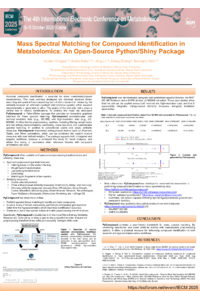
Compound identification is a critical step for mass spectrometry-based metabolomics. Two widely adopted approaches are chemical structure library- and mass spectral library-based compound identifications, both of which rely on calculating similarity scores between a query mass spectrum and reference spectra, either experimentally acquired or generated in silico. The use of a highly accurate similarity measure for mass spectral matching is a key component for successful compound identification. To meet this need, we developed a user-friendly Python/Shiny package with a graphical interface for mass spectral matching-based compound identification. The package supports both nominal-resolution mass spectrometry data (e.g., GC-MS) and high-resolution data (e.g., LC-MS/MS). It provides comprehensive preprocessing options, including filtering, weight factor transformation, low-entropy transformation, centroiding, noise removal, and spectral matching, and allows users to customize the order of these steps. The package also incorporates recently proposed entropy-based similarity measures, such as Shannon, Tsallis, and Rényi entropy correlations, alongside traditional cosine and binary similarity measures (1,2). Users can also combine these similarity measures to create mixture similarity measures with custom-defined weights. When using a mass spectral library with known compound names, parameters for specific preprocessing steps can be fine-tuned beyond the default settings. The package supports both untargeted and targeted metabolomics workflows and includes a command-line interface for batch processing. The implementation was validated on two reference libraries, a Webbook-based NIST GC-MS library and a GNPS-derived LC-MS/MS library. On the WebNist GC-MS data, the Cosine Similarity Measure outperformed the three entropy-based similarity measures with respect to accuracy (Cosine: 84.28% [83.75%,84.73%]; Shannon: 80.69% [80.17%,81.25%]; Rényi: 81.09% [80.56%,81.63%]; Tsallis: 81.68% [81.15%,82.19%]), and on GNPS LC-MS/MS data, the Cosine Similarity Measure slightly outperforms the three entropy-based similarity measures with respect to accuracy, although the 95% CIs overlap (Cosine: 69.07% [67.26%,71.01%]; Shannon: 67.92% [66.02%,69.95%]; Rényi: 68.63% [66.72%,70.66%]; Tsallis: 68.94% [67.03%,70.79%]).
Keywords
liquid-chromatography mass spectrometry
gas-chromatography mass spectrometry
compound identification
similarity measure
Cosine similarity
Shannon Entropy
Rényi Entropy
Tsallis Entropy
Python
Poster
sciforum_139892_S3_slides_poster_submission.pdf
Sepsis-associated microbial metabolites as an indicator of complications during extracorporeal therapy in cases of sepsis and septic shock in children
Bacillus coagulans improves late-laying hen performance through bile acid modulation that suppresses hepatic lipid accumulation and alleviates ovarian oxidative stress