Event submissions
Published
This submission belongs to the session S3. Advanced Metabolomics and Data Analysis Approaches of the event The 4th International Electronic Conference on Metabolomics
Published date
10 Oct, 2025
Academic Editor
'%3e%3cpath%20d='M12.6657%2010.9104C12.4185%2010.325%2012.0599%209.79327%2011.6097%209.34482C11.1609%208.89508%2010.6293%208.5365%2010.0442%208.28888C10.0389%208.28626%2010.0337%208.28495%2010.0285%208.28233C10.8446%207.69279%2011.3752%206.73249%2011.3752%205.64904C11.3752%203.8542%209.92103%202.39999%208.1262%202.39999C6.33136%202.39999%204.87715%203.8542%204.87715%205.64904C4.87715%206.73249%205.40774%207.69279%206.22393%208.28364C6.21869%208.28626%206.21345%208.28757%206.20821%208.29019C5.62129%208.5378%205.09463%208.89284%204.64265%209.34613C4.1929%209.79493%203.83432%2010.3266%203.58671%2010.9117C3.34345%2011.4845%203.21226%2012.0987%203.20023%2012.7209C3.19988%2012.7349%203.20233%2012.7488%203.20744%2012.7619C3.21255%2012.7749%203.22022%2012.7867%203.22998%2012.7968C3.23975%2012.8068%203.25142%2012.8147%203.26431%2012.8202C3.2772%2012.8256%203.29105%2012.8284%203.30504%2012.8284H4.09109C4.14874%2012.8284%204.19459%2012.7825%204.1959%2012.7262C4.2221%2011.7148%204.62823%2010.7676%205.34617%2010.0497C6.08899%209.30683%207.0755%208.89808%208.1262%208.89808C9.17689%208.89808%2010.1634%209.30683%2010.9062%2010.0497C11.6242%2010.7676%2012.0303%2011.7148%2012.0565%2012.7262C12.0578%2012.7838%2012.1037%2012.8284%2012.1613%2012.8284H12.9474C12.9613%2012.8284%2012.9752%2012.8256%2012.9881%2012.8202C13.001%2012.8147%2013.0126%2012.8068%2013.0224%2012.7968C13.0322%2012.7867%2013.0398%2012.7749%2013.0449%2012.7619C13.0501%2012.7488%2013.0525%2012.7349%2013.0522%2012.7209C13.0391%2012.0947%2012.9094%2011.4855%2012.6657%2010.9104ZM8.1262%207.9024C7.52486%207.9024%206.9589%207.6679%206.53312%207.24211C6.10733%206.81633%205.87283%206.25037%205.87283%205.64904C5.87283%205.0477%206.10733%204.48174%206.53312%204.05596C6.9589%203.63018%207.52486%203.39567%208.1262%203.39567C8.72753%203.39567%209.29349%203.63018%209.71927%204.05596C10.1451%204.48174%2010.3796%205.0477%2010.3796%205.64904C10.3796%206.25037%2010.1451%206.81633%209.71927%207.24211C9.29349%207.6679%208.72753%207.9024%208.1262%207.9024Z'%20fill='%235D1EE1'/%3e%3c/g%3e%3c/svg%3e) Hunter Moseley
Hunter MoseleyCitation
Hannah Sophie Auricht, Bushra Ijaz, Markus Teige, Alexandra Ribarits, Cristina Lopéz-Hidalgo, Wolfram Weckwerth, Using gas chromatography and mass spectrometry (GC-MS) for the detection of drought stress effects on the metabolome of Solanum tuberosum varieties, in Proceedings of The 4th International Electronic Conference on Metabolomics, 13 October–15 October 2025, MDPI: Basel, Switzerland
Share
Email
Facebook
Twitter
LinkedIn
Using gas chromatography and mass spectrometry (GC-MS) for the detection of drought stress effects on the metabolome of Solanum tuberosum varieties
'%3e%3cpath%20d='M12.6647%2010.9104C12.4176%2010.325%2012.0589%209.7933%2011.6088%209.34485C11.16%208.89511%2010.6283%208.53653%2010.0432%208.28891C10.038%208.28629%2010.0327%208.28498%2010.0275%208.28236C10.8437%207.69282%2011.3743%206.73252%2011.3743%205.64907C11.3743%203.85423%209.92005%202.40002%208.12522%202.40002C6.33038%202.40002%204.87618%203.85423%204.87618%205.64907C4.87618%206.73252%205.40677%207.69282%206.22296%208.28367C6.21772%208.28629%206.21248%208.2876%206.20724%208.29022C5.62031%208.53783%205.09365%208.89287%204.64167%209.34616C4.19192%209.79496%203.83334%2010.3266%203.58573%2010.9117C3.34247%2011.4846%203.21128%2012.0987%203.19925%2012.721C3.1989%2012.735%203.20135%2012.7489%203.20646%2012.7619C3.21157%2012.7749%203.21924%2012.7868%203.22901%2012.7968C3.23877%2012.8068%203.25045%2012.8148%203.26334%2012.8202C3.27623%2012.8256%203.29007%2012.8284%203.30406%2012.8284H4.09012C4.14776%2012.8284%204.19362%2012.7825%204.19493%2012.7262C4.22113%2011.7148%204.62726%2010.7676%205.34519%2010.0497C6.08802%209.30686%207.07452%208.89811%208.12522%208.89811C9.17592%208.89811%2010.1624%209.30686%2010.9052%2010.0497C11.6232%2010.7676%2012.0293%2011.7148%2012.0555%2012.7262C12.0568%2012.7839%2012.1027%2012.8284%2012.1603%2012.8284H12.9464C12.9604%2012.8284%2012.9742%2012.8256%2012.9871%2012.8202C13%2012.8148%2013.0117%2012.8068%2013.0214%2012.7968C13.0312%2012.7868%2013.0389%2012.7749%2013.044%2012.7619C13.0491%2012.7489%2013.0515%2012.735%2013.0512%2012.721C13.0381%2012.0947%2012.9084%2011.4856%2012.6647%2010.9104ZM8.12522%207.90243C7.52388%207.90243%206.95792%207.66793%206.53214%207.24215C6.10636%206.81636%205.87185%206.2504%205.87185%205.64907C5.87185%205.04773%206.10636%204.48177%206.53214%204.05599C6.95792%203.63021%207.52388%203.3957%208.12522%203.3957C8.72655%203.3957%209.29252%203.63021%209.7183%204.05599C10.1441%204.48177%2010.3786%205.04773%2010.3786%205.64907C10.3786%206.2504%2010.1441%206.81636%209.7183%207.24215C9.29252%207.66793%208.72655%207.90243%208.12522%207.90243Z'%20fill='%235D1EE1'/%3e%3c/g%3e%3c/svg%3e)
Hannah Sophie Auricht 1
Bushra Ijaz 1

Markus Teige 1
Alexandra Ribarits 2
Cristina Lopéz-Hidalgo 1
Wolfram Weckwerth 1
1. Molecular Systems Biology Lab (MOSYS), Department of Functional and Evolutionary Ecology, University of Vienna, Djerassiplatz 1, 1030 Vienna, Austria
2. Austrian Agency for Health and Food Safety, Institute for Seed and Propagating Material, Phytosanitary Service and Apicultur, Spargelfeldstraße 191, 1220 Vienna, Austria
Abstract
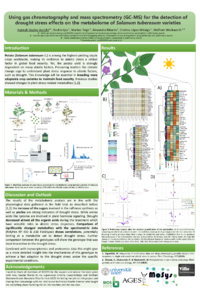
Background: Potato (Solanum tuberosum L.) is among the highest-yielding staple crops worldwide, making its resilience to abiotic stress a critical factor in global food security. Yet, the potato yield is strongly dependent on many abiotic factors. Pressuring environmental matters like climate change urge to understand plant stress response to abiotic factors, such as drought. This knowledge will be essential in breeding more adaptable crop varieties to maintain food security. Previous studies showed changes in plant stress-related metabolites [1,2]. Methods: Ten potato varieties were tested for their drought stress response in a field trial. Four biological replicates of each variety were collected from both irrigated (control) and non-irrigated (treatment) fields 2024 in two time points in July (at the onset of flowering). Leaf discs were grinded, and their weight normalized to ~22 mg (freshweight). Primary metabolites were targeted in the analysis by collecting the polar phase of the Methanol-Chloroform-Water extract. The metabolites were quantified and identified using Gas chromatography-mass spectrometry analysis. Further processing was done using MS-Dial and statistical analysis with R. Results: Preliminary results indicate separation between the control and the treatment group. Between the potato varieties and treatment significant metabolite changes (e. g. in proline) with p-value < 0.05 could be measured. In total 39 primary metabolites (Sugar alcohols, amino acids and organic acids) were absolutely quantified and compared between the varieties. A correlation between the visual data (PolyPen RP 410 & ASD FieldSpec Handeld 2) obtained by AGES and a set of significantly changed metabolites was detected. Discussion: The differences could depend on varying conditions in the soil, the microclimate and pests in a field trial which were partially assessed and further analyzed by AGES. Conclusion: We were able to characterize metabolic changes in Solanum tuberosum that are likely related to the applied drought stress conditions.
Keywords
Solanum tuberosum L.
Metabolomics
Gas Chromatography-Mass Spectrometry
field trial
abiotic stresses
Poster
MDPI_poster_HA_ESKILEB.pdf
LipidIN 2.0: an end-to-end intelligent analysis platform for 4D lipidomics and glycolipidomics
ClearAIF: An R-Based Computational Pipeline for DIA Metabolomic Data Processing and Reporting