Event submissions
Published
This submission belongs to the session S4. Metabolomics for Precision Nutrition in Humans and Animals of the event The 4th International Electronic Conference on Metabolomics
Published date
10 Oct, 2025
Academic Editor
'%3e%3cpath%20d='M12.6657%2010.9104C12.4185%2010.325%2012.0599%209.79327%2011.6097%209.34482C11.1609%208.89508%2010.6293%208.5365%2010.0442%208.28888C10.0389%208.28626%2010.0337%208.28495%2010.0285%208.28233C10.8446%207.69279%2011.3752%206.73249%2011.3752%205.64904C11.3752%203.8542%209.92103%202.39999%208.1262%202.39999C6.33136%202.39999%204.87715%203.8542%204.87715%205.64904C4.87715%206.73249%205.40774%207.69279%206.22393%208.28364C6.21869%208.28626%206.21345%208.28757%206.20821%208.29019C5.62129%208.5378%205.09463%208.89284%204.64265%209.34613C4.1929%209.79493%203.83432%2010.3266%203.58671%2010.9117C3.34345%2011.4845%203.21226%2012.0987%203.20023%2012.7209C3.19988%2012.7349%203.20233%2012.7488%203.20744%2012.7619C3.21255%2012.7749%203.22022%2012.7867%203.22998%2012.7968C3.23975%2012.8068%203.25142%2012.8147%203.26431%2012.8202C3.2772%2012.8256%203.29105%2012.8284%203.30504%2012.8284H4.09109C4.14874%2012.8284%204.19459%2012.7825%204.1959%2012.7262C4.2221%2011.7148%204.62823%2010.7676%205.34617%2010.0497C6.08899%209.30683%207.0755%208.89808%208.1262%208.89808C9.17689%208.89808%2010.1634%209.30683%2010.9062%2010.0497C11.6242%2010.7676%2012.0303%2011.7148%2012.0565%2012.7262C12.0578%2012.7838%2012.1037%2012.8284%2012.1613%2012.8284H12.9474C12.9613%2012.8284%2012.9752%2012.8256%2012.9881%2012.8202C13.001%2012.8147%2013.0126%2012.8068%2013.0224%2012.7968C13.0322%2012.7867%2013.0398%2012.7749%2013.0449%2012.7619C13.0501%2012.7488%2013.0525%2012.7349%2013.0522%2012.7209C13.0391%2012.0947%2012.9094%2011.4855%2012.6657%2010.9104ZM8.1262%207.9024C7.52486%207.9024%206.9589%207.6679%206.53312%207.24211C6.10733%206.81633%205.87283%206.25037%205.87283%205.64904C5.87283%205.0477%206.10733%204.48174%206.53312%204.05596C6.9589%203.63018%207.52486%203.39567%208.1262%203.39567C8.72753%203.39567%209.29349%203.63018%209.71927%204.05596C10.1451%204.48174%2010.3796%205.0477%2010.3796%205.64904C10.3796%206.25037%2010.1451%206.81633%209.71927%207.24211C9.29349%207.6679%208.72753%207.9024%208.1262%207.9024Z'%20fill='%235D1EE1'/%3e%3c/g%3e%3c/svg%3e) Reza Salek
Reza SalekCitation
CLAUDIA MILENA ARDILA MELENDEZ, Feeding Patterns with Circadian Misalignment and Their Relationship with Lipid and Glycemic Metabolic Responses in Healthy Adults, in Proceedings of The 4th International Electronic Conference on Metabolomics, 13 October–15 October 2025, MDPI: Basel, Switzerland
Share
Email
Facebook
Twitter
LinkedIn
Feeding Patterns with Circadian Misalignment and Their Relationship with Lipid and Glycemic Metabolic Responses in Healthy Adults

CLAUDIA MILENA ARDILA MELENDEZ 1
1. Nutrition School, Health Faculty, Industrial University of Santander, ICU Hospital San Juan de Dios Floridablanca, Santander, Colombia, Floridablanca, Santander, 680002, Colombia
Abstract
Introduction
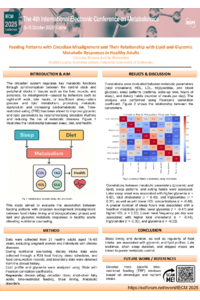
The circadian system regulates key metabolic functions through synchronization between the central clock and peripheral clocks in tissues such as the liver, muscle, and pancreas. Its misalignment—caused by behaviors such as night-shift work, late meals, or insufficient sleep—alters glucose and lipid metabolism, promoting metabolic dysfunction and increasing cardiometabolic risk. Time-restricted eating (TRE) has been shown to improve glycemic and lipid parameters by resynchronizing circadian rhythms and reducing the risk of metabolic diseases.
Objective
This study aimed to evaluate the association between feeding patterns with circadian misalignment (disalignment between food intake timing and biological/sleep phase) and lipid and glycemic metabolic responses in healthy adults attending nutritional counseling.
Methods
Data were collected from 21 healthy adults aged 18–65 years, excluding pregnant women and individuals with chronic diseases. Lipid profile and glycemia were analyzed using Stata with Pearson correlation coefficients.
Results
Correlations between metabolic parameters (glycemic and lipid), sleep patterns, and eating habits were assessed. Later sleep onset was associated with higher glycemia (r = 0.63), total cholesterol (r = 0.43), and triglycerides (r = 0.31), as well as with lower HDL concentrations (r = -0.48). A greater number of sleep hours was associated with a healthier metabolic profile: lower glycemia (r = -0.47) and higher HDL (r = 0.33). Lower meal frequency per day was associated with higher total cholesterol (r = -0.44), triglycerides (r = -0.33), and glycemia (r = -0.32).
Conclusions
Sleep timing and duration, as well as regularity of food intake, are associated with glycemic and lipid profiles. Late bedtimes, short sleep duration, and skipped meals are linked to poorer metabolic control.
Keywords
chronic jetlag
circadian clock
short-chain fatty acids
time-restricted feeding
Meal timing
Metabolic disorders
Poster
Feedings patterns metabolomics.pdf
ClearAIF: An R-Based Computational Pipeline for DIA Metabolomic Data Processing and Reporting
Aromatic Microbial Metabolites and Biomarkers in Cerebrospinal Fluid for the Diagnosis of Secondary Bacterial Meningitis