Event submissions
Published
This submission belongs to the session S2. Technological Advances in Metabolomics of the event The 4th International Electronic Conference on Metabolomics
Published date
10 Oct, 2025
Academic Editor
'%3e%3cpath%20d='M12.6657%2010.9104C12.4185%2010.325%2012.0599%209.79327%2011.6097%209.34482C11.1609%208.89508%2010.6293%208.5365%2010.0442%208.28888C10.0389%208.28626%2010.0337%208.28495%2010.0285%208.28233C10.8446%207.69279%2011.3752%206.73249%2011.3752%205.64904C11.3752%203.8542%209.92103%202.39999%208.1262%202.39999C6.33136%202.39999%204.87715%203.8542%204.87715%205.64904C4.87715%206.73249%205.40774%207.69279%206.22393%208.28364C6.21869%208.28626%206.21345%208.28757%206.20821%208.29019C5.62129%208.5378%205.09463%208.89284%204.64265%209.34613C4.1929%209.79493%203.83432%2010.3266%203.58671%2010.9117C3.34345%2011.4845%203.21226%2012.0987%203.20023%2012.7209C3.19988%2012.7349%203.20233%2012.7488%203.20744%2012.7619C3.21255%2012.7749%203.22022%2012.7867%203.22998%2012.7968C3.23975%2012.8068%203.25142%2012.8147%203.26431%2012.8202C3.2772%2012.8256%203.29105%2012.8284%203.30504%2012.8284H4.09109C4.14874%2012.8284%204.19459%2012.7825%204.1959%2012.7262C4.2221%2011.7148%204.62823%2010.7676%205.34617%2010.0497C6.08899%209.30683%207.0755%208.89808%208.1262%208.89808C9.17689%208.89808%2010.1634%209.30683%2010.9062%2010.0497C11.6242%2010.7676%2012.0303%2011.7148%2012.0565%2012.7262C12.0578%2012.7838%2012.1037%2012.8284%2012.1613%2012.8284H12.9474C12.9613%2012.8284%2012.9752%2012.8256%2012.9881%2012.8202C13.001%2012.8147%2013.0126%2012.8068%2013.0224%2012.7968C13.0322%2012.7867%2013.0398%2012.7749%2013.0449%2012.7619C13.0501%2012.7488%2013.0525%2012.7349%2013.0522%2012.7209C13.0391%2012.0947%2012.9094%2011.4855%2012.6657%2010.9104ZM8.1262%207.9024C7.52486%207.9024%206.9589%207.6679%206.53312%207.24211C6.10733%206.81633%205.87283%206.25037%205.87283%205.64904C5.87283%205.0477%206.10733%204.48174%206.53312%204.05596C6.9589%203.63018%207.52486%203.39567%208.1262%203.39567C8.72753%203.39567%209.29349%203.63018%209.71927%204.05596C10.1451%204.48174%2010.3796%205.0477%2010.3796%205.64904C10.3796%206.25037%2010.1451%206.81633%209.71927%207.24211C9.29349%207.6679%208.72753%207.9024%208.1262%207.9024Z'%20fill='%235D1EE1'/%3e%3c/g%3e%3c/svg%3e) Madhu Basetti
Madhu BasettiCitation
Luis Ramalhete, Rúben Araújo, Miguel Bigote Vierira, Emanuel Vigia, Ana Pena, Sofia Carrelha, Anibal Ferreira, Cecilia RC Calado, FTIR Spectroscopy of Allograft Perfusate Separates DCD and DBD Donors: Early Results, in Proceedings of The 4th International Electronic Conference on Metabolomics, 13 October–15 October 2025, MDPI: Basel, Switzerland
Share
Email
Facebook
Twitter
LinkedIn
FTIR Spectroscopy of Allograft Perfusate Separates DCD and DBD Donors: Early Results
'%3e%3cpath%20d='M12.6647%2010.9104C12.4176%2010.325%2012.0589%209.7933%2011.6088%209.34485C11.16%208.89511%2010.6283%208.53653%2010.0432%208.28891C10.038%208.28629%2010.0327%208.28498%2010.0275%208.28236C10.8437%207.69282%2011.3743%206.73252%2011.3743%205.64907C11.3743%203.85423%209.92005%202.40002%208.12522%202.40002C6.33038%202.40002%204.87618%203.85423%204.87618%205.64907C4.87618%206.73252%205.40677%207.69282%206.22296%208.28367C6.21772%208.28629%206.21248%208.2876%206.20724%208.29022C5.62031%208.53783%205.09365%208.89287%204.64167%209.34616C4.19192%209.79496%203.83334%2010.3266%203.58573%2010.9117C3.34247%2011.4846%203.21128%2012.0987%203.19925%2012.721C3.1989%2012.735%203.20135%2012.7489%203.20646%2012.7619C3.21157%2012.7749%203.21924%2012.7868%203.22901%2012.7968C3.23877%2012.8068%203.25045%2012.8148%203.26334%2012.8202C3.27623%2012.8256%203.29007%2012.8284%203.30406%2012.8284H4.09012C4.14776%2012.8284%204.19362%2012.7825%204.19493%2012.7262C4.22113%2011.7148%204.62726%2010.7676%205.34519%2010.0497C6.08802%209.30686%207.07452%208.89811%208.12522%208.89811C9.17592%208.89811%2010.1624%209.30686%2010.9052%2010.0497C11.6232%2010.7676%2012.0293%2011.7148%2012.0555%2012.7262C12.0568%2012.7839%2012.1027%2012.8284%2012.1603%2012.8284H12.9464C12.9604%2012.8284%2012.9742%2012.8256%2012.9871%2012.8202C13%2012.8148%2013.0117%2012.8068%2013.0214%2012.7968C13.0312%2012.7868%2013.0389%2012.7749%2013.044%2012.7619C13.0491%2012.7489%2013.0515%2012.735%2013.0512%2012.721C13.0381%2012.0947%2012.9084%2011.4856%2012.6647%2010.9104ZM8.12522%207.90243C7.52388%207.90243%206.95792%207.66793%206.53214%207.24215C6.10636%206.81636%205.87185%206.2504%205.87185%205.64907C5.87185%205.04773%206.10636%204.48177%206.53214%204.05599C6.95792%203.63021%207.52388%203.3957%208.12522%203.3957C8.72655%203.3957%209.29252%203.63021%209.7183%204.05599C10.1441%204.48177%2010.3786%205.04773%2010.3786%205.64907C10.3786%206.2504%2010.1441%206.81636%209.7183%207.24215C9.29252%207.66793%208.72655%207.90243%208.12522%207.90243Z'%20fill='%235D1EE1'/%3e%3c/g%3e%3c/svg%3e)
Luis Ramalhete 1,2,3

Rúben Araújo 4

Miguel Bigote Vierira 5,6,7

Emanuel Vigia 3,4,8
Ana Pena 9
Sofia Carrelha 9
Anibal Ferreira 5,6,7

Cecilia RC Calado 10,11
1. Blood and Transplantation Center of Lisbon, Instituto Português do Sangue e da Transplantação, Alamedadas Linhas de Torres, n◦ 117, 1769-001 Lisbon, Portugal
2. NOVA Medical School, Faculdade de Ciências Médicas, Universidade NOVA de Lisboa, 1169-056 Lisbon, Portuga
3. iNOVA4Health—Advancing Precision Medicine, Núcleo de Investigação em Doenças Renais, NOVA Medical School, Faculdade de Ciências Médicas, Universidade NOVA de Lisboa, 1169-056 Lisbon, Portugal
4. NOVA Medical School, Faculdade de Ciências Médicas, Universidade NOVA de Lisboa, 1169-056 Lisbon, Portugal
5. NOVA Medical School, Faculdade de Ciências Médicas, Universidade NOVA de Lisboa
6. iNOVA4Health—Advancing Precision Medicine, Núcleo de Investigação em Doenças Renais, NOVA Medical School, Faculdade de Ciências Médicas, Universidade NOVA de Lisboa
7. Nephrology, Hospital Curry Cabral, Unidade Local de Saúde de São José
8. Hepato-Biliary-Pancreatic and Transplantation Centre, Curry Cabral Hospital - Local Health Unit of S. José - Lisbon, Portugal
9. Hepatobiliopancreatic and Transplantation Center, Curry Cabral Hospital, Unidade Local de Saúde de São José
10. ISEL—Instituto Superior de Engenharia de Lisboa, Instituto Politécnico de Lisboa
11. Institute for Bioengineering and Biosciences (iBB), The Associate Laboratory Institute for Health and Bioe-conomy-i4HB, Instituto Superior Técnico (IST), Universidade de Lisboa (UL)
Abstract
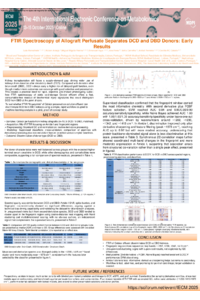
Background: Rapid, objective phenotyping of donor organs is an unmet need in kidney transplantation, particularly when comparing donation after circulatory death (DCD) with donation after brain death (DBD). We tested whether Fourier-transform infrared (FTIR) spectra of the static cold-storage preservation solution collected from kidney allografts capture discriminative biochemical signatures of donor type.
Methods: Perfusates from Celsior-preserved kidney allografts (n=10; 5 DCD/ 5 DBD) were analyzed in the Fourier transform infrared (FTIR) spectroscopy mid-infrared (Amide I and fingerprint regions). After standard quality control and normalization, spectra underwent routine derivative processing. Supervised classifiers were trained and assessed with cross-validation to evaluate discrimination between donor types.
Results: FTIR spectroscopy of perfusate revealed donor-type signatures. Pipelines combining derivatives with non-redundant feature selection consistently improved discrimination. The fingerprint region outperformed Amide I. In cross-validation, models achieved high performance, with area under the curve up to 0.84–1.00 and accuracies up to 1.00 within this pilot; the best pipeline reached perfect in-cohort discrimination.
Conclusions: Perfusate FTIR spectroscopy provides a rapid, economic label-free readout that could complement pump parameters and metabolomics during organ perfusion. Given the small, matched pilot and heterogeneous spectral quality, larger, standardized, multi-site studies with rigorous internal validation and assessment of instrument/site transferability are required before clinical deployment.
Keywords
FTIR spectroscopy
kidney transplantation
perfusate
donation after circulatory death (DCD)
donation after brain death (DBD)
donor phenotyping
spectral fingerprinting
machine learning
label-free diagnostics
organ preservation
Poster
Ramalhete.pdf
Aromatic Microbial Metabolites and Biomarkers in Cerebrospinal Fluid for the Diagnosis of Secondary Bacterial Meningitis
Breed-Dependent Metabolic Signatures in Bovine Milk Under Thermal Stress: Insights from Sahiwal, Tharparkar, and Karan Fries Cattle