Event submissions
Published
This submission belongs to the session S3. Materials in Separation Science of the event The 1st International Online Conference on Separations
Published date
13 Oct, 2025
Academic Editor
'%3e%3cpath%20d='M12.6657%2010.9104C12.4185%2010.325%2012.0599%209.79327%2011.6097%209.34482C11.1609%208.89508%2010.6293%208.5365%2010.0442%208.28888C10.0389%208.28626%2010.0337%208.28495%2010.0285%208.28233C10.8446%207.69279%2011.3752%206.73249%2011.3752%205.64904C11.3752%203.8542%209.92103%202.39999%208.1262%202.39999C6.33136%202.39999%204.87715%203.8542%204.87715%205.64904C4.87715%206.73249%205.40774%207.69279%206.22393%208.28364C6.21869%208.28626%206.21345%208.28757%206.20821%208.29019C5.62129%208.5378%205.09463%208.89284%204.64265%209.34613C4.1929%209.79493%203.83432%2010.3266%203.58671%2010.9117C3.34345%2011.4845%203.21226%2012.0987%203.20023%2012.7209C3.19988%2012.7349%203.20233%2012.7488%203.20744%2012.7619C3.21255%2012.7749%203.22022%2012.7867%203.22998%2012.7968C3.23975%2012.8068%203.25142%2012.8147%203.26431%2012.8202C3.2772%2012.8256%203.29105%2012.8284%203.30504%2012.8284H4.09109C4.14874%2012.8284%204.19459%2012.7825%204.1959%2012.7262C4.2221%2011.7148%204.62823%2010.7676%205.34617%2010.0497C6.08899%209.30683%207.0755%208.89808%208.1262%208.89808C9.17689%208.89808%2010.1634%209.30683%2010.9062%2010.0497C11.6242%2010.7676%2012.0303%2011.7148%2012.0565%2012.7262C12.0578%2012.7838%2012.1037%2012.8284%2012.1613%2012.8284H12.9474C12.9613%2012.8284%2012.9752%2012.8256%2012.9881%2012.8202C13.001%2012.8147%2013.0126%2012.8068%2013.0224%2012.7968C13.0322%2012.7867%2013.0398%2012.7749%2013.0449%2012.7619C13.0501%2012.7488%2013.0525%2012.7349%2013.0522%2012.7209C13.0391%2012.0947%2012.9094%2011.4855%2012.6657%2010.9104ZM8.1262%207.9024C7.52486%207.9024%206.9589%207.6679%206.53312%207.24211C6.10733%206.81633%205.87283%206.25037%205.87283%205.64904C5.87283%205.0477%206.10733%204.48174%206.53312%204.05596C6.9589%203.63018%207.52486%203.39567%208.1262%203.39567C8.72753%203.39567%209.29349%203.63018%209.71927%204.05596C10.1451%204.48174%2010.3796%205.0477%2010.3796%205.64904C10.3796%206.25037%2010.1451%206.81633%209.71927%207.24211C9.29349%207.6679%208.72753%207.9024%208.1262%207.9024Z'%20fill='%235D1EE1'/%3e%3c/g%3e%3c/svg%3e) Wim De Malsche
Wim De MalscheCitation
Ronaldo Antunes Funari Junior, Lucas Biondo, Lucas Antônio Fantinel, Cesar Aguzzoli, Marcelo Godinho, Guilherme Luiz Dotto, Enhanced Paracetamol Adsorption Using Titanium-Coated Biochar Prepared via Magnetron Sputtering, in Proceedings of The 1st International Online Conference on Separations, 15 October–17 October 2025, MDPI: Basel, Switzerland
Share
Email
Facebook
Twitter
LinkedIn
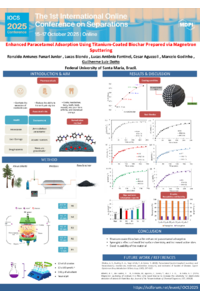
Enhanced Paracetamol Adsorption Using Titanium-Coated Biochar Prepared via Magnetron Sputtering
'%3e%3cpath%20d='M12.6647%2010.9104C12.4176%2010.325%2012.0589%209.7933%2011.6088%209.34485C11.16%208.89511%2010.6283%208.53653%2010.0432%208.28891C10.038%208.28629%2010.0327%208.28498%2010.0275%208.28236C10.8437%207.69282%2011.3743%206.73252%2011.3743%205.64907C11.3743%203.85423%209.92005%202.40002%208.12522%202.40002C6.33038%202.40002%204.87618%203.85423%204.87618%205.64907C4.87618%206.73252%205.40677%207.69282%206.22296%208.28367C6.21772%208.28629%206.21248%208.2876%206.20724%208.29022C5.62031%208.53783%205.09365%208.89287%204.64167%209.34616C4.19192%209.79496%203.83334%2010.3266%203.58573%2010.9117C3.34247%2011.4846%203.21128%2012.0987%203.19925%2012.721C3.1989%2012.735%203.20135%2012.7489%203.20646%2012.7619C3.21157%2012.7749%203.21924%2012.7868%203.22901%2012.7968C3.23877%2012.8068%203.25045%2012.8148%203.26334%2012.8202C3.27623%2012.8256%203.29007%2012.8284%203.30406%2012.8284H4.09012C4.14776%2012.8284%204.19362%2012.7825%204.19493%2012.7262C4.22113%2011.7148%204.62726%2010.7676%205.34519%2010.0497C6.08802%209.30686%207.07452%208.89811%208.12522%208.89811C9.17592%208.89811%2010.1624%209.30686%2010.9052%2010.0497C11.6232%2010.7676%2012.0293%2011.7148%2012.0555%2012.7262C12.0568%2012.7839%2012.1027%2012.8284%2012.1603%2012.8284H12.9464C12.9604%2012.8284%2012.9742%2012.8256%2012.9871%2012.8202C13%2012.8148%2013.0117%2012.8068%2013.0214%2012.7968C13.0312%2012.7868%2013.0389%2012.7749%2013.044%2012.7619C13.0491%2012.7489%2013.0515%2012.735%2013.0512%2012.721C13.0381%2012.0947%2012.9084%2011.4856%2012.6647%2010.9104ZM8.12522%207.90243C7.52388%207.90243%206.95792%207.66793%206.53214%207.24215C6.10636%206.81636%205.87185%206.2504%205.87185%205.64907C5.87185%205.04773%206.10636%204.48177%206.53214%204.05599C6.95792%203.63021%207.52388%203.3957%208.12522%203.3957C8.72655%203.3957%209.29252%203.63021%209.7183%204.05599C10.1441%204.48177%2010.3786%205.04773%2010.3786%205.64907C10.3786%206.2504%2010.1441%206.81636%209.7183%207.24215C9.29252%207.66793%208.72655%207.90243%208.12522%207.90243Z'%20fill='%235D1EE1'/%3e%3c/g%3e%3c/svg%3e)
Ronaldo Antunes Funari Junior 1
Lucas Biondo 2
Lucas Antônio Fantinel 2
Cesar Aguzzoli 3
Marcelo Godinho 2
Guilherme Luiz Dotto 1
1. Research Group on Adsorptive and Catalytic Process Engineering (ENGEPAC), Federal University of Santa Maria, Av. Roraima, 1000-7, 97105–900, Santa Maria, RS, Brazil
2. Postgraduate Program in Engineering Processes and Technologies, University of Caxias do Sul (UCS), Caxias do Sul, Rio Grande do Sul, Brazil
3. Postgraduate Program in Materials Science and Engineering, University of Caxias do Sul (UCS), 95070560 Caxias do Sul, Rio Grande do Sul, Brazil
Abstract
This study investigated the application of titanium thin films deposited onto biochar derived from Pinus elliottii to improve the adsorption of paracetamol, a pharmaceutical contaminant. Paracetamol is extensively used as an analgesic and antipyretic, but its degradation in aquatic environments can lead to the formation of harmful and potentially carcinogenic byproducts. Among the available remediation strategies, adsorption stands out as a reliable and efficient method for removing such compounds from water. Initially, biochar was produced from Pinus elliottii biomass, followed by surface modification through titanium film deposition via magnetron sputtering. The sputtering parameters were varied to obtain different coating intensities: 100 W for 10 minutes (R1); 150 W for 20, 30, and 40 minutes (R2, R3, R4); and 200 W for 30 minutes (R5). The materials were characterized to assess the structural and surface changes induced by Ti deposition. Equilibrium adsorption experiments indicated that the Sips isotherm model best described the data, with the adsorption capacities increasing alongside the amount of titanium coating. Specifically, the adsorption capacities (µmol g⁻¹) were 6.98 for the unmodified biochar and 14.0, 11.3, 11.9, 13.8, and 21.4 for R1 through R5, respectively, representing a threefold increase for R5 relative to that of Raw. The thermodynamic analysis revealed a spontaneous adsorption process, with the Gibbs free energy () values ranging from −3.50 to −6.0 kJ mol⁻¹. Kinetic modeling showed that the pseudo-first-order model provided the best fit for Raw and R5, whereas the pseudo-second-order model was more suitable for the R1–R4 biochars. All materials reached equilibrium within 200 minutes. Furthermore, desorption studies demonstrated the good reusability of the material, with an approximately 90% desorption efficiency maintained over five consecutive cycles. These findings confirm that titanium-coated biochars offer enhanced paracetamol adsorption, likely due to the synergistic effects of the modified surface chemistry and increased active sites introduced by the Ti thin films.
Keywords
adsorption
thin films
Gibbs free energy
Poster
sciforum_138638_S3_slides_IOCS_Paracetamol.pdf
Improving the Performance of Functionalized Activated Carbon for Anionic Contaminant Removal
Preparation and Characterization of a New Chitosan–Iron–Cobalt Composite for Tetracycline Sorption