Event submissions
Published
This submission belongs to the session S3. Materials in Separation Science of the event The 1st International Online Conference on Separations
Published date
13 Oct, 2025
Academic Editor
'%3e%3cpath%20d='M12.6657%2010.9104C12.4185%2010.325%2012.0599%209.79327%2011.6097%209.34482C11.1609%208.89508%2010.6293%208.5365%2010.0442%208.28888C10.0389%208.28626%2010.0337%208.28495%2010.0285%208.28233C10.8446%207.69279%2011.3752%206.73249%2011.3752%205.64904C11.3752%203.8542%209.92103%202.39999%208.1262%202.39999C6.33136%202.39999%204.87715%203.8542%204.87715%205.64904C4.87715%206.73249%205.40774%207.69279%206.22393%208.28364C6.21869%208.28626%206.21345%208.28757%206.20821%208.29019C5.62129%208.5378%205.09463%208.89284%204.64265%209.34613C4.1929%209.79493%203.83432%2010.3266%203.58671%2010.9117C3.34345%2011.4845%203.21226%2012.0987%203.20023%2012.7209C3.19988%2012.7349%203.20233%2012.7488%203.20744%2012.7619C3.21255%2012.7749%203.22022%2012.7867%203.22998%2012.7968C3.23975%2012.8068%203.25142%2012.8147%203.26431%2012.8202C3.2772%2012.8256%203.29105%2012.8284%203.30504%2012.8284H4.09109C4.14874%2012.8284%204.19459%2012.7825%204.1959%2012.7262C4.2221%2011.7148%204.62823%2010.7676%205.34617%2010.0497C6.08899%209.30683%207.0755%208.89808%208.1262%208.89808C9.17689%208.89808%2010.1634%209.30683%2010.9062%2010.0497C11.6242%2010.7676%2012.0303%2011.7148%2012.0565%2012.7262C12.0578%2012.7838%2012.1037%2012.8284%2012.1613%2012.8284H12.9474C12.9613%2012.8284%2012.9752%2012.8256%2012.9881%2012.8202C13.001%2012.8147%2013.0126%2012.8068%2013.0224%2012.7968C13.0322%2012.7867%2013.0398%2012.7749%2013.0449%2012.7619C13.0501%2012.7488%2013.0525%2012.7349%2013.0522%2012.7209C13.0391%2012.0947%2012.9094%2011.4855%2012.6657%2010.9104ZM8.1262%207.9024C7.52486%207.9024%206.9589%207.6679%206.53312%207.24211C6.10733%206.81633%205.87283%206.25037%205.87283%205.64904C5.87283%205.0477%206.10733%204.48174%206.53312%204.05596C6.9589%203.63018%207.52486%203.39567%208.1262%203.39567C8.72753%203.39567%209.29349%203.63018%209.71927%204.05596C10.1451%204.48174%2010.3796%205.0477%2010.3796%205.64904C10.3796%206.25037%2010.1451%206.81633%209.71927%207.24211C9.29349%207.6679%208.72753%207.9024%208.1262%207.9024Z'%20fill='%235D1EE1'/%3e%3c/g%3e%3c/svg%3e) Wim De Malsche
Wim De MalscheCitation
Lacrimioara Senila, Development of PLA-Based Membrane Materials from Lignocellulosic Biomass for Efficient Separation Processes, in Proceedings of The 1st International Online Conference on Separations, 15 October–17 October 2025, MDPI: Basel, Switzerland
Share
Email
Facebook
Twitter
LinkedIn
Development of PLA-Based Membrane Materials from Lignocellulosic Biomass for Efficient Separation Processes
'%3e%3cpath%20d='M12.6647%2010.9104C12.4176%2010.325%2012.0589%209.7933%2011.6088%209.34485C11.16%208.89511%2010.6283%208.53653%2010.0432%208.28891C10.038%208.28629%2010.0327%208.28498%2010.0275%208.28236C10.8437%207.69282%2011.3743%206.73252%2011.3743%205.64907C11.3743%203.85423%209.92005%202.40002%208.12522%202.40002C6.33038%202.40002%204.87618%203.85423%204.87618%205.64907C4.87618%206.73252%205.40677%207.69282%206.22296%208.28367C6.21772%208.28629%206.21248%208.2876%206.20724%208.29022C5.62031%208.53783%205.09365%208.89287%204.64167%209.34616C4.19192%209.79496%203.83334%2010.3266%203.58573%2010.9117C3.34247%2011.4846%203.21128%2012.0987%203.19925%2012.721C3.1989%2012.735%203.20135%2012.7489%203.20646%2012.7619C3.21157%2012.7749%203.21924%2012.7868%203.22901%2012.7968C3.23877%2012.8068%203.25045%2012.8148%203.26334%2012.8202C3.27623%2012.8256%203.29007%2012.8284%203.30406%2012.8284H4.09012C4.14776%2012.8284%204.19362%2012.7825%204.19493%2012.7262C4.22113%2011.7148%204.62726%2010.7676%205.34519%2010.0497C6.08802%209.30686%207.07452%208.89811%208.12522%208.89811C9.17592%208.89811%2010.1624%209.30686%2010.9052%2010.0497C11.6232%2010.7676%2012.0293%2011.7148%2012.0555%2012.7262C12.0568%2012.7839%2012.1027%2012.8284%2012.1603%2012.8284H12.9464C12.9604%2012.8284%2012.9742%2012.8256%2012.9871%2012.8202C13%2012.8148%2013.0117%2012.8068%2013.0214%2012.7968C13.0312%2012.7868%2013.0389%2012.7749%2013.044%2012.7619C13.0491%2012.7489%2013.0515%2012.735%2013.0512%2012.721C13.0381%2012.0947%2012.9084%2011.4856%2012.6647%2010.9104ZM8.12522%207.90243C7.52388%207.90243%206.95792%207.66793%206.53214%207.24215C6.10636%206.81636%205.87185%206.2504%205.87185%205.64907C5.87185%205.04773%206.10636%204.48177%206.53214%204.05599C6.95792%203.63021%207.52388%203.3957%208.12522%203.3957C8.72655%203.3957%209.29252%203.63021%209.7183%204.05599C10.1441%204.48177%2010.3786%205.04773%2010.3786%205.64907C10.3786%206.2504%2010.1441%206.81636%209.7183%207.24215C9.29252%207.66793%208.72655%207.90243%208.12522%207.90243Z'%20fill='%235D1EE1'/%3e%3c/g%3e%3c/svg%3e)
Lacrimioara Senila 1
1. National Institute for Research and Development of Optoelectronics INOE 2000, Research Institute for Analytical Instrumentation, Donath 67, 400293 Cluj-Napoca, Romania
Abstract
In recent years, membranes have been extensively used, particularly in wastewater treatment and food packaging. As a result, significant research efforts are focused on identifying eco-friendly alternatives to the materials traditionally employed in membrane fabrication. One promising material is polylactic acid (PLA), a renewable and biodegradable polymer derived from lignocellulosic agricultural waste. In this study, PLA was synthesized from lignocellulosic biomass via a comprehensive multi-step process comprising autohydrolysis, delignification, and simultaneous saccharification and fermentation (SSF) of cellulose derived from lignocellulosic waste, lactic acid recovery, and subsequent polycondensation of lactic acid. The production of bioplastics from lignocellulosic feedstocks involves the extraction of key polysaccharide components, namely cellulose and hemicellulose. These are then subjected to pretreatment and hydrolysis processes. The polymerization of L-lactic acid obtained above was conducted in two stages: dehydration, followed by microwave-assisted polycondensation in the presence of SnCl₂ as a catalyst. This sustainable approach utilizes renewable biomass as a raw material for the production of biodegradable polymers, presenting a viable alternative to conventional petroleum-based plastics. The synthesized PLA was subsequently used to fabricate polymeric membranes aiming to separate heavy metals from wastewater. These membranes can be used to separate the metals Cd, Cu, Zn, Mn, Ni, and Pb from wastewater, with separation efficiencies ranging from 5% to 17%. The highest separation efficiencies are achieved for Co and Ni (83% and 84%, respectively) when using a filter such as cellulose nanowhiskers. Membranes derived from PLA have shown promising potential in environmental remediation applications. PLA-based membranes can effectively remove contaminants such as heavy metals, dyes, and organic pollutants from wastewater. Due to their biodegradability and eco-friendly nature, these membranes contribute to sustainable water treatment processes by reducing secondary pollution and minimizing environmental impact. Overall, this work demonstrates a sustainable and environmentally friendly strategy for converting biomass into high-value materials for water purification applications.
Keywords
PLA
lignocellulosic biomass
membranes
separation
Poster
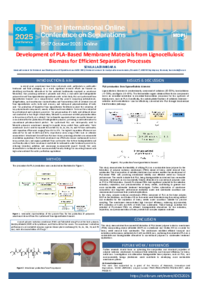
Senila poster.pdf
Detection of Walnut and Pumpkin Oil Adulteration Using Tocopherol Profiling and Predictive Modeling
Determination of pesticide residues in foods for infant and follow-on infant formula by LC-MS/MS and GC-MS/MS methods