Event submissions
Published
This submission belongs to the session S1. Analysis of Natural Products and Pharmaceuticals of the event The 1st International Online Conference on Separations
Published date
13 Oct, 2025
Academic Editor
'%3e%3cpath%20d='M12.6657%2010.9104C12.4185%2010.325%2012.0599%209.79327%2011.6097%209.34482C11.1609%208.89508%2010.6293%208.5365%2010.0442%208.28888C10.0389%208.28626%2010.0337%208.28495%2010.0285%208.28233C10.8446%207.69279%2011.3752%206.73249%2011.3752%205.64904C11.3752%203.8542%209.92103%202.39999%208.1262%202.39999C6.33136%202.39999%204.87715%203.8542%204.87715%205.64904C4.87715%206.73249%205.40774%207.69279%206.22393%208.28364C6.21869%208.28626%206.21345%208.28757%206.20821%208.29019C5.62129%208.5378%205.09463%208.89284%204.64265%209.34613C4.1929%209.79493%203.83432%2010.3266%203.58671%2010.9117C3.34345%2011.4845%203.21226%2012.0987%203.20023%2012.7209C3.19988%2012.7349%203.20233%2012.7488%203.20744%2012.7619C3.21255%2012.7749%203.22022%2012.7867%203.22998%2012.7968C3.23975%2012.8068%203.25142%2012.8147%203.26431%2012.8202C3.2772%2012.8256%203.29105%2012.8284%203.30504%2012.8284H4.09109C4.14874%2012.8284%204.19459%2012.7825%204.1959%2012.7262C4.2221%2011.7148%204.62823%2010.7676%205.34617%2010.0497C6.08899%209.30683%207.0755%208.89808%208.1262%208.89808C9.17689%208.89808%2010.1634%209.30683%2010.9062%2010.0497C11.6242%2010.7676%2012.0303%2011.7148%2012.0565%2012.7262C12.0578%2012.7838%2012.1037%2012.8284%2012.1613%2012.8284H12.9474C12.9613%2012.8284%2012.9752%2012.8256%2012.9881%2012.8202C13.001%2012.8147%2013.0126%2012.8068%2013.0224%2012.7968C13.0322%2012.7867%2013.0398%2012.7749%2013.0449%2012.7619C13.0501%2012.7488%2013.0525%2012.7349%2013.0522%2012.7209C13.0391%2012.0947%2012.9094%2011.4855%2012.6657%2010.9104ZM8.1262%207.9024C7.52486%207.9024%206.9589%207.6679%206.53312%207.24211C6.10733%206.81633%205.87283%206.25037%205.87283%205.64904C5.87283%205.0477%206.10733%204.48174%206.53312%204.05596C6.9589%203.63018%207.52486%203.39567%208.1262%203.39567C8.72753%203.39567%209.29349%203.63018%209.71927%204.05596C10.1451%204.48174%2010.3796%205.0477%2010.3796%205.64904C10.3796%206.25037%2010.1451%206.81633%209.71927%207.24211C9.29349%207.6679%208.72753%207.9024%208.1262%207.9024Z'%20fill='%235D1EE1'/%3e%3c/g%3e%3c/svg%3e) Marcello Locatelli
Marcello LocatelliCitation
Maria Celeiro, Alba Pedrouso, Matrix solid-phase dispersion-high-performance liquid chromatography with diode array detection as a sustainable alternative for carotenoids analysis in green and brown macroalgae, in Proceedings of The 1st International Online Conference on Separations, 15 October–17 October 2025, MDPI: Basel, Switzerland
Share
Email
Facebook
Twitter
LinkedIn
Matrix solid-phase dispersion-high-performance liquid chromatography with diode array detection as a sustainable alternative for carotenoids analysis in green and brown macroalgae

Maria Celeiro 1
'%3e%3cpath%20d='M12.6647%2010.9104C12.4176%2010.325%2012.0589%209.7933%2011.6088%209.34485C11.16%208.89511%2010.6283%208.53653%2010.0432%208.28891C10.038%208.28629%2010.0327%208.28498%2010.0275%208.28236C10.8437%207.69282%2011.3743%206.73252%2011.3743%205.64907C11.3743%203.85423%209.92005%202.40002%208.12522%202.40002C6.33038%202.40002%204.87618%203.85423%204.87618%205.64907C4.87618%206.73252%205.40677%207.69282%206.22296%208.28367C6.21772%208.28629%206.21248%208.2876%206.20724%208.29022C5.62031%208.53783%205.09365%208.89287%204.64167%209.34616C4.19192%209.79496%203.83334%2010.3266%203.58573%2010.9117C3.34247%2011.4846%203.21128%2012.0987%203.19925%2012.721C3.1989%2012.735%203.20135%2012.7489%203.20646%2012.7619C3.21157%2012.7749%203.21924%2012.7868%203.22901%2012.7968C3.23877%2012.8068%203.25045%2012.8148%203.26334%2012.8202C3.27623%2012.8256%203.29007%2012.8284%203.30406%2012.8284H4.09012C4.14776%2012.8284%204.19362%2012.7825%204.19493%2012.7262C4.22113%2011.7148%204.62726%2010.7676%205.34519%2010.0497C6.08802%209.30686%207.07452%208.89811%208.12522%208.89811C9.17592%208.89811%2010.1624%209.30686%2010.9052%2010.0497C11.6232%2010.7676%2012.0293%2011.7148%2012.0555%2012.7262C12.0568%2012.7839%2012.1027%2012.8284%2012.1603%2012.8284H12.9464C12.9604%2012.8284%2012.9742%2012.8256%2012.9871%2012.8202C13%2012.8148%2013.0117%2012.8068%2013.0214%2012.7968C13.0312%2012.7868%2013.0389%2012.7749%2013.044%2012.7619C13.0491%2012.7489%2013.0515%2012.735%2013.0512%2012.721C13.0381%2012.0947%2012.9084%2011.4856%2012.6647%2010.9104ZM8.12522%207.90243C7.52388%207.90243%206.95792%207.66793%206.53214%207.24215C6.10636%206.81636%205.87185%206.2504%205.87185%205.64907C5.87185%205.04773%206.10636%204.48177%206.53214%204.05599C6.95792%203.63021%207.52388%203.3957%208.12522%203.3957C8.72655%203.3957%209.29252%203.63021%209.7183%204.05599C10.1441%204.48177%2010.3786%205.04773%2010.3786%205.64907C10.3786%206.2504%2010.1441%206.81636%209.7183%207.24215C9.29252%207.66793%208.72655%207.90243%208.12522%207.90243Z'%20fill='%235D1EE1'/%3e%3c/g%3e%3c/svg%3e)
Alba Pedrouso 2
1. CRETUS, Department of Analytical Chemistry, Nutrition and Food Science, University of Santiago de Compostela, Santiago de Compostela, 15782, Spain
2. CRETUS, Department of Chemical Engineering, University of Santiago de Compostela, Santiago de Compostela, 15782, Spain
Abstract
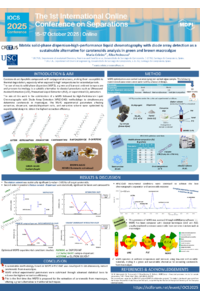
In recent years, marine macroalgae, i.e., seaweeds, have moved from being considered as a waste or residue to an added-value raw material rich in bioactive compounds, including carotenoids.
Due to carotenoids' physicochemical properties, extracting them from complex matrices is a challenge. Thus, sample preparation techniques must be effective in breaking down the cell matrix without analyte degradation. Conventional techniques to extract carotenoids and other bioactive compounds from macroalgae include Ultrasound-Assisted Extraction (UAE), Pressurized Liquid Extraction (PLE), or supercritical CO2 extraction.
However, carotenoids are lipophilic compounds with conjugated structures, making them susceptible to thermal degradation, especially when exposed to high temperatures for extended periods. In this way, the use of matrix solid-phase dispersion (MSPD) is a suitable alternative to these classical procedures, as extraction is performed at ambient temperature and pressure. The MSPD experimental parameters affecting extraction, dispersant, sample/dispersant ratio, and extraction solvent were optimized by experimental design to obtain the highest extraction efficiency. A High-Performance Liquid Chromatography with Diode Array Detection (HPLC-DAD) methodology using a C30 column was developed to successfully separate and identify seven carotenoids.
Finally, the MSPD-HPLC-DAD methodology was validated for green, Codium spp., and brown, Kombu spp. macroalgae from the coast of Galicia (northwest Spain), showing its suitability.
Keywords
carotenoids
macroalgae
MSPD
HPLC-DAD
green chemistry
Poster
Celeiro et al.pdf
Optimization of a Fast-Analytical Method for the Determination of Selected Agricultural Pesticides Using Supercritical Fluid Chromatography
Selective Separation of Quercetin from Grape Pomace Based on Experimental Solubility in Organic Monosolvents