Event submissions
Published
This submission belongs to the session S5. Separation Engineering of the event The 1st International Online Conference on Separations
Published date
13 Oct, 2025
Academic Editor
'%3e%3cpath%20d='M12.6657%2010.9104C12.4185%2010.325%2012.0599%209.79327%2011.6097%209.34482C11.1609%208.89508%2010.6293%208.5365%2010.0442%208.28888C10.0389%208.28626%2010.0337%208.28495%2010.0285%208.28233C10.8446%207.69279%2011.3752%206.73249%2011.3752%205.64904C11.3752%203.8542%209.92103%202.39999%208.1262%202.39999C6.33136%202.39999%204.87715%203.8542%204.87715%205.64904C4.87715%206.73249%205.40774%207.69279%206.22393%208.28364C6.21869%208.28626%206.21345%208.28757%206.20821%208.29019C5.62129%208.5378%205.09463%208.89284%204.64265%209.34613C4.1929%209.79493%203.83432%2010.3266%203.58671%2010.9117C3.34345%2011.4845%203.21226%2012.0987%203.20023%2012.7209C3.19988%2012.7349%203.20233%2012.7488%203.20744%2012.7619C3.21255%2012.7749%203.22022%2012.7867%203.22998%2012.7968C3.23975%2012.8068%203.25142%2012.8147%203.26431%2012.8202C3.2772%2012.8256%203.29105%2012.8284%203.30504%2012.8284H4.09109C4.14874%2012.8284%204.19459%2012.7825%204.1959%2012.7262C4.2221%2011.7148%204.62823%2010.7676%205.34617%2010.0497C6.08899%209.30683%207.0755%208.89808%208.1262%208.89808C9.17689%208.89808%2010.1634%209.30683%2010.9062%2010.0497C11.6242%2010.7676%2012.0303%2011.7148%2012.0565%2012.7262C12.0578%2012.7838%2012.1037%2012.8284%2012.1613%2012.8284H12.9474C12.9613%2012.8284%2012.9752%2012.8256%2012.9881%2012.8202C13.001%2012.8147%2013.0126%2012.8068%2013.0224%2012.7968C13.0322%2012.7867%2013.0398%2012.7749%2013.0449%2012.7619C13.0501%2012.7488%2013.0525%2012.7349%2013.0522%2012.7209C13.0391%2012.0947%2012.9094%2011.4855%2012.6657%2010.9104ZM8.1262%207.9024C7.52486%207.9024%206.9589%207.6679%206.53312%207.24211C6.10733%206.81633%205.87283%206.25037%205.87283%205.64904C5.87283%205.0477%206.10733%204.48174%206.53312%204.05596C6.9589%203.63018%207.52486%203.39567%208.1262%203.39567C8.72753%203.39567%209.29349%203.63018%209.71927%204.05596C10.1451%204.48174%2010.3796%205.0477%2010.3796%205.64904C10.3796%206.25037%2010.1451%206.81633%209.71927%207.24211C9.29349%207.6679%208.72753%207.9024%208.1262%207.9024Z'%20fill='%235D1EE1'/%3e%3c/g%3e%3c/svg%3e) Guo-quan Zhang
Guo-quan ZhangCitation
Vitaly M. Nekrasov, Inna V. Zinov'eva, Yulia A. Zakhodyaeva, Andrey A. Voshkin, Extraction separation of Cu(II) and Fe(III) using a hydrophobic eutectic solvent TIBPS /octanoic acid, in Proceedings of The 1st International Online Conference on Separations, 15 October–17 October 2025, MDPI: Basel, Switzerland
Share
Email
Facebook
Twitter
LinkedIn
Extraction separation of Cu(II) and Fe(III) using a hydrophobic eutectic solvent TIBPS /octanoic acid
'%3e%3cpath%20d='M12.6647%2010.9104C12.4176%2010.325%2012.0589%209.7933%2011.6088%209.34485C11.16%208.89511%2010.6283%208.53653%2010.0432%208.28891C10.038%208.28629%2010.0327%208.28498%2010.0275%208.28236C10.8437%207.69282%2011.3743%206.73252%2011.3743%205.64907C11.3743%203.85423%209.92005%202.40002%208.12522%202.40002C6.33038%202.40002%204.87618%203.85423%204.87618%205.64907C4.87618%206.73252%205.40677%207.69282%206.22296%208.28367C6.21772%208.28629%206.21248%208.2876%206.20724%208.29022C5.62031%208.53783%205.09365%208.89287%204.64167%209.34616C4.19192%209.79496%203.83334%2010.3266%203.58573%2010.9117C3.34247%2011.4846%203.21128%2012.0987%203.19925%2012.721C3.1989%2012.735%203.20135%2012.7489%203.20646%2012.7619C3.21157%2012.7749%203.21924%2012.7868%203.22901%2012.7968C3.23877%2012.8068%203.25045%2012.8148%203.26334%2012.8202C3.27623%2012.8256%203.29007%2012.8284%203.30406%2012.8284H4.09012C4.14776%2012.8284%204.19362%2012.7825%204.19493%2012.7262C4.22113%2011.7148%204.62726%2010.7676%205.34519%2010.0497C6.08802%209.30686%207.07452%208.89811%208.12522%208.89811C9.17592%208.89811%2010.1624%209.30686%2010.9052%2010.0497C11.6232%2010.7676%2012.0293%2011.7148%2012.0555%2012.7262C12.0568%2012.7839%2012.1027%2012.8284%2012.1603%2012.8284H12.9464C12.9604%2012.8284%2012.9742%2012.8256%2012.9871%2012.8202C13%2012.8148%2013.0117%2012.8068%2013.0214%2012.7968C13.0312%2012.7868%2013.0389%2012.7749%2013.044%2012.7619C13.0491%2012.7489%2013.0515%2012.735%2013.0512%2012.721C13.0381%2012.0947%2012.9084%2011.4856%2012.6647%2010.9104ZM8.12522%207.90243C7.52388%207.90243%206.95792%207.66793%206.53214%207.24215C6.10636%206.81636%205.87185%206.2504%205.87185%205.64907C5.87185%205.04773%206.10636%204.48177%206.53214%204.05599C6.95792%203.63021%207.52388%203.3957%208.12522%203.3957C8.72655%203.3957%209.29252%203.63021%209.7183%204.05599C10.1441%204.48177%2010.3786%205.04773%2010.3786%205.64907C10.3786%206.2504%2010.1441%206.81636%209.7183%207.24215C9.29252%207.66793%208.72655%207.90243%208.12522%207.90243Z'%20fill='%235D1EE1'/%3e%3c/g%3e%3c/svg%3e)
Vitaly M. Nekrasov 1

Inna V. Zinov'eva 1
Yulia A. Zakhodyaeva 1

Andrey A. Voshkin 1
1. Kurnakov Institute of General and Inorganic Chemistry, Russian Academy of Sciences, Leninsky Prospekt 31, 119991 Moscow, Russia
Abstract
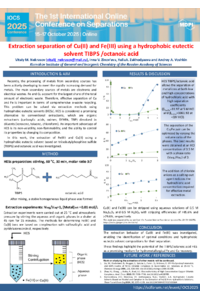
Recently, the processing of metals from secondary sources has been actively developing to meet the rapidly increasing demand for metals. The main secondary sources of metals are electronic and electrical wastes. Fe and Cu account for the largest share of the total amount of electronic waste. Therefore, effective separation of Cu and Fe is important in terms of comprehensive e-waste recycling. This problem can be solved via extraction methods using hydrophobic eutectic solvents (HESs). HES is considered a promising alternative to conventional extractants, which are organic extractants (carboxylic acids, oximes, DEHPA, TBP) dissolved in diluents (kerosene, toluene, chloroform). An important advantage of HES is its non-volatility, non-flammability, and the ability to control its properties by changing its composition.
In this work, the extraction of Fe(III) and Cu(II) using a hydrophobic eutectic solvent based on triisobutylphosphine sulfide (TIBPS) and octanoic acid was investigated.
HES was obtained by mixing TIBPS and octanoic acid in a molar ratio of 3:7, respectively. Extraction experiments were carried out at 25 °C and atmospheric pressure by stirring the aqueous and organic phases in a shaker at 45 rpm for 15 minutes.
During the work, the dependence of the extraction efficiency on the acid concentration, the phase ratio, and salting-out agent concentration were established. It was found that HES TIBPS/octanoic acid allows for the separation of metal ions at both low and high concentrations of hydrochloric acid with high separation coefficients (βCu/Fe=31.97 at 5 M HCl and βFe/Сu=1061.92 at <1M HCl). Cu(II) and Fe(III) can be stripped using aqueous solutions of 0.5 M Na2S2O3 and 0.5 M H2SO4, respectively.
The results obtained open up prospects for using HES TIBPS/octanoic acid to develop effective hydrometallurgical processes for recovering Fe and Cu.
Keywords
solvent extraction
eutectic solvent
metals
octanoic acid
triisobutylphosphine sulfide
Poster
sciforum_131857_S5_slides_IOCS2025_087558.pdf
Gas versus liquid chromatography–mass spectrometry for the analysis of aromatic metabolites in the blood serum and cerebrospinal fluid
Extraction of Thiophene, Indole, Quinoline, and Pyridine from Model Solutions Using a Polyethylene Glycol Methyl Ether/Tetrabutylammonium Bromide Eutectic Solvent