Event submissions
Published
This submission belongs to the session S5. Separation Engineering of the event The 1st International Online Conference on Separations
Published date
13 Oct, 2025
Academic Editor
'%3e%3cpath%20d='M12.6657%2010.9104C12.4185%2010.325%2012.0599%209.79327%2011.6097%209.34482C11.1609%208.89508%2010.6293%208.5365%2010.0442%208.28888C10.0389%208.28626%2010.0337%208.28495%2010.0285%208.28233C10.8446%207.69279%2011.3752%206.73249%2011.3752%205.64904C11.3752%203.8542%209.92103%202.39999%208.1262%202.39999C6.33136%202.39999%204.87715%203.8542%204.87715%205.64904C4.87715%206.73249%205.40774%207.69279%206.22393%208.28364C6.21869%208.28626%206.21345%208.28757%206.20821%208.29019C5.62129%208.5378%205.09463%208.89284%204.64265%209.34613C4.1929%209.79493%203.83432%2010.3266%203.58671%2010.9117C3.34345%2011.4845%203.21226%2012.0987%203.20023%2012.7209C3.19988%2012.7349%203.20233%2012.7488%203.20744%2012.7619C3.21255%2012.7749%203.22022%2012.7867%203.22998%2012.7968C3.23975%2012.8068%203.25142%2012.8147%203.26431%2012.8202C3.2772%2012.8256%203.29105%2012.8284%203.30504%2012.8284H4.09109C4.14874%2012.8284%204.19459%2012.7825%204.1959%2012.7262C4.2221%2011.7148%204.62823%2010.7676%205.34617%2010.0497C6.08899%209.30683%207.0755%208.89808%208.1262%208.89808C9.17689%208.89808%2010.1634%209.30683%2010.9062%2010.0497C11.6242%2010.7676%2012.0303%2011.7148%2012.0565%2012.7262C12.0578%2012.7838%2012.1037%2012.8284%2012.1613%2012.8284H12.9474C12.9613%2012.8284%2012.9752%2012.8256%2012.9881%2012.8202C13.001%2012.8147%2013.0126%2012.8068%2013.0224%2012.7968C13.0322%2012.7867%2013.0398%2012.7749%2013.0449%2012.7619C13.0501%2012.7488%2013.0525%2012.7349%2013.0522%2012.7209C13.0391%2012.0947%2012.9094%2011.4855%2012.6657%2010.9104ZM8.1262%207.9024C7.52486%207.9024%206.9589%207.6679%206.53312%207.24211C6.10733%206.81633%205.87283%206.25037%205.87283%205.64904C5.87283%205.0477%206.10733%204.48174%206.53312%204.05596C6.9589%203.63018%207.52486%203.39567%208.1262%203.39567C8.72753%203.39567%209.29349%203.63018%209.71927%204.05596C10.1451%204.48174%2010.3796%205.0477%2010.3796%205.64904C10.3796%206.25037%2010.1451%206.81633%209.71927%207.24211C9.29349%207.6679%208.72753%207.9024%208.1262%207.9024Z'%20fill='%235D1EE1'/%3e%3c/g%3e%3c/svg%3e) Guo-quan Zhang
Guo-quan ZhangCitation
Dmitriy V Lobovich, Grigoriy M Oleshkov, Yulia A Zakhodyaeva, Andrey A Voshkin, Extraction of Thiophene, Indole, Quinoline, and Pyridine from Model Solutions Using a Polyethylene Glycol Methyl Ether/Tetrabutylammonium Bromide Eutectic Solvent, in Proceedings of The 1st International Online Conference on Separations, 15 October–17 October 2025, MDPI: Basel, Switzerland
Share
Email
Facebook
Twitter
LinkedIn
Extraction of Thiophene, Indole, Quinoline, and Pyridine from Model Solutions Using a Polyethylene Glycol Methyl Ether/Tetrabutylammonium Bromide Eutectic Solvent
'%3e%3cpath%20d='M12.6647%2010.9104C12.4176%2010.325%2012.0589%209.7933%2011.6088%209.34485C11.16%208.89511%2010.6283%208.53653%2010.0432%208.28891C10.038%208.28629%2010.0327%208.28498%2010.0275%208.28236C10.8437%207.69282%2011.3743%206.73252%2011.3743%205.64907C11.3743%203.85423%209.92005%202.40002%208.12522%202.40002C6.33038%202.40002%204.87618%203.85423%204.87618%205.64907C4.87618%206.73252%205.40677%207.69282%206.22296%208.28367C6.21772%208.28629%206.21248%208.2876%206.20724%208.29022C5.62031%208.53783%205.09365%208.89287%204.64167%209.34616C4.19192%209.79496%203.83334%2010.3266%203.58573%2010.9117C3.34247%2011.4846%203.21128%2012.0987%203.19925%2012.721C3.1989%2012.735%203.20135%2012.7489%203.20646%2012.7619C3.21157%2012.7749%203.21924%2012.7868%203.22901%2012.7968C3.23877%2012.8068%203.25045%2012.8148%203.26334%2012.8202C3.27623%2012.8256%203.29007%2012.8284%203.30406%2012.8284H4.09012C4.14776%2012.8284%204.19362%2012.7825%204.19493%2012.7262C4.22113%2011.7148%204.62726%2010.7676%205.34519%2010.0497C6.08802%209.30686%207.07452%208.89811%208.12522%208.89811C9.17592%208.89811%2010.1624%209.30686%2010.9052%2010.0497C11.6232%2010.7676%2012.0293%2011.7148%2012.0555%2012.7262C12.0568%2012.7839%2012.1027%2012.8284%2012.1603%2012.8284H12.9464C12.9604%2012.8284%2012.9742%2012.8256%2012.9871%2012.8202C13%2012.8148%2013.0117%2012.8068%2013.0214%2012.7968C13.0312%2012.7868%2013.0389%2012.7749%2013.044%2012.7619C13.0491%2012.7489%2013.0515%2012.735%2013.0512%2012.721C13.0381%2012.0947%2012.9084%2011.4856%2012.6647%2010.9104ZM8.12522%207.90243C7.52388%207.90243%206.95792%207.66793%206.53214%207.24215C6.10636%206.81636%205.87185%206.2504%205.87185%205.64907C5.87185%205.04773%206.10636%204.48177%206.53214%204.05599C6.95792%203.63021%207.52388%203.3957%208.12522%203.3957C8.72655%203.3957%209.29252%203.63021%209.7183%204.05599C10.1441%204.48177%2010.3786%205.04773%2010.3786%205.64907C10.3786%206.2504%2010.1441%206.81636%209.7183%207.24215C9.29252%207.66793%208.72655%207.90243%208.12522%207.90243Z'%20fill='%235D1EE1'/%3e%3c/g%3e%3c/svg%3e)
Dmitriy V Lobovich 1
Grigoriy M Oleshkov 1
Yulia A Zakhodyaeva 1

Andrey A Voshkin 1
1. Kurnakov Institute of General and Inorganic Chemistry, Russian Academy of Sciences, Moscow, 119071, Russia
Abstract
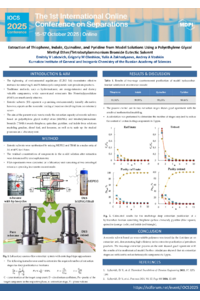
The tightening of environmental regulations (EURO 5/6) necessitates effective methods for removing S- and N-heterocyclic compounds from petroleum products. Traditional methods, such as hydrotreatment, are energy-intensive and destroy valuable components, while conventional extractants like N-methylpyrrolidone (NMP) are insufficiently effective. Eutectic solvents (ES) represent a promising environmentally friendly alternative; however, reports on the successful scaling of processes involving them are extremely scarce. The aim of the present work was to study the extraction capacity of eutectic solvents based on polyethylene glycol methyl ether (MEPEG) and tetrabutylammonium bromide (TBAB) towards thiophene, quinoline, pyridine, and indole from solutions modeling gasoline, diesel fuel, and kerosene, as well as to scale up the studied processes on a laboratory unit.
Eutectic solvents were synthesized by mixing MEPEG and TBAB in a molar ratio of 3:1 at 60°C for 1 hour. The residual concentrations of components in the model solution after extraction were determined by spectrophotometry. Pilot experiments were conducted on a laboratory unit consisting of a cascade of centrifugal extractors. The extraction efficiency of the target organic compounds using the proposed deep eutectic solvents was compared with that of N-methylpyrrolidone and pure MEPEG.
The eutectic solvent demonstrated an increase in the degree of component extraction compared to N-methylpyrrolidone, averaging 78%, 7%, 9%, and 14% for thiophene, pyridine, quinoline, and indole, respectively. The investigated process was implemented on a cascade of centrifugal extractors, enabling the denitrification and desulfurization of model fractions to sulfur and nitrogen contents below 1 ppm, meeting modern quality standards.
Thus, the proposed eutectic solvent based on polyethylene glycol methyl ether and tetrabutylammonium bromide exhibits higher extraction capacity compared to traditional extractants. For the first time, a eutectic solvent based on water-soluble polymers was applied on an extraction unit, demonstrating high productivity and efficiency in the extractive purification of petroleum products.
Keywords
Deep Eutectic solvents (DES)
Solvent Extraction
Thiophene
Indole
Quinoline
Pyridine
Polyethylene glycol methyl ether
Tetrabutylammonium bromide
Centrifugal extractors
Petroleum products
Poster
IOCS2025_Poster_Lobovich.pdf
Extraction separation of Cu(II) and Fe(III) using a hydrophobic eutectic solvent TIBPS /octanoic acid
Influence of the mobile phase on the vortex generation in silicon-on-insulator-based column