Event submissions
Published
This submission belongs to the session S3. Advanced Metabolomics and Data Analysis Approaches of the event The 4th International Electronic Conference on Metabolomics
Published date
13 Oct, 2025
Academic Editor
'%3e%3cpath%20d='M12.6657%2010.9104C12.4185%2010.325%2012.0599%209.79327%2011.6097%209.34482C11.1609%208.89508%2010.6293%208.5365%2010.0442%208.28888C10.0389%208.28626%2010.0337%208.28495%2010.0285%208.28233C10.8446%207.69279%2011.3752%206.73249%2011.3752%205.64904C11.3752%203.8542%209.92103%202.39999%208.1262%202.39999C6.33136%202.39999%204.87715%203.8542%204.87715%205.64904C4.87715%206.73249%205.40774%207.69279%206.22393%208.28364C6.21869%208.28626%206.21345%208.28757%206.20821%208.29019C5.62129%208.5378%205.09463%208.89284%204.64265%209.34613C4.1929%209.79493%203.83432%2010.3266%203.58671%2010.9117C3.34345%2011.4845%203.21226%2012.0987%203.20023%2012.7209C3.19988%2012.7349%203.20233%2012.7488%203.20744%2012.7619C3.21255%2012.7749%203.22022%2012.7867%203.22998%2012.7968C3.23975%2012.8068%203.25142%2012.8147%203.26431%2012.8202C3.2772%2012.8256%203.29105%2012.8284%203.30504%2012.8284H4.09109C4.14874%2012.8284%204.19459%2012.7825%204.1959%2012.7262C4.2221%2011.7148%204.62823%2010.7676%205.34617%2010.0497C6.08899%209.30683%207.0755%208.89808%208.1262%208.89808C9.17689%208.89808%2010.1634%209.30683%2010.9062%2010.0497C11.6242%2010.7676%2012.0303%2011.7148%2012.0565%2012.7262C12.0578%2012.7838%2012.1037%2012.8284%2012.1613%2012.8284H12.9474C12.9613%2012.8284%2012.9752%2012.8256%2012.9881%2012.8202C13.001%2012.8147%2013.0126%2012.8068%2013.0224%2012.7968C13.0322%2012.7867%2013.0398%2012.7749%2013.0449%2012.7619C13.0501%2012.7488%2013.0525%2012.7349%2013.0522%2012.7209C13.0391%2012.0947%2012.9094%2011.4855%2012.6657%2010.9104ZM8.1262%207.9024C7.52486%207.9024%206.9589%207.6679%206.53312%207.24211C6.10733%206.81633%205.87283%206.25037%205.87283%205.64904C5.87283%205.0477%206.10733%204.48174%206.53312%204.05596C6.9589%203.63018%207.52486%203.39567%208.1262%203.39567C8.72753%203.39567%209.29349%203.63018%209.71927%204.05596C10.1451%204.48174%2010.3796%205.0477%2010.3796%205.64904C10.3796%206.25037%2010.1451%206.81633%209.71927%207.24211C9.29349%207.6679%208.72753%207.9024%208.1262%207.9024Z'%20fill='%235D1EE1'/%3e%3c/g%3e%3c/svg%3e) Hunter Moseley
Hunter MoseleyCitation
Joana Pereira Rodrigues, Lénia Rodrigues, Catarina Campos, Mónica Marques, Catarina Estevão, Luís Cabrita, Hélia Cardoso, Metabolomic Characterization of Portuguese Ceratonia siliqua Varieties, in Proceedings of The 4th International Electronic Conference on Metabolomics, 13 October–15 October 2025, MDPI: Basel, Switzerland
Share
Email
Facebook
Twitter
LinkedIn
Metabolomic Characterization of Portuguese Ceratonia siliqua Varieties
'%3e%3cpath%20d='M12.6647%2010.9104C12.4176%2010.325%2012.0589%209.7933%2011.6088%209.34485C11.16%208.89511%2010.6283%208.53653%2010.0432%208.28891C10.038%208.28629%2010.0327%208.28498%2010.0275%208.28236C10.8437%207.69282%2011.3743%206.73252%2011.3743%205.64907C11.3743%203.85423%209.92005%202.40002%208.12522%202.40002C6.33038%202.40002%204.87618%203.85423%204.87618%205.64907C4.87618%206.73252%205.40677%207.69282%206.22296%208.28367C6.21772%208.28629%206.21248%208.2876%206.20724%208.29022C5.62031%208.53783%205.09365%208.89287%204.64167%209.34616C4.19192%209.79496%203.83334%2010.3266%203.58573%2010.9117C3.34247%2011.4846%203.21128%2012.0987%203.19925%2012.721C3.1989%2012.735%203.20135%2012.7489%203.20646%2012.7619C3.21157%2012.7749%203.21924%2012.7868%203.22901%2012.7968C3.23877%2012.8068%203.25045%2012.8148%203.26334%2012.8202C3.27623%2012.8256%203.29007%2012.8284%203.30406%2012.8284H4.09012C4.14776%2012.8284%204.19362%2012.7825%204.19493%2012.7262C4.22113%2011.7148%204.62726%2010.7676%205.34519%2010.0497C6.08802%209.30686%207.07452%208.89811%208.12522%208.89811C9.17592%208.89811%2010.1624%209.30686%2010.9052%2010.0497C11.6232%2010.7676%2012.0293%2011.7148%2012.0555%2012.7262C12.0568%2012.7839%2012.1027%2012.8284%2012.1603%2012.8284H12.9464C12.9604%2012.8284%2012.9742%2012.8256%2012.9871%2012.8202C13%2012.8148%2013.0117%2012.8068%2013.0214%2012.7968C13.0312%2012.7868%2013.0389%2012.7749%2013.044%2012.7619C13.0491%2012.7489%2013.0515%2012.735%2013.0512%2012.721C13.0381%2012.0947%2012.9084%2011.4856%2012.6647%2010.9104ZM8.12522%207.90243C7.52388%207.90243%206.95792%207.66793%206.53214%207.24215C6.10636%206.81636%205.87185%206.2504%205.87185%205.64907C5.87185%205.04773%206.10636%204.48177%206.53214%204.05599C6.95792%203.63021%207.52388%203.3957%208.12522%203.3957C8.72655%203.3957%209.29252%203.63021%209.7183%204.05599C10.1441%204.48177%2010.3786%205.04773%2010.3786%205.64907C10.3786%206.2504%2010.1441%206.81636%209.7183%207.24215C9.29252%207.66793%208.72655%207.90243%208.12522%207.90243Z'%20fill='%235D1EE1'/%3e%3c/g%3e%3c/svg%3e)
Joana Pereira Rodrigues 1

Lénia Rodrigues 1

Catarina Campos 1
Mónica Marques 1
Catarina Estevão 1
Luís Cabrita 2

Hélia Cardoso 1
1. MED (Mediterranean Institute for Agriculture, Environment and Development) & CHANGE — Global Change and Sustainability Institute, Instituto de Investigação e Formação Avançada, Universidade de Évora, Pólo da Mitra, Ap. 94, 7006-554 Évora, Portugal.
2. Regional Development and Coordenation Commission of the Algarve, I. P, Rua Joaquim Domingos Pereira, 8005-511 Faro, Portugal.
Abstract
The carob tree (Ceratonia siliqua L.) is a Mediterranean species known for its tolerance to salinity and drought stress, making it well-suited to regions with unused soils and high exploitation, thereby contributing to ecosystem recovery. Carob is also known for its resistance to biotic stress, requiring minimal inputs to control pests and diseases. To tolerate these conditions, carob synthesizes and accumulates protective compounds. Data from leaf extracts reveal the accumulation of metabolites with strong antioxidants and antimicrobial properties, highlighting the potential of these extracts. Despite the high diversity in the Portuguese carob germplasm, comprising nearly 30 varieties, few studies have characterized its metabolome. This study focused on the detailed metabolomic profiling of ten Portuguese varieties from the national carob field collection in Tavira (Portugal). Following exhaustive extraction with an ethanol/water solution, untargeted analysis was performed using chromatographic separation with a high-performance liquid chromatograph (HPLC) equipped with a diode array detector (DAD). MassLynx software was used for data processing. A preliminary assay comparing three biological replicates per variety showed no significant differences. Consequently, a single sample per variety was considered. Preliminary results suggest the presence of over 20 compounds, primarily belonging to the phenolic class, particularly flavonoids and hydrolyzable tannins, as well as fatty acid derivatives. These metabolites are widely recognized for their central roles in plant defense mechanisms against biotic and abiotic stresses. Their potential applications will be further explored in relation to enhancing stress resistance in plants.
This work is funded by national funds through FCT (Foundation for Science and Technology) under the Project UIDB/05183, and through the project ALCAROB (ref. PD24-00024), funded by the “la Caixa” Foundation’s Promove Program, in partnership with FCT (Projetos I&D Mobilizadores 2024). The authors would like to thank MED (https://doi.org/10.54499/UIDB/05183/2020; https://doi.org/10.54499/UIDP/05183/2020) and CHANGE (https://doi.org/10.54499/LA/P/0121/2020).
Keywords
Ceratonia siliqua
metabolomics
biotic and abiotic stresses
Poster
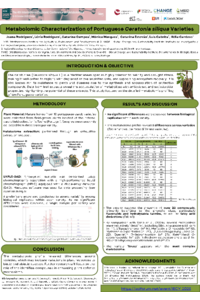
Metabolomic Characterization of Portuguese Ceratonia siliqua Varieties.pdf
Anthocyanin-Enriched Fraction from Callistemon citrinus Modulates Leydig Cell Function: Insights into Cytotoxicity and Metabolic Impact