Event submissions
Published
This submission belongs to the session S2. Behavioral, Experimental, and Cooperative Game Theory and Bargaining of the event The 1st International Electronic Conference on Games
Published date
14 Oct, 2025
Academic Editor
'%3e%3cpath%20d='M12.6657%2010.9104C12.4185%2010.325%2012.0599%209.79327%2011.6097%209.34482C11.1609%208.89508%2010.6293%208.5365%2010.0442%208.28888C10.0389%208.28626%2010.0337%208.28495%2010.0285%208.28233C10.8446%207.69279%2011.3752%206.73249%2011.3752%205.64904C11.3752%203.8542%209.92103%202.39999%208.1262%202.39999C6.33136%202.39999%204.87715%203.8542%204.87715%205.64904C4.87715%206.73249%205.40774%207.69279%206.22393%208.28364C6.21869%208.28626%206.21345%208.28757%206.20821%208.29019C5.62129%208.5378%205.09463%208.89284%204.64265%209.34613C4.1929%209.79493%203.83432%2010.3266%203.58671%2010.9117C3.34345%2011.4845%203.21226%2012.0987%203.20023%2012.7209C3.19988%2012.7349%203.20233%2012.7488%203.20744%2012.7619C3.21255%2012.7749%203.22022%2012.7867%203.22998%2012.7968C3.23975%2012.8068%203.25142%2012.8147%203.26431%2012.8202C3.2772%2012.8256%203.29105%2012.8284%203.30504%2012.8284H4.09109C4.14874%2012.8284%204.19459%2012.7825%204.1959%2012.7262C4.2221%2011.7148%204.62823%2010.7676%205.34617%2010.0497C6.08899%209.30683%207.0755%208.89808%208.1262%208.89808C9.17689%208.89808%2010.1634%209.30683%2010.9062%2010.0497C11.6242%2010.7676%2012.0303%2011.7148%2012.0565%2012.7262C12.0578%2012.7838%2012.1037%2012.8284%2012.1613%2012.8284H12.9474C12.9613%2012.8284%2012.9752%2012.8256%2012.9881%2012.8202C13.001%2012.8147%2013.0126%2012.8068%2013.0224%2012.7968C13.0322%2012.7867%2013.0398%2012.7749%2013.0449%2012.7619C13.0501%2012.7488%2013.0525%2012.7349%2013.0522%2012.7209C13.0391%2012.0947%2012.9094%2011.4855%2012.6657%2010.9104ZM8.1262%207.9024C7.52486%207.9024%206.9589%207.6679%206.53312%207.24211C6.10733%206.81633%205.87283%206.25037%205.87283%205.64904C5.87283%205.0477%206.10733%204.48174%206.53312%204.05596C6.9589%203.63018%207.52486%203.39567%208.1262%203.39567C8.72753%203.39567%209.29349%203.63018%209.71927%204.05596C10.1451%204.48174%2010.3796%205.0477%2010.3796%205.64904C10.3796%206.25037%2010.1451%206.81633%209.71927%207.24211C9.29349%207.6679%208.72753%207.9024%208.1262%207.9024Z'%20fill='%235D1EE1'/%3e%3c/g%3e%3c/svg%3e) Marco Marini
Marco MariniCitation
Pablo Fernández-Arias, Diego Vergara, Antonio del Bosque, Álvaro Antón-Sancho, Player profiles in the gamification of engineering education: statistical analysis, in Proceedings of The 1st International Electronic Conference on Games, 15 October–16 October 2025, MDPI: Basel, Switzerland
Share
Email
Facebook
Twitter
LinkedIn
Player profiles in the gamification of engineering education: statistical analysis

Pablo Fernández-Arias 1

Diego Vergara 1

Antonio del Bosque 1

Álvaro Antón-Sancho 2
1. Technology, Instruction and Design in Engineering and Education Research Group (TiDEE.rg), Catholic University of Ávila, C/Canteros, s/n, 05005 Ávila, Spain
2. Technology, Instruction and Design in Engineering and Education Research Group (TiDEE.rg), Catholic University of Avila, C/Canteros s/n, 05005 Ávila, Spain
Abstract
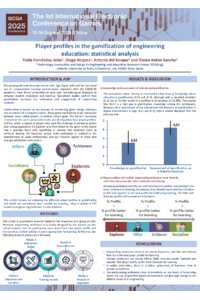
The incorporation of digital learning environments in higher education has driven the development of innovative methodological strategies, such as gamification, aimed at computer-assisted learning. The effectiveness of gamification is conditioned by the adaptation of the methodology to the player’s profile, for which Bartle’s taxonomy of player types distinguishes four profiles: Explorer, Killer, Socializer, and Achiever. This quantitative study analyzes both the distribution of player profiles among engineering faculty and their perceptions regarding the most suitable profile for learning. Additionally, sociological and academic factors influencing the selection of these profiles are examined. The sample size is 532 engineering professors, and a descriptive and inferential analysis was conducted on the answers of those who participated in a training course on gamification in digital environments and answered a questionnaire developed by the authors. The principal findings indicate that most professors identify with the Explorer profile, which is also considered the most suitable for learning, although a discrepancy is observed between one’s own profile and the preference for the most effective profile. Furthermore, the predominant profile among professors differs from the one most attributed to students in the literature, which is the Achiever. Significant differences were also identified according to gender, age, teaching experience, and university tenure. Based on these results, it is recommended that universities strengthen faculty training in the design of personalized game-based learning environments, considering the detected sociological and academic differences.
Keywords
Gamification
Player Profiles
Engineering Education
Behavioral Game Theory
Game-Based Learning
Poster
IECGA.pdf
Guaranteed Payoff Equilibrium
Control of Incomplete Fractional Punishment in Optional Public Goods Game