Event submissions
Published
This submission belongs to the session S4. Process Control and Monitoring of the event The 4th International Electronic Conference on Processes
Published date
17 Oct, 2025
Academic Editor
'%3e%3cpath%20d='M12.6657%2010.9104C12.4185%2010.325%2012.0599%209.79327%2011.6097%209.34482C11.1609%208.89508%2010.6293%208.5365%2010.0442%208.28888C10.0389%208.28626%2010.0337%208.28495%2010.0285%208.28233C10.8446%207.69279%2011.3752%206.73249%2011.3752%205.64904C11.3752%203.8542%209.92103%202.39999%208.1262%202.39999C6.33136%202.39999%204.87715%203.8542%204.87715%205.64904C4.87715%206.73249%205.40774%207.69279%206.22393%208.28364C6.21869%208.28626%206.21345%208.28757%206.20821%208.29019C5.62129%208.5378%205.09463%208.89284%204.64265%209.34613C4.1929%209.79493%203.83432%2010.3266%203.58671%2010.9117C3.34345%2011.4845%203.21226%2012.0987%203.20023%2012.7209C3.19988%2012.7349%203.20233%2012.7488%203.20744%2012.7619C3.21255%2012.7749%203.22022%2012.7867%203.22998%2012.7968C3.23975%2012.8068%203.25142%2012.8147%203.26431%2012.8202C3.2772%2012.8256%203.29105%2012.8284%203.30504%2012.8284H4.09109C4.14874%2012.8284%204.19459%2012.7825%204.1959%2012.7262C4.2221%2011.7148%204.62823%2010.7676%205.34617%2010.0497C6.08899%209.30683%207.0755%208.89808%208.1262%208.89808C9.17689%208.89808%2010.1634%209.30683%2010.9062%2010.0497C11.6242%2010.7676%2012.0303%2011.7148%2012.0565%2012.7262C12.0578%2012.7838%2012.1037%2012.8284%2012.1613%2012.8284H12.9474C12.9613%2012.8284%2012.9752%2012.8256%2012.9881%2012.8202C13.001%2012.8147%2013.0126%2012.8068%2013.0224%2012.7968C13.0322%2012.7867%2013.0398%2012.7749%2013.0449%2012.7619C13.0501%2012.7488%2013.0525%2012.7349%2013.0522%2012.7209C13.0391%2012.0947%2012.9094%2011.4855%2012.6657%2010.9104ZM8.1262%207.9024C7.52486%207.9024%206.9589%207.6679%206.53312%207.24211C6.10733%206.81633%205.87283%206.25037%205.87283%205.64904C5.87283%205.0477%206.10733%204.48174%206.53312%204.05596C6.9589%203.63018%207.52486%203.39567%208.1262%203.39567C8.72753%203.39567%209.29349%203.63018%209.71927%204.05596C10.1451%204.48174%2010.3796%205.0477%2010.3796%205.64904C10.3796%206.25037%2010.1451%206.81633%209.71927%207.24211C9.29349%207.6679%208.72753%207.9024%208.1262%207.9024Z'%20fill='%235D1EE1'/%3e%3c/g%3e%3c/svg%3e) Jie Zhang
Jie ZhangCitation
Bongiwe Mbele, Tumisang Seodigeng, Robert Someo Makomere, Mathematical Modelling of the Kinetics of Biomethanol Production on a Fibrous Cu/Zn/Al/Zr Catalyst from Biomass-Derived Syngas, in Proceedings of The 4th International Electronic Conference on Processes, 20 October–22 October 2025, MDPI: Basel, Switzerland
Share
Email
Facebook
Twitter
LinkedIn
Mathematical Modelling of the Kinetics of Biomethanol Production on a Fibrous Cu/Zn/Al/Zr Catalyst from Biomass-Derived Syngas
'%3e%3cpath%20d='M12.6647%2010.9104C12.4176%2010.325%2012.0589%209.7933%2011.6088%209.34485C11.16%208.89511%2010.6283%208.53653%2010.0432%208.28891C10.038%208.28629%2010.0327%208.28498%2010.0275%208.28236C10.8437%207.69282%2011.3743%206.73252%2011.3743%205.64907C11.3743%203.85423%209.92005%202.40002%208.12522%202.40002C6.33038%202.40002%204.87618%203.85423%204.87618%205.64907C4.87618%206.73252%205.40677%207.69282%206.22296%208.28367C6.21772%208.28629%206.21248%208.2876%206.20724%208.29022C5.62031%208.53783%205.09365%208.89287%204.64167%209.34616C4.19192%209.79496%203.83334%2010.3266%203.58573%2010.9117C3.34247%2011.4846%203.21128%2012.0987%203.19925%2012.721C3.1989%2012.735%203.20135%2012.7489%203.20646%2012.7619C3.21157%2012.7749%203.21924%2012.7868%203.22901%2012.7968C3.23877%2012.8068%203.25045%2012.8148%203.26334%2012.8202C3.27623%2012.8256%203.29007%2012.8284%203.30406%2012.8284H4.09012C4.14776%2012.8284%204.19362%2012.7825%204.19493%2012.7262C4.22113%2011.7148%204.62726%2010.7676%205.34519%2010.0497C6.08802%209.30686%207.07452%208.89811%208.12522%208.89811C9.17592%208.89811%2010.1624%209.30686%2010.9052%2010.0497C11.6232%2010.7676%2012.0293%2011.7148%2012.0555%2012.7262C12.0568%2012.7839%2012.1027%2012.8284%2012.1603%2012.8284H12.9464C12.9604%2012.8284%2012.9742%2012.8256%2012.9871%2012.8202C13%2012.8148%2013.0117%2012.8068%2013.0214%2012.7968C13.0312%2012.7868%2013.0389%2012.7749%2013.044%2012.7619C13.0491%2012.7489%2013.0515%2012.735%2013.0512%2012.721C13.0381%2012.0947%2012.9084%2011.4856%2012.6647%2010.9104ZM8.12522%207.90243C7.52388%207.90243%206.95792%207.66793%206.53214%207.24215C6.10636%206.81636%205.87185%206.2504%205.87185%205.64907C5.87185%205.04773%206.10636%204.48177%206.53214%204.05599C6.95792%203.63021%207.52388%203.3957%208.12522%203.3957C8.72655%203.3957%209.29252%203.63021%209.7183%204.05599C10.1441%204.48177%2010.3786%205.04773%2010.3786%205.64907C10.3786%206.2504%2010.1441%206.81636%209.7183%207.24215C9.29252%207.66793%208.72655%207.90243%208.12522%207.90243Z'%20fill='%235D1EE1'/%3e%3c/g%3e%3c/svg%3e)
Bongiwe Mbele 1
Tumisang Seodigeng 1
Robert Someo Makomere 1
1. Department of Chemical and Metallurgical Engineering, Vaal University of Technology, Private Bag X021, Vanderbijlpark, Gauteng, 1900, South Africa
Abstract
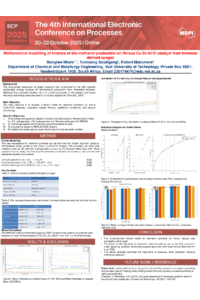
The accelerated growth of the global economy has contributed to the shift towards sustainable energy sources, amplifying the need for biomethanol production from biomass-derived syngas. This study evaluated an extensive kinetic model incorporating equilibrium restrictions for biomentanol synthesis utilizing a fibrous Cu/Zn/Al/Zr catalyst. A modified Langmuir–Hinshelwood–Hougen–Watson (LHHW) model was employed to better capture the equilibrium effects of CO hydrogenation, CO2 hydrogenation, and reverse water gas shift (RWGS) for precise predictions. Parameters evaluated included temperature (200-300°C), pressure (50-100 bar), H2/CO ratio (1.5–2.5), and H2/CO2 (2.5–3.5) molar feed and space velocity (100-1000 h⁻¹). LHHW rate constants were calculated from pilot scale experimental data, and the model bioethanol yield was compared against ground truth values, yielding a deviation of 7.23%. The LHHW was solved with the ODE15s solver in MATLAB to address the stiff equations generated by the LHHW model. Sensitivity analysis evaluated by the finite difference technique assessesed the uncertainty of biomethanol yield, highlighting that pressure had the most influence. From this, an 11.70% yield increase was seen when pressure was raised from 65 to 75 bar. ChemCAD8 was employed for process flowsheeting, enabling quantification of the biomethanol yield, and analyzed with the coefficient of determination (R2), root mean squared error (RMSE), mean squared error (MSE), and mean absolute error (MAE). The model attained an R2 of 0.9756, an MSE of 0.2453, an RMSE of 0.4953, and an MAE of 0.035. A plug‐flow reactor simulation reached 0.402 kg methanol per kg biomass with 87.3 % CO2 conversion, compared to experimental values of 0.379 kg/kg and 81.4 %. The simulation carried a ±4.23 % uncertainty at 95 % confidence. These results were generated at optimal points spanning 246 °C, 78 bar, 379 h-1, H2/CO=2.3, and H2/CO2=3. The refined kinetic model accurately predicted biomethanol performance; however, for effective scale-up application, heat management of the catalyst should be practiced.
Keywords
Kinetic Modelling
Process Optimization
Surface Mechanism
Sustainable Energy
Poster
ProcessControlandMonitoring_24377_Mathematical_Modelling_of_the_slidessciforum-132100.pdf
Fuzzy-Logic-Based Intelligent Control of a Cabinet Solar Dryer for Plantago major Leaves under Real Climatic Conditions in Tashkent
Development of an ANN-based predictive model for intelligent control of water hardness and TDS in industrial wastewater treatment using ion-exchange resins