Event submissions
Published
This submission belongs to the session S4. Process Control and Monitoring of the event The 4th International Electronic Conference on Processes
Published date
17 Oct, 2025
Academic Editor
'%3e%3cpath%20d='M12.6657%2010.9104C12.4185%2010.325%2012.0599%209.79327%2011.6097%209.34482C11.1609%208.89508%2010.6293%208.5365%2010.0442%208.28888C10.0389%208.28626%2010.0337%208.28495%2010.0285%208.28233C10.8446%207.69279%2011.3752%206.73249%2011.3752%205.64904C11.3752%203.8542%209.92103%202.39999%208.1262%202.39999C6.33136%202.39999%204.87715%203.8542%204.87715%205.64904C4.87715%206.73249%205.40774%207.69279%206.22393%208.28364C6.21869%208.28626%206.21345%208.28757%206.20821%208.29019C5.62129%208.5378%205.09463%208.89284%204.64265%209.34613C4.1929%209.79493%203.83432%2010.3266%203.58671%2010.9117C3.34345%2011.4845%203.21226%2012.0987%203.20023%2012.7209C3.19988%2012.7349%203.20233%2012.7488%203.20744%2012.7619C3.21255%2012.7749%203.22022%2012.7867%203.22998%2012.7968C3.23975%2012.8068%203.25142%2012.8147%203.26431%2012.8202C3.2772%2012.8256%203.29105%2012.8284%203.30504%2012.8284H4.09109C4.14874%2012.8284%204.19459%2012.7825%204.1959%2012.7262C4.2221%2011.7148%204.62823%2010.7676%205.34617%2010.0497C6.08899%209.30683%207.0755%208.89808%208.1262%208.89808C9.17689%208.89808%2010.1634%209.30683%2010.9062%2010.0497C11.6242%2010.7676%2012.0303%2011.7148%2012.0565%2012.7262C12.0578%2012.7838%2012.1037%2012.8284%2012.1613%2012.8284H12.9474C12.9613%2012.8284%2012.9752%2012.8256%2012.9881%2012.8202C13.001%2012.8147%2013.0126%2012.8068%2013.0224%2012.7968C13.0322%2012.7867%2013.0398%2012.7749%2013.0449%2012.7619C13.0501%2012.7488%2013.0525%2012.7349%2013.0522%2012.7209C13.0391%2012.0947%2012.9094%2011.4855%2012.6657%2010.9104ZM8.1262%207.9024C7.52486%207.9024%206.9589%207.6679%206.53312%207.24211C6.10733%206.81633%205.87283%206.25037%205.87283%205.64904C5.87283%205.0477%206.10733%204.48174%206.53312%204.05596C6.9589%203.63018%207.52486%203.39567%208.1262%203.39567C8.72753%203.39567%209.29349%203.63018%209.71927%204.05596C10.1451%204.48174%2010.3796%205.0477%2010.3796%205.64904C10.3796%206.25037%2010.1451%206.81633%209.71927%207.24211C9.29349%207.6679%208.72753%207.9024%208.1262%207.9024Z'%20fill='%235D1EE1'/%3e%3c/g%3e%3c/svg%3e) Jie Zhang
Jie ZhangCitation
Mikhail Savelyev, Artem Kuksin, Ekaterina Otsupko, Victoria Suchkova, Kristina Popovich, Pavel Vasilevsky, Ulyana Kurilova, Sergey Selishchev, Alexander Gerasimenko, Application of reduced graphene oxide in the photolithography process of biodegradable composite to improve its electrical conductivity, in Proceedings of The 4th International Electronic Conference on Processes, 20 October–22 October 2025, MDPI: Basel, Switzerland
Share
Email
Facebook
Twitter
LinkedIn
Application of reduced graphene oxide in the photolithography process of biodegradable composite to improve its electrical conductivity
'%3e%3cpath%20d='M12.6647%2010.9104C12.4176%2010.325%2012.0589%209.7933%2011.6088%209.34485C11.16%208.89511%2010.6283%208.53653%2010.0432%208.28891C10.038%208.28629%2010.0327%208.28498%2010.0275%208.28236C10.8437%207.69282%2011.3743%206.73252%2011.3743%205.64907C11.3743%203.85423%209.92005%202.40002%208.12522%202.40002C6.33038%202.40002%204.87618%203.85423%204.87618%205.64907C4.87618%206.73252%205.40677%207.69282%206.22296%208.28367C6.21772%208.28629%206.21248%208.2876%206.20724%208.29022C5.62031%208.53783%205.09365%208.89287%204.64167%209.34616C4.19192%209.79496%203.83334%2010.3266%203.58573%2010.9117C3.34247%2011.4846%203.21128%2012.0987%203.19925%2012.721C3.1989%2012.735%203.20135%2012.7489%203.20646%2012.7619C3.21157%2012.7749%203.21924%2012.7868%203.22901%2012.7968C3.23877%2012.8068%203.25045%2012.8148%203.26334%2012.8202C3.27623%2012.8256%203.29007%2012.8284%203.30406%2012.8284H4.09012C4.14776%2012.8284%204.19362%2012.7825%204.19493%2012.7262C4.22113%2011.7148%204.62726%2010.7676%205.34519%2010.0497C6.08802%209.30686%207.07452%208.89811%208.12522%208.89811C9.17592%208.89811%2010.1624%209.30686%2010.9052%2010.0497C11.6232%2010.7676%2012.0293%2011.7148%2012.0555%2012.7262C12.0568%2012.7839%2012.1027%2012.8284%2012.1603%2012.8284H12.9464C12.9604%2012.8284%2012.9742%2012.8256%2012.9871%2012.8202C13%2012.8148%2013.0117%2012.8068%2013.0214%2012.7968C13.0312%2012.7868%2013.0389%2012.7749%2013.044%2012.7619C13.0491%2012.7489%2013.0515%2012.735%2013.0512%2012.721C13.0381%2012.0947%2012.9084%2011.4856%2012.6647%2010.9104ZM8.12522%207.90243C7.52388%207.90243%206.95792%207.66793%206.53214%207.24215C6.10636%206.81636%205.87185%206.2504%205.87185%205.64907C5.87185%205.04773%206.10636%204.48177%206.53214%204.05599C6.95792%203.63021%207.52388%203.3957%208.12522%203.3957C8.72655%203.3957%209.29252%203.63021%209.7183%204.05599C10.1441%204.48177%2010.3786%205.04773%2010.3786%205.64907C10.3786%206.2504%2010.1441%206.81636%209.7183%207.24215C9.29252%207.66793%208.72655%207.90243%208.12522%207.90243Z'%20fill='%235D1EE1'/%3e%3c/g%3e%3c/svg%3e)
Mikhail Savelyev 1,2
Artem Kuksin 1
Ekaterina Otsupko 1
Victoria Suchkova 1,2
Kristina Popovich 1,2
Pavel Vasilevsky 1
Ulyana Kurilova 1,2
Sergey Selishchev 1

Alexander Gerasimenko 1,2
1. Institute of Biomedical Systems, National Research University of Electronic Technology (MIET), 124498, Zelenograd, Russia
2. Institute for Bionic Technologies and Engineering, I. M. Sechenov First Moscow State Medical University (Sechenov University), 119991, Moscow, Russia
Abstract
Introduction
The combination of single-walled carbon nanotubes (SWCNTs) and reduced graphene oxide (rGO) in the photoresist minimizes the amount of carbon particles. While developing neuroimplants designed to restore damaged neural networks or modulate pain transmission, the key requirements are both biocompatibility and electrical conductivity.
Methods
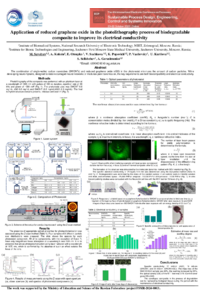
Photolithography of the composite was performed with an ytterbium laser at a wavelength of 1035 nm with pulses of 100 ns duration, repetition rate of 30 kHz and power of ~550 mW. The photoresist used was SWCNT 0.6 mg/mL, rGO 0.6 mg/mL and SWCNT (0.3 mg/mL)/rGO (0.3 mg/mL). The final biohybrid structure contains proteins, chitosan and eosin Y. The formation of the structure was simulated by the molecular dynamics method with SEM monitoring.
The specific electrical conductivity of 15 5×5 mm layers was determined using the four-probe method. Biodegradation was estimated by the mass of the swollen sample in an isotonic sodium chloride solution and dried, with the following enzymes: lipase - 25,000 PhEur; amylase - 18,000 PhEur and protease - 1000 PhEur. In vitro biocompatibility studies were conducted with the Neuro 2A cell line with the MTT test for 72 hours.
Results
Specific conductivity: 17 mS/cm (rGO), 19 mS/cm (SWCNT) and 35 mS/cm (SWCNT/rGO). The mass loss of the SWCNT/rGO sample was 40%, the swelling increased by 20%, and the optical density (OD) of the MTT test was 0.76. Control cover glass OD=0.62. Enzymes degraded the sample in a week. Simulation and SEM confirmed laser-induced rearrangement of SWCNTs with RGO into single nanostructures with the formation of non-hexagonal carbon elements.
Conclusions
The composite developed in the process of degradation can be replaced by biological tissue during this period with the maintenance of electrical conductivity.
Funding: The work was supported by the Ministry of Education and Science of the Russian Federation (project FSMR-2024-0003).
Keywords
specific conductivity
single-wall carbon nanotubes
reduced graphene oxide
degradation
eosin Y
Poster
Poster_Savelyev_ECP25.pdf
Development of an ANN-based predictive model for intelligent control of water hardness and TDS in industrial wastewater treatment using ion-exchange resins
Model Predictive Control of a Data-Driven Model of a Medium-Temperature Cold Storage System