Event submissions
Published
This submission belongs to the session S3. Food Process Engineering of the event The 4th International Electronic Conference on Processes
Published date
17 Oct, 2025
Academic Editor
'%3e%3cpath%20d='M12.6657%2010.9104C12.4185%2010.325%2012.0599%209.79327%2011.6097%209.34482C11.1609%208.89508%2010.6293%208.5365%2010.0442%208.28888C10.0389%208.28626%2010.0337%208.28495%2010.0285%208.28233C10.8446%207.69279%2011.3752%206.73249%2011.3752%205.64904C11.3752%203.8542%209.92103%202.39999%208.1262%202.39999C6.33136%202.39999%204.87715%203.8542%204.87715%205.64904C4.87715%206.73249%205.40774%207.69279%206.22393%208.28364C6.21869%208.28626%206.21345%208.28757%206.20821%208.29019C5.62129%208.5378%205.09463%208.89284%204.64265%209.34613C4.1929%209.79493%203.83432%2010.3266%203.58671%2010.9117C3.34345%2011.4845%203.21226%2012.0987%203.20023%2012.7209C3.19988%2012.7349%203.20233%2012.7488%203.20744%2012.7619C3.21255%2012.7749%203.22022%2012.7867%203.22998%2012.7968C3.23975%2012.8068%203.25142%2012.8147%203.26431%2012.8202C3.2772%2012.8256%203.29105%2012.8284%203.30504%2012.8284H4.09109C4.14874%2012.8284%204.19459%2012.7825%204.1959%2012.7262C4.2221%2011.7148%204.62823%2010.7676%205.34617%2010.0497C6.08899%209.30683%207.0755%208.89808%208.1262%208.89808C9.17689%208.89808%2010.1634%209.30683%2010.9062%2010.0497C11.6242%2010.7676%2012.0303%2011.7148%2012.0565%2012.7262C12.0578%2012.7838%2012.1037%2012.8284%2012.1613%2012.8284H12.9474C12.9613%2012.8284%2012.9752%2012.8256%2012.9881%2012.8202C13.001%2012.8147%2013.0126%2012.8068%2013.0224%2012.7968C13.0322%2012.7867%2013.0398%2012.7749%2013.0449%2012.7619C13.0501%2012.7488%2013.0525%2012.7349%2013.0522%2012.7209C13.0391%2012.0947%2012.9094%2011.4855%2012.6657%2010.9104ZM8.1262%207.9024C7.52486%207.9024%206.9589%207.6679%206.53312%207.24211C6.10733%206.81633%205.87283%206.25037%205.87283%205.64904C5.87283%205.0477%206.10733%204.48174%206.53312%204.05596C6.9589%203.63018%207.52486%203.39567%208.1262%203.39567C8.72753%203.39567%209.29349%203.63018%209.71927%204.05596C10.1451%204.48174%2010.3796%205.0477%2010.3796%205.64904C10.3796%206.25037%2010.1451%206.81633%209.71927%207.24211C9.29349%207.6679%208.72753%207.9024%208.1262%207.9024Z'%20fill='%235D1EE1'/%3e%3c/g%3e%3c/svg%3e) Young-Cheol Chang
Young-Cheol ChangCitation
Adriana Rodrigues Machado, Jeisa Farias Santana, Glenda Antonia da Rocha Neves, Dayane Cristina da Costa, Nelson Roberto Antoniosi Filho, Fabiano Guimarães Silva, Leticia Fleury Viana, Alcoholic fermented cagaita (Eugenia dysenterica): Identification of Volatile Compounds, in Proceedings of The 4th International Electronic Conference on Processes, 20 October–22 October 2025, MDPI: Basel, Switzerland
Share
Email
Facebook
Twitter
LinkedIn
Alcoholic fermented cagaita (Eugenia dysenterica): Identification of Volatile Compounds
'%3e%3cpath%20d='M12.6647%2010.9104C12.4176%2010.325%2012.0589%209.7933%2011.6088%209.34485C11.16%208.89511%2010.6283%208.53653%2010.0432%208.28891C10.038%208.28629%2010.0327%208.28498%2010.0275%208.28236C10.8437%207.69282%2011.3743%206.73252%2011.3743%205.64907C11.3743%203.85423%209.92005%202.40002%208.12522%202.40002C6.33038%202.40002%204.87618%203.85423%204.87618%205.64907C4.87618%206.73252%205.40677%207.69282%206.22296%208.28367C6.21772%208.28629%206.21248%208.2876%206.20724%208.29022C5.62031%208.53783%205.09365%208.89287%204.64167%209.34616C4.19192%209.79496%203.83334%2010.3266%203.58573%2010.9117C3.34247%2011.4846%203.21128%2012.0987%203.19925%2012.721C3.1989%2012.735%203.20135%2012.7489%203.20646%2012.7619C3.21157%2012.7749%203.21924%2012.7868%203.22901%2012.7968C3.23877%2012.8068%203.25045%2012.8148%203.26334%2012.8202C3.27623%2012.8256%203.29007%2012.8284%203.30406%2012.8284H4.09012C4.14776%2012.8284%204.19362%2012.7825%204.19493%2012.7262C4.22113%2011.7148%204.62726%2010.7676%205.34519%2010.0497C6.08802%209.30686%207.07452%208.89811%208.12522%208.89811C9.17592%208.89811%2010.1624%209.30686%2010.9052%2010.0497C11.6232%2010.7676%2012.0293%2011.7148%2012.0555%2012.7262C12.0568%2012.7839%2012.1027%2012.8284%2012.1603%2012.8284H12.9464C12.9604%2012.8284%2012.9742%2012.8256%2012.9871%2012.8202C13%2012.8148%2013.0117%2012.8068%2013.0214%2012.7968C13.0312%2012.7868%2013.0389%2012.7749%2013.044%2012.7619C13.0491%2012.7489%2013.0515%2012.735%2013.0512%2012.721C13.0381%2012.0947%2012.9084%2011.4856%2012.6647%2010.9104ZM8.12522%207.90243C7.52388%207.90243%206.95792%207.66793%206.53214%207.24215C6.10636%206.81636%205.87185%206.2504%205.87185%205.64907C5.87185%205.04773%206.10636%204.48177%206.53214%204.05599C6.95792%203.63021%207.52388%203.3957%208.12522%203.3957C8.72655%203.3957%209.29252%203.63021%209.7183%204.05599C10.1441%204.48177%2010.3786%205.04773%2010.3786%205.64907C10.3786%206.2504%2010.1441%206.81636%209.7183%207.24215C9.29252%207.66793%208.72655%207.90243%208.12522%207.90243Z'%20fill='%235D1EE1'/%3e%3c/g%3e%3c/svg%3e)
Adriana Rodrigues Machado 1
Jeisa Farias Santana 2
Glenda Antonia da Rocha Neves 3
Dayane Cristina da Costa 3
Nelson Roberto Antoniosi Filho 3
Fabiano Guimarães Silva 2
Leticia Fleury Viana 2
1. Department of Food Science, Goiano Federal Institute of Education, Science and Technology, Campus Rio Verde, Rodovia Sul Goiana, Km 01, Rio Verde 75901-970, GO, Brazil
2. Instituto Federal de Educação Ciência e Tecnologia Goiano, Campus Rio Verde, GO, Brazil.
3. Universidade Federal de Goiás – Campus Samambaia, Goiânia, GO, Brazil.
Abstract
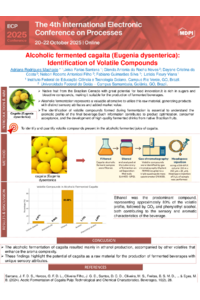
Cagaita (Eugenia dysenterica), a native fruit of the Brazilian Cerrado, has high potential for the elaboration of fermented products due to its content of sugars and bioactive compounds. Alcoholic fermentation emerges as a promising alternative for the use of this raw material, resulting in beverages with differentiated sensory characteristics and added value. In addition, the study of the volatile compounds generated during the fermentation process is essential to understand the aromatic profile of the final product and its acceptance by the consumer. The objective of this study was to identify the volatile compounds present in the fermented juice of cagaita (Eugenia dysenterica). A sample of cagaita alcoholic ferment was filtered, properly stored and sent to the Laboratory of Extraction and Separation Methods (LAMES-UFG) in Goiânia-GO for the identification of volatile compounds by gas chromatography. Analyses were performed with 3 μL of the sample by Headspace in an Aglient gas chromatograph model 7890B coupled to a 7000D triple quadrupole mass spectrometer, equipped with a DB-WAX column (30 m x 250 μm x 25 μm). Five main compounds were identified: carbon dioxide (5.97%), acetaldehyde (0.94%), ethanol (89.08%), acetoin (1.73%) and phenylethylalcohol (2.28%). Ethanol was the major compound, accounting for approximately 89% of the volatile composition, followed by carbon dioxide and phenylethylalcohol. These results indicate that the fermentation process resulted predominantly in the production of ethanol, with the presence of other volatiles that may have contributed to the sensory profile of the beverage.
Keywords
Cerrado
chromatography
ethanol
fruits and must.
Poster
Alc. Cagaita.pdf
Deep Learning for Cybersecurity Threat Detection in Industrial Process Control and Monitoring Systems
Modelling of Open-Circuit Cooling System Chemical Emissions to River Water via Blowdown Water, and their Impact on the Quality of Effluents Discharged