Event submissions
Published
This submission belongs to the session S4. Process Control and Monitoring of the event The 4th International Electronic Conference on Processes
Published date
17 Oct, 2025
Academic Editor
'%3e%3cpath%20d='M12.6657%2010.9104C12.4185%2010.325%2012.0599%209.79327%2011.6097%209.34482C11.1609%208.89508%2010.6293%208.5365%2010.0442%208.28888C10.0389%208.28626%2010.0337%208.28495%2010.0285%208.28233C10.8446%207.69279%2011.3752%206.73249%2011.3752%205.64904C11.3752%203.8542%209.92103%202.39999%208.1262%202.39999C6.33136%202.39999%204.87715%203.8542%204.87715%205.64904C4.87715%206.73249%205.40774%207.69279%206.22393%208.28364C6.21869%208.28626%206.21345%208.28757%206.20821%208.29019C5.62129%208.5378%205.09463%208.89284%204.64265%209.34613C4.1929%209.79493%203.83432%2010.3266%203.58671%2010.9117C3.34345%2011.4845%203.21226%2012.0987%203.20023%2012.7209C3.19988%2012.7349%203.20233%2012.7488%203.20744%2012.7619C3.21255%2012.7749%203.22022%2012.7867%203.22998%2012.7968C3.23975%2012.8068%203.25142%2012.8147%203.26431%2012.8202C3.2772%2012.8256%203.29105%2012.8284%203.30504%2012.8284H4.09109C4.14874%2012.8284%204.19459%2012.7825%204.1959%2012.7262C4.2221%2011.7148%204.62823%2010.7676%205.34617%2010.0497C6.08899%209.30683%207.0755%208.89808%208.1262%208.89808C9.17689%208.89808%2010.1634%209.30683%2010.9062%2010.0497C11.6242%2010.7676%2012.0303%2011.7148%2012.0565%2012.7262C12.0578%2012.7838%2012.1037%2012.8284%2012.1613%2012.8284H12.9474C12.9613%2012.8284%2012.9752%2012.8256%2012.9881%2012.8202C13.001%2012.8147%2013.0126%2012.8068%2013.0224%2012.7968C13.0322%2012.7867%2013.0398%2012.7749%2013.0449%2012.7619C13.0501%2012.7488%2013.0525%2012.7349%2013.0522%2012.7209C13.0391%2012.0947%2012.9094%2011.4855%2012.6657%2010.9104ZM8.1262%207.9024C7.52486%207.9024%206.9589%207.6679%206.53312%207.24211C6.10733%206.81633%205.87283%206.25037%205.87283%205.64904C5.87283%205.0477%206.10733%204.48174%206.53312%204.05596C6.9589%203.63018%207.52486%203.39567%208.1262%203.39567C8.72753%203.39567%209.29349%203.63018%209.71927%204.05596C10.1451%204.48174%2010.3796%205.0477%2010.3796%205.64904C10.3796%206.25037%2010.1451%206.81633%209.71927%207.24211C9.29349%207.6679%208.72753%207.9024%208.1262%207.9024Z'%20fill='%235D1EE1'/%3e%3c/g%3e%3c/svg%3e) Jie Zhang
Jie ZhangCitation
Jonathan Wavomba Mtogo, Gladys Wanyaga Mugo, Emmanuel Karimere Kariuki, Martin Gichungu Murimi, Bevin Nabai Kundu, Electrified Pressure Swing Distillation: A Systems-Based Sustainability Assessment, in Proceedings of The 4th International Electronic Conference on Processes, 20 October–22 October 2025, MDPI: Basel, Switzerland
Share
Email
Facebook
Twitter
LinkedIn
Electrified Pressure Swing Distillation: A Systems-Based Sustainability Assessment

Jonathan Wavomba Mtogo 1
'%3e%3cpath%20d='M12.6647%2010.9104C12.4176%2010.325%2012.0589%209.7933%2011.6088%209.34485C11.16%208.89511%2010.6283%208.53653%2010.0432%208.28891C10.038%208.28629%2010.0327%208.28498%2010.0275%208.28236C10.8437%207.69282%2011.3743%206.73252%2011.3743%205.64907C11.3743%203.85423%209.92005%202.40002%208.12522%202.40002C6.33038%202.40002%204.87618%203.85423%204.87618%205.64907C4.87618%206.73252%205.40677%207.69282%206.22296%208.28367C6.21772%208.28629%206.21248%208.2876%206.20724%208.29022C5.62031%208.53783%205.09365%208.89287%204.64167%209.34616C4.19192%209.79496%203.83334%2010.3266%203.58573%2010.9117C3.34247%2011.4846%203.21128%2012.0987%203.19925%2012.721C3.1989%2012.735%203.20135%2012.7489%203.20646%2012.7619C3.21157%2012.7749%203.21924%2012.7868%203.22901%2012.7968C3.23877%2012.8068%203.25045%2012.8148%203.26334%2012.8202C3.27623%2012.8256%203.29007%2012.8284%203.30406%2012.8284H4.09012C4.14776%2012.8284%204.19362%2012.7825%204.19493%2012.7262C4.22113%2011.7148%204.62726%2010.7676%205.34519%2010.0497C6.08802%209.30686%207.07452%208.89811%208.12522%208.89811C9.17592%208.89811%2010.1624%209.30686%2010.9052%2010.0497C11.6232%2010.7676%2012.0293%2011.7148%2012.0555%2012.7262C12.0568%2012.7839%2012.1027%2012.8284%2012.1603%2012.8284H12.9464C12.9604%2012.8284%2012.9742%2012.8256%2012.9871%2012.8202C13%2012.8148%2013.0117%2012.8068%2013.0214%2012.7968C13.0312%2012.7868%2013.0389%2012.7749%2013.044%2012.7619C13.0491%2012.7489%2013.0515%2012.735%2013.0512%2012.721C13.0381%2012.0947%2012.9084%2011.4856%2012.6647%2010.9104ZM8.12522%207.90243C7.52388%207.90243%206.95792%207.66793%206.53214%207.24215C6.10636%206.81636%205.87185%206.2504%205.87185%205.64907C5.87185%205.04773%206.10636%204.48177%206.53214%204.05599C6.95792%203.63021%207.52388%203.3957%208.12522%203.3957C8.72655%203.3957%209.29252%203.63021%209.7183%204.05599C10.1441%204.48177%2010.3786%205.04773%2010.3786%205.64907C10.3786%206.2504%2010.1441%206.81636%209.7183%207.24215C9.29252%207.66793%208.72655%207.90243%208.12522%207.90243Z'%20fill='%235D1EE1'/%3e%3c/g%3e%3c/svg%3e)
Gladys Wanyaga Mugo 1
Emmanuel Karimere Kariuki 1
Martin Gichungu Murimi 1
Bevin Nabai Kundu 1
1. Chemical Engineering and Allied Processes Research Centre, Kenya Industrial Research and Development Institute, P.O. Box 30650 – 00100 Nairobi, Kenya
Abstract
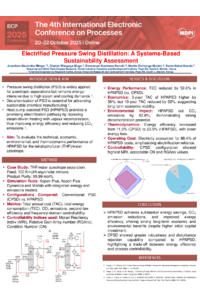
The decarbonization of energy-intensive separation processes is critical for achieving net-zero goals in the chemical industry. While widely used for separating azeotropic and close-boiling mixtures, pressure swing distillation (PSD) remains highly energy intensive due to significant thermal demands. This study explores the integration of electrification and hybrid heat pump-assisted systems into PSD as a pathway to enhanced sustainability. This work presents a comprehensive systems-based assessment of electrified distillation designs, with a specific focus on tetrahydrofuran–water separation as a case study.
Using Aspen Plus and Aspen Plus Dynamics for steady-state and dynamic simulations, coupled with MATLAB-based multi-criteria optimization, we evaluated key performance indicators including thermal and exergy efficiencies, CO₂ emissions reduction potential, and controllability metrics. The electrified configurations employed electric reboilers and heat pumps as partial or full substitutes for conventional steam heating.
The results show that hybrid electrified systems can reduce primary energy demand by up to 28%, while improving exergy efficiency by 22% compared to conventional setups. Dynamic controllability analysis using the Morari Resiliency Index (MRI) and Condition Number (CN) confirmed enhanced stability and responsiveness under variable electricity input scenarios. Additionally, GHG emissions were reduced by 35–45%, depending on the electricity source mix.
This study demonstrates the potential of electrification to transform PSD systems from rigid, energy-intensive operations into flexible and sustainable processes. The findings support a shift toward integrated, systems-driven design strategies in chemical separation, aligning with broader goals in process electrification, circularity, and net-zero manufacturing. This approach can serve as a blueprint for retrofitting traditional separation systems with next-generation, low-emission technologies.
Keywords
Distillation: Separation: Azeotropic: Process Control: Energy efficiency
Poster
ProcessControlandMonitoring_24411_Electrified_Pressure_Swing_Dis_slidessciforum-124146.pdf
Efficient Phenol Degradation by a Natural Illite-Based Catalyst via Integrated Advanced Oxidation Processes
Trajectory tracking control of a quadrotor: A comparative study of PSO- and FPA-optimized PID controllers.