Event submissions
Published
This submission belongs to the session S2. Chemical Processes and Systems of the event The 4th International Electronic Conference on Processes
Published date
17 Oct, 2025
Academic Editor
'%3e%3cpath%20d='M12.6657%2010.9104C12.4185%2010.325%2012.0599%209.79327%2011.6097%209.34482C11.1609%208.89508%2010.6293%208.5365%2010.0442%208.28888C10.0389%208.28626%2010.0337%208.28495%2010.0285%208.28233C10.8446%207.69279%2011.3752%206.73249%2011.3752%205.64904C11.3752%203.8542%209.92103%202.39999%208.1262%202.39999C6.33136%202.39999%204.87715%203.8542%204.87715%205.64904C4.87715%206.73249%205.40774%207.69279%206.22393%208.28364C6.21869%208.28626%206.21345%208.28757%206.20821%208.29019C5.62129%208.5378%205.09463%208.89284%204.64265%209.34613C4.1929%209.79493%203.83432%2010.3266%203.58671%2010.9117C3.34345%2011.4845%203.21226%2012.0987%203.20023%2012.7209C3.19988%2012.7349%203.20233%2012.7488%203.20744%2012.7619C3.21255%2012.7749%203.22022%2012.7867%203.22998%2012.7968C3.23975%2012.8068%203.25142%2012.8147%203.26431%2012.8202C3.2772%2012.8256%203.29105%2012.8284%203.30504%2012.8284H4.09109C4.14874%2012.8284%204.19459%2012.7825%204.1959%2012.7262C4.2221%2011.7148%204.62823%2010.7676%205.34617%2010.0497C6.08899%209.30683%207.0755%208.89808%208.1262%208.89808C9.17689%208.89808%2010.1634%209.30683%2010.9062%2010.0497C11.6242%2010.7676%2012.0303%2011.7148%2012.0565%2012.7262C12.0578%2012.7838%2012.1037%2012.8284%2012.1613%2012.8284H12.9474C12.9613%2012.8284%2012.9752%2012.8256%2012.9881%2012.8202C13.001%2012.8147%2013.0126%2012.8068%2013.0224%2012.7968C13.0322%2012.7867%2013.0398%2012.7749%2013.0449%2012.7619C13.0501%2012.7488%2013.0525%2012.7349%2013.0522%2012.7209C13.0391%2012.0947%2012.9094%2011.4855%2012.6657%2010.9104ZM8.1262%207.9024C7.52486%207.9024%206.9589%207.6679%206.53312%207.24211C6.10733%206.81633%205.87283%206.25037%205.87283%205.64904C5.87283%205.0477%206.10733%204.48174%206.53312%204.05596C6.9589%203.63018%207.52486%203.39567%208.1262%203.39567C8.72753%203.39567%209.29349%203.63018%209.71927%204.05596C10.1451%204.48174%2010.3796%205.0477%2010.3796%205.64904C10.3796%206.25037%2010.1451%206.81633%209.71927%207.24211C9.29349%207.6679%208.72753%207.9024%208.1262%207.9024Z'%20fill='%235D1EE1'/%3e%3c/g%3e%3c/svg%3e) Blaž Likozar
Blaž LikozarCitation
Dmitrii Gribanev, Elena Pankratova, Hassan Alqahtani, Khalid Alruwaili, Vera Solovyeva, Facilitation of amine-bridged covalent triazine framework synthesis by microwave irradiation., in Proceedings of The 4th International Electronic Conference on Processes, 20 October–22 October 2025, MDPI: Basel, Switzerland
Share
Email
Facebook
Twitter
LinkedIn
Facilitation of amine-bridged covalent triazine framework synthesis by microwave irradiation.
'%3e%3cpath%20d='M12.6647%2010.9104C12.4176%2010.325%2012.0589%209.7933%2011.6088%209.34485C11.16%208.89511%2010.6283%208.53653%2010.0432%208.28891C10.038%208.28629%2010.0327%208.28498%2010.0275%208.28236C10.8437%207.69282%2011.3743%206.73252%2011.3743%205.64907C11.3743%203.85423%209.92005%202.40002%208.12522%202.40002C6.33038%202.40002%204.87618%203.85423%204.87618%205.64907C4.87618%206.73252%205.40677%207.69282%206.22296%208.28367C6.21772%208.28629%206.21248%208.2876%206.20724%208.29022C5.62031%208.53783%205.09365%208.89287%204.64167%209.34616C4.19192%209.79496%203.83334%2010.3266%203.58573%2010.9117C3.34247%2011.4846%203.21128%2012.0987%203.19925%2012.721C3.1989%2012.735%203.20135%2012.7489%203.20646%2012.7619C3.21157%2012.7749%203.21924%2012.7868%203.22901%2012.7968C3.23877%2012.8068%203.25045%2012.8148%203.26334%2012.8202C3.27623%2012.8256%203.29007%2012.8284%203.30406%2012.8284H4.09012C4.14776%2012.8284%204.19362%2012.7825%204.19493%2012.7262C4.22113%2011.7148%204.62726%2010.7676%205.34519%2010.0497C6.08802%209.30686%207.07452%208.89811%208.12522%208.89811C9.17592%208.89811%2010.1624%209.30686%2010.9052%2010.0497C11.6232%2010.7676%2012.0293%2011.7148%2012.0555%2012.7262C12.0568%2012.7839%2012.1027%2012.8284%2012.1603%2012.8284H12.9464C12.9604%2012.8284%2012.9742%2012.8256%2012.9871%2012.8202C13%2012.8148%2013.0117%2012.8068%2013.0214%2012.7968C13.0312%2012.7868%2013.0389%2012.7749%2013.044%2012.7619C13.0491%2012.7489%2013.0515%2012.735%2013.0512%2012.721C13.0381%2012.0947%2012.9084%2011.4856%2012.6647%2010.9104ZM8.12522%207.90243C7.52388%207.90243%206.95792%207.66793%206.53214%207.24215C6.10636%206.81636%205.87185%206.2504%205.87185%205.64907C5.87185%205.04773%206.10636%204.48177%206.53214%204.05599C6.95792%203.63021%207.52388%203.3957%208.12522%203.3957C8.72655%203.3957%209.29252%203.63021%209.7183%204.05599C10.1441%204.48177%2010.3786%205.04773%2010.3786%205.64907C10.3786%206.2504%2010.1441%206.81636%209.7183%207.24215C9.29252%207.66793%208.72655%207.90243%208.12522%207.90243Z'%20fill='%235D1EE1'/%3e%3c/g%3e%3c/svg%3e)
Dmitrii Gribanev 1
Elena Pankratova 1
Hassan Alqahtani 2
Khalid Alruwaili 2
Vera Solovyeva 1
1. Aramco Innovations LLC, Bld. 1, 9 Varshavskoye Highway, 117105 Moscow, Russia
2. EXPEC Advanced Research Center (EXPEC ARC), Dhahran, 31311, Saudi Arabia
Abstract
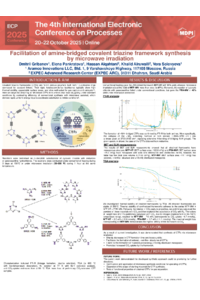
Covalent triazine frameworks (CTFs) are nitrogen-rich porous polymer networks composed of 1,3,5-triazine rings linked by organic moieties via covalent bonds. These materials often exhibit high thermal stability and specific surface areas. Their heteroatom-rich structure[1] makes them attractive for catalysis and gas adsorption applications. One of the efficient synthetic routes for obtaining CTFs is the nucleophilic substitution between cyanuric chloride (2,4,6-trichloro-1,3,5-triazine) and polyfunctional amines, which forms –NH–bridged triazine networks. These syntheses could be performed under conventional heating methods; however, complete substitution often requires prolonged reaction times.
Microwave irradiation has emerged as a powerful method in such types of reactions due to rapid and uniform energy input, accelerating the substitution and formation of CTFs under mild conditions. For example, the –NH–linked triazine framework was synthesized in just 30 minutes via microwave heating (400W) from cyanuric chloride and melamine[2].
According to our results, the reaction between melamine and cyanuric chloride in DMSO for 3 days yielded 31% of –NH–linked CTF, while in microwave conditions. it proceeds for 1 h under 50–200W, with a double yield of 67%. Moreover, the synthesis of CTF from melamine and pararosaniline under conventional heating did not proceed, but under microwave-assisted heating, we isolated the product with 48% yield.
Thus, microwave-assisted routes significantly reduce reaction times and improve yields. This work highlights how microwave-driven nucleophilic substitution strategies can efficiently produce –NH–bridged CTFs, offering a scalable pathway for these functional porous materials.
References:
[1] Silpa Elizabeth Peter et al., “Cyanuric Chloride as a Linker towards the Synthesis of Covalent Triazine Polymers: A Review,” Materials Advances 5, no. 23 (2024): 9175–9209, https://doi.org/10.1039/D4MA00739E.
[2] Monika Chaudhary and Paritosh Mohanty, “Nitrogen Enriched Polytriazine as a Metal-Free Heterogeneous Catalyst for the Knoevenagel Reaction under Mild Conditions,” New Journal of Chemistry 42, no. 15 (2018): 12924–28, https://doi.org/10.1039/C8NJ02174K.
Keywords
mircrowave-assisted synthesis
covalent triazine frameworks
functional porous materials
gas adsoprtion
Poster
ChemicalProcessesandSystems_24417_Facilitation_of_amine_bridged_slidessciforum-128158.pdf
Spectroscopic Fingerprints of Few-Layer Graphene on PET: Toward Intelligent Food Packaging Systems
Materials Manufacturing and Packing Analysis: A Study for Sustainable Production of Composites Through Emerging Technologies for infrastructure management