Event submissions
Published
This submission belongs to the session S3. Food Process Engineering of the event The 4th International Electronic Conference on Processes
Published date
17 Oct, 2025
Academic Editor
'%3e%3cpath%20d='M12.6657%2010.9104C12.4185%2010.325%2012.0599%209.79327%2011.6097%209.34482C11.1609%208.89508%2010.6293%208.5365%2010.0442%208.28888C10.0389%208.28626%2010.0337%208.28495%2010.0285%208.28233C10.8446%207.69279%2011.3752%206.73249%2011.3752%205.64904C11.3752%203.8542%209.92103%202.39999%208.1262%202.39999C6.33136%202.39999%204.87715%203.8542%204.87715%205.64904C4.87715%206.73249%205.40774%207.69279%206.22393%208.28364C6.21869%208.28626%206.21345%208.28757%206.20821%208.29019C5.62129%208.5378%205.09463%208.89284%204.64265%209.34613C4.1929%209.79493%203.83432%2010.3266%203.58671%2010.9117C3.34345%2011.4845%203.21226%2012.0987%203.20023%2012.7209C3.19988%2012.7349%203.20233%2012.7488%203.20744%2012.7619C3.21255%2012.7749%203.22022%2012.7867%203.22998%2012.7968C3.23975%2012.8068%203.25142%2012.8147%203.26431%2012.8202C3.2772%2012.8256%203.29105%2012.8284%203.30504%2012.8284H4.09109C4.14874%2012.8284%204.19459%2012.7825%204.1959%2012.7262C4.2221%2011.7148%204.62823%2010.7676%205.34617%2010.0497C6.08899%209.30683%207.0755%208.89808%208.1262%208.89808C9.17689%208.89808%2010.1634%209.30683%2010.9062%2010.0497C11.6242%2010.7676%2012.0303%2011.7148%2012.0565%2012.7262C12.0578%2012.7838%2012.1037%2012.8284%2012.1613%2012.8284H12.9474C12.9613%2012.8284%2012.9752%2012.8256%2012.9881%2012.8202C13.001%2012.8147%2013.0126%2012.8068%2013.0224%2012.7968C13.0322%2012.7867%2013.0398%2012.7749%2013.0449%2012.7619C13.0501%2012.7488%2013.0525%2012.7349%2013.0522%2012.7209C13.0391%2012.0947%2012.9094%2011.4855%2012.6657%2010.9104ZM8.1262%207.9024C7.52486%207.9024%206.9589%207.6679%206.53312%207.24211C6.10733%206.81633%205.87283%206.25037%205.87283%205.64904C5.87283%205.0477%206.10733%204.48174%206.53312%204.05596C6.9589%203.63018%207.52486%203.39567%208.1262%203.39567C8.72753%203.39567%209.29349%203.63018%209.71927%204.05596C10.1451%204.48174%2010.3796%205.0477%2010.3796%205.64904C10.3796%206.25037%2010.1451%206.81633%209.71927%207.24211C9.29349%207.6679%208.72753%207.9024%208.1262%207.9024Z'%20fill='%235D1EE1'/%3e%3c/g%3e%3c/svg%3e) Young-Cheol Chang
Young-Cheol ChangCitation
Linda Oluchi Akajiaku, Euphresia Nkiru Odimegwu, Munachiso Chukwuma Umelo, Anthonia E. Uzoukwu, Evelyn Juachi Anaeke, Friday Pascal Okezie, Sonia O. Nwosu, Impact of Millet Adjunct on Physicochemical and Sensory Characteristics of a Non-Alcoholic Beverage from Malted Sorghum, in Proceedings of The 4th International Electronic Conference on Processes, 20 October–22 October 2025, MDPI: Basel, Switzerland
Share
Email
Facebook
Twitter
LinkedIn
Impact of Millet Adjunct on Physicochemical and Sensory Characteristics of a Non-Alcoholic Beverage from Malted Sorghum
'%3e%3cpath%20d='M12.6647%2010.9104C12.4176%2010.325%2012.0589%209.7933%2011.6088%209.34485C11.16%208.89511%2010.6283%208.53653%2010.0432%208.28891C10.038%208.28629%2010.0327%208.28498%2010.0275%208.28236C10.8437%207.69282%2011.3743%206.73252%2011.3743%205.64907C11.3743%203.85423%209.92005%202.40002%208.12522%202.40002C6.33038%202.40002%204.87618%203.85423%204.87618%205.64907C4.87618%206.73252%205.40677%207.69282%206.22296%208.28367C6.21772%208.28629%206.21248%208.2876%206.20724%208.29022C5.62031%208.53783%205.09365%208.89287%204.64167%209.34616C4.19192%209.79496%203.83334%2010.3266%203.58573%2010.9117C3.34247%2011.4846%203.21128%2012.0987%203.19925%2012.721C3.1989%2012.735%203.20135%2012.7489%203.20646%2012.7619C3.21157%2012.7749%203.21924%2012.7868%203.22901%2012.7968C3.23877%2012.8068%203.25045%2012.8148%203.26334%2012.8202C3.27623%2012.8256%203.29007%2012.8284%203.30406%2012.8284H4.09012C4.14776%2012.8284%204.19362%2012.7825%204.19493%2012.7262C4.22113%2011.7148%204.62726%2010.7676%205.34519%2010.0497C6.08802%209.30686%207.07452%208.89811%208.12522%208.89811C9.17592%208.89811%2010.1624%209.30686%2010.9052%2010.0497C11.6232%2010.7676%2012.0293%2011.7148%2012.0555%2012.7262C12.0568%2012.7839%2012.1027%2012.8284%2012.1603%2012.8284H12.9464C12.9604%2012.8284%2012.9742%2012.8256%2012.9871%2012.8202C13%2012.8148%2013.0117%2012.8068%2013.0214%2012.7968C13.0312%2012.7868%2013.0389%2012.7749%2013.044%2012.7619C13.0491%2012.7489%2013.0515%2012.735%2013.0512%2012.721C13.0381%2012.0947%2012.9084%2011.4856%2012.6647%2010.9104ZM8.12522%207.90243C7.52388%207.90243%206.95792%207.66793%206.53214%207.24215C6.10636%206.81636%205.87185%206.2504%205.87185%205.64907C5.87185%205.04773%206.10636%204.48177%206.53214%204.05599C6.95792%203.63021%207.52388%203.3957%208.12522%203.3957C8.72655%203.3957%209.29252%203.63021%209.7183%204.05599C10.1441%204.48177%2010.3786%205.04773%2010.3786%205.64907C10.3786%206.2504%2010.1441%206.81636%209.7183%207.24215C9.29252%207.66793%208.72655%207.90243%208.12522%207.90243Z'%20fill='%235D1EE1'/%3e%3c/g%3e%3c/svg%3e)
Linda Oluchi Akajiaku 1
Euphresia Nkiru Odimegwu 1
Munachiso Chukwuma Umelo 1
Anthonia E. Uzoukwu 1
Evelyn Juachi Anaeke 1
Friday Pascal Okezie 1
Sonia O. Nwosu 1
1. Department of Food Science and Technology, Federal University of Technology, P.M.B. 1526, Owerri, Imo State, Nigeria
Abstract
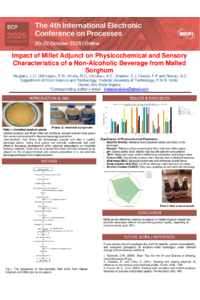
Malted sorghum (Sorghum bicolor) and finger millet (Eleusine coracana) are drought-tolerant grains widely available in Nigeria but remain underutilized in beverage production. Malt drinks, wholesome and non-alcoholic, are gaining popularity in the country. These local grains offer promising potential for sustainable beverage development. This study investigated the impact of incorporating millet as an adjunct on the physicochemical and sensory properties of a non-alcoholic beverage formulated from malted sorghum. Six beverage samples were formulated using malted sorghum and finger millet in the following ratios: 100:0 (S), 90:10 (SM1), 80:20 (SM2), 70:30 (SM3), 60:40 (SM4), and 50:50 (SM5). Standard analytical methods were employed to assess physicochemical parameters, including pH (4.71–4.88), °Brix (12.36–12. 77), density (1,048.28–1,049.68 kg/m³), specific gravity (1.05018 –1.05157), colour (180.05–200.15 HU), pasteurization unit (85.05–85.20 PU), bitterness (12.15–13.10 IBU), and alcohol content (0.065–0.105% ABV). The results showed millet inclusion did not compromise key quality indicators, with most values meeting industry standards. Density and specific gravity confirmed optimal extract concentration, while °Brix and bitterness supported an acceptable sensory balance. Although pH values were slightly above the ideal range for microbial inhibition, they indicated moderate acidity. Pasteurization units confirmed sufficient thermal processing for safety. Sensory evaluation showed no significant differences (p < 0.05) in appearance, aroma, taste, mouthfeel, or general acceptability among S, SM1, SM2, SM3, and SM4, except for SM5, which had significantly lower scores, especially in taste (3.67), aroma (4.40), and overall acceptability (2.60). The control (S) had the highest acceptability (6.53), followed by SM2 (6.13). Millet can serve as a viable adjunct in non-alcoholic beverage production using malted sorghum without adversely affecting physicochemical or sensory quality, particularly at inclusion levels up to 40%. This highlights the potential of using indigenous grains to reduce dependency on imported brewing materials and to enhance local crop utilization in developing regions like Nigeria.
Keywords
Malted sorghum
Millet adjunct
Non-alcoholic beverage
Physicochemical properties
Sensory evaluation.
Poster
sciforum-130984-Linda Oluchi Akajiaku.pdf
Carbohydrate profiling by HPLC—Advancing the use of Opuntia fruits as nutrient-rich inputs for sustainable food processing
Impact of Artificial Ripening Agents (Paracetamol and Calcium carbide) on Heavy Metals Compositions of Plantain (Musa paradisiaca) Fruit