Event submissions
Published
This submission belongs to the session S2. Chemical Processes and Systems of the event The 4th International Electronic Conference on Processes
Published date
17 Oct, 2025
Academic Editor
'%3e%3cpath%20d='M12.6657%2010.9104C12.4185%2010.325%2012.0599%209.79327%2011.6097%209.34482C11.1609%208.89508%2010.6293%208.5365%2010.0442%208.28888C10.0389%208.28626%2010.0337%208.28495%2010.0285%208.28233C10.8446%207.69279%2011.3752%206.73249%2011.3752%205.64904C11.3752%203.8542%209.92103%202.39999%208.1262%202.39999C6.33136%202.39999%204.87715%203.8542%204.87715%205.64904C4.87715%206.73249%205.40774%207.69279%206.22393%208.28364C6.21869%208.28626%206.21345%208.28757%206.20821%208.29019C5.62129%208.5378%205.09463%208.89284%204.64265%209.34613C4.1929%209.79493%203.83432%2010.3266%203.58671%2010.9117C3.34345%2011.4845%203.21226%2012.0987%203.20023%2012.7209C3.19988%2012.7349%203.20233%2012.7488%203.20744%2012.7619C3.21255%2012.7749%203.22022%2012.7867%203.22998%2012.7968C3.23975%2012.8068%203.25142%2012.8147%203.26431%2012.8202C3.2772%2012.8256%203.29105%2012.8284%203.30504%2012.8284H4.09109C4.14874%2012.8284%204.19459%2012.7825%204.1959%2012.7262C4.2221%2011.7148%204.62823%2010.7676%205.34617%2010.0497C6.08899%209.30683%207.0755%208.89808%208.1262%208.89808C9.17689%208.89808%2010.1634%209.30683%2010.9062%2010.0497C11.6242%2010.7676%2012.0303%2011.7148%2012.0565%2012.7262C12.0578%2012.7838%2012.1037%2012.8284%2012.1613%2012.8284H12.9474C12.9613%2012.8284%2012.9752%2012.8256%2012.9881%2012.8202C13.001%2012.8147%2013.0126%2012.8068%2013.0224%2012.7968C13.0322%2012.7867%2013.0398%2012.7749%2013.0449%2012.7619C13.0501%2012.7488%2013.0525%2012.7349%2013.0522%2012.7209C13.0391%2012.0947%2012.9094%2011.4855%2012.6657%2010.9104ZM8.1262%207.9024C7.52486%207.9024%206.9589%207.6679%206.53312%207.24211C6.10733%206.81633%205.87283%206.25037%205.87283%205.64904C5.87283%205.0477%206.10733%204.48174%206.53312%204.05596C6.9589%203.63018%207.52486%203.39567%208.1262%203.39567C8.72753%203.39567%209.29349%203.63018%209.71927%204.05596C10.1451%204.48174%2010.3796%205.0477%2010.3796%205.64904C10.3796%206.25037%2010.1451%206.81633%209.71927%207.24211C9.29349%207.6679%208.72753%207.9024%208.1262%207.9024Z'%20fill='%235D1EE1'/%3e%3c/g%3e%3c/svg%3e) Blaž Likozar
Blaž LikozarCitation
Ruzimurod Sattorovich Jurayev, SYNTHESIS OF BENZENE-1,2,4-TRIYL TRIS(2-(3-CARBOXY-4-HYDROXYBENZENESULFONATE) ACETATE), in Proceedings of The 4th International Electronic Conference on Processes, 20 October–22 October 2025, MDPI: Basel, Switzerland
Share
Email
Facebook
Twitter
LinkedIn
SYNTHESIS OF BENZENE-1,2,4-TRIYL TRIS(2-(3-CARBOXY-4-HYDROXYBENZENESULFONATE) ACETATE)

Ruzimurod Sattorovich Jurayev 1
1. Shahrisabz faculty of Food Engineering, Karshi State Technical University, 20, Shahrisabz str., Shakhrisabz 181306, Uzbekistan;
Abstract
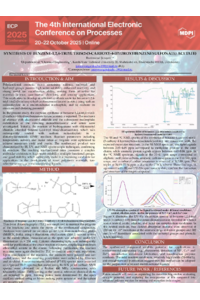
Benzene-1,2,4-triyl tris(2-(3-carboxy-4-hydroxybenzenesulfonate) acetate) synthesis is an important step forward in the synthesis of multifunctional organic molecules, which have potential uses in material science and medical chemistry, among other domains. In analytical chemistry, it can also be utilized for metal ion determination. This work presents a thorough and methodical approach to the synthesis of this complicated trisulfonated aromatic ester, emphasizing the effectiveness and scaling possibilities of the methodology. Choosing the right precursors to ensure that each one contributes to the intended molecular architecture was the first step in the synthesis process. In the initial stages of the synthesis process, oxyhydroquinone reacted with chloroacetyl chloride for 20 hours. As a result, benzene-1,2,4-triyl tris(2-chloroacetate) of triatomic phenol-oxyhydroquinone was formed. The resulting phenacetyl chloride was reacted with sodium sulfosalicylate in the presence of DMFA. Benzene-1,2,4-triyl tris(2-(3-carboxy-4-hydroxybenzenesulfonate) acetate) was formed. To obtain high yields and purity, careful adjustment of the reaction conditions—including temperature, solvent selection, and reagent ratios—was required. The synthesized molecule was characterized using advanced spectroscopic techniques such as NMR, IR, and UV spectrometry, which confirmed its structural integrity and functional group configuration. Benzene-1,2,4-triyl tris(2-(3-carboxy-4-hydroxybenzenesulfonate) acetate), the resultant product, has special physicochemical characteristics. In particular, it is more soluble and has the potential to be a useful intermediate in organic synthesis. Because it has several reactive sites, preliminary research indicates that it may be useful in the development of new polymeric materials and as a possible ligand in coordination chemistry.
Keywords
Oxyhydroquinone
chloracylation
sodium sulfosalicylate (sodium 3-carboxy-4-hydroxybenzenesulfonate)
nucleophilic substitution
trisulfonated aromatic ester
NMR
IR
UV
Poster
ChemicalProcessesandSystems_24424_SYNTHESIS_OF_BENZENE_1_2_4_TRI_slidessciforum-131560.pdf
Impact of Artificial Ripening Agents (Paracetamol and Calcium carbide) on Heavy Metals Compositions of Plantain (Musa paradisiaca) Fruit
A new extraction system based on the TBPS/thymol hydrophobic deep eutectic solvent