Event submissions
Published
This submission belongs to the session S2. Chemical Processes and Systems of the event The 4th International Electronic Conference on Processes
Published date
17 Oct, 2025
Academic Editor
'%3e%3cpath%20d='M12.6657%2010.9104C12.4185%2010.325%2012.0599%209.79327%2011.6097%209.34482C11.1609%208.89508%2010.6293%208.5365%2010.0442%208.28888C10.0389%208.28626%2010.0337%208.28495%2010.0285%208.28233C10.8446%207.69279%2011.3752%206.73249%2011.3752%205.64904C11.3752%203.8542%209.92103%202.39999%208.1262%202.39999C6.33136%202.39999%204.87715%203.8542%204.87715%205.64904C4.87715%206.73249%205.40774%207.69279%206.22393%208.28364C6.21869%208.28626%206.21345%208.28757%206.20821%208.29019C5.62129%208.5378%205.09463%208.89284%204.64265%209.34613C4.1929%209.79493%203.83432%2010.3266%203.58671%2010.9117C3.34345%2011.4845%203.21226%2012.0987%203.20023%2012.7209C3.19988%2012.7349%203.20233%2012.7488%203.20744%2012.7619C3.21255%2012.7749%203.22022%2012.7867%203.22998%2012.7968C3.23975%2012.8068%203.25142%2012.8147%203.26431%2012.8202C3.2772%2012.8256%203.29105%2012.8284%203.30504%2012.8284H4.09109C4.14874%2012.8284%204.19459%2012.7825%204.1959%2012.7262C4.2221%2011.7148%204.62823%2010.7676%205.34617%2010.0497C6.08899%209.30683%207.0755%208.89808%208.1262%208.89808C9.17689%208.89808%2010.1634%209.30683%2010.9062%2010.0497C11.6242%2010.7676%2012.0303%2011.7148%2012.0565%2012.7262C12.0578%2012.7838%2012.1037%2012.8284%2012.1613%2012.8284H12.9474C12.9613%2012.8284%2012.9752%2012.8256%2012.9881%2012.8202C13.001%2012.8147%2013.0126%2012.8068%2013.0224%2012.7968C13.0322%2012.7867%2013.0398%2012.7749%2013.0449%2012.7619C13.0501%2012.7488%2013.0525%2012.7349%2013.0522%2012.7209C13.0391%2012.0947%2012.9094%2011.4855%2012.6657%2010.9104ZM8.1262%207.9024C7.52486%207.9024%206.9589%207.6679%206.53312%207.24211C6.10733%206.81633%205.87283%206.25037%205.87283%205.64904C5.87283%205.0477%206.10733%204.48174%206.53312%204.05596C6.9589%203.63018%207.52486%203.39567%208.1262%203.39567C8.72753%203.39567%209.29349%203.63018%209.71927%204.05596C10.1451%204.48174%2010.3796%205.0477%2010.3796%205.64904C10.3796%206.25037%2010.1451%206.81633%209.71927%207.24211C9.29349%207.6679%208.72753%207.9024%208.1262%207.9024Z'%20fill='%235D1EE1'/%3e%3c/g%3e%3c/svg%3e) Blaž Likozar
Blaž LikozarCitation
Ruzimurod Jurayev, Bekzod Eshkulov, Electrochemical Synthesis of Ortho- and Para-Hydroxybenzoic Acids Using CO₂: Experimental and Simulation-Based Optimization, in Proceedings of The 4th International Electronic Conference on Processes, 20 October–22 October 2025, MDPI: Basel, Switzerland
Share
Email
Facebook
Twitter
LinkedIn
Electrochemical Synthesis of Ortho- and Para-Hydroxybenzoic Acids Using CO₂: Experimental and Simulation-Based Optimization

Ruzimurod Jurayev 1

Bekzod Eshkulov 2
1. Department of “Chemical Engineering”, Karshi State Technical University, 20, Shahrisabz str., Shakhrisabz 181306, Uzbekistan
2. Student of “Chemical technology”, Karshi State Technical University Shahrisabz Faculty of Food Engineering, 20, Shakhrisabz str., Shakhrisabz 181306, Uzbekistan
Abstract
The electrochemical synthesis of ortho- and para-hydroxybenzoic acids (o-HBA and p-HBA) utilizing CO₂ as a carbon source represents a sustainable and energy-efficient alternative to traditional high-temperature synthetic methods, such as the Kolbe–Schmitt reaction. These hydroxybenzoic acid isomers are valuable intermediates in pharmaceuticals, polymers, and cosmetics. This study presents an integrated approach combining experimental electrochemical analysis with process modeling using Aspen Plus to optimize key parameters affecting product yield and selectivity. Laboratory experiments identified the optimal reaction conditions at an applied potential of −1.2 V (vs. Ag/AgCl), 3 atm CO₂ pressure, and 50 °C, yielding 55.6% o-HBA and 38.2% p-HBA. Electrochemical behavior was further supported by simulations incorporating electrolyte thermodynamics (ELECNRTL) and yield-based reaction blocks (RYield), which accurately reflected observed trends. The model also included a recycle loop that improved the effective CO₂ utilization to over 76.8%, demonstrating process efficiency and resource recovery. Despite slight discrepancies between experimental and simulated yields due to modeling simplifications, the framework proved effective for evaluating process scalability. The study underscores the potential of CO₂-based electrochemical methods as green pathways for producing high-value chemicals while contributing to carbon mitigation strategies. This work lays a foundation for future advancements in reactor design, catalyst development, and industrial integration of CO₂ valorization technologies, aligning with global sustainability goals and the circular carbon economy.
Keywords
CO₂ utilization
electrochemical carboxylation
green synthesis
hydroxybenzoic acid isomers
process simulation
Aspen Plus
reaction optimization
sustainable chemistry
carbon capture and conversion
electrode performance
Poster
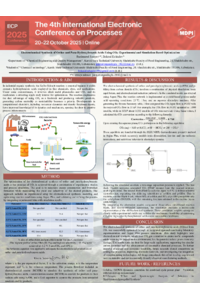
Electrochemistry.pdf
Modified Atmosphere Packaging as a Tool for Extending the Shelf Life of Desi Gulab (Rosa damascena)
Design and Analysis of an Ultra-Wideband Reconfigurable Intelligent Surface (RIS) at 28 GHz for mmWave Applications