Event submissions
Published
This submission belongs to the session S2. Chemical Processes and Systems of the event The 4th International Electronic Conference on Processes
Published date
17 Oct, 2025
Academic Editor
'%3e%3cpath%20d='M12.6657%2010.9104C12.4185%2010.325%2012.0599%209.79327%2011.6097%209.34482C11.1609%208.89508%2010.6293%208.5365%2010.0442%208.28888C10.0389%208.28626%2010.0337%208.28495%2010.0285%208.28233C10.8446%207.69279%2011.3752%206.73249%2011.3752%205.64904C11.3752%203.8542%209.92103%202.39999%208.1262%202.39999C6.33136%202.39999%204.87715%203.8542%204.87715%205.64904C4.87715%206.73249%205.40774%207.69279%206.22393%208.28364C6.21869%208.28626%206.21345%208.28757%206.20821%208.29019C5.62129%208.5378%205.09463%208.89284%204.64265%209.34613C4.1929%209.79493%203.83432%2010.3266%203.58671%2010.9117C3.34345%2011.4845%203.21226%2012.0987%203.20023%2012.7209C3.19988%2012.7349%203.20233%2012.7488%203.20744%2012.7619C3.21255%2012.7749%203.22022%2012.7867%203.22998%2012.7968C3.23975%2012.8068%203.25142%2012.8147%203.26431%2012.8202C3.2772%2012.8256%203.29105%2012.8284%203.30504%2012.8284H4.09109C4.14874%2012.8284%204.19459%2012.7825%204.1959%2012.7262C4.2221%2011.7148%204.62823%2010.7676%205.34617%2010.0497C6.08899%209.30683%207.0755%208.89808%208.1262%208.89808C9.17689%208.89808%2010.1634%209.30683%2010.9062%2010.0497C11.6242%2010.7676%2012.0303%2011.7148%2012.0565%2012.7262C12.0578%2012.7838%2012.1037%2012.8284%2012.1613%2012.8284H12.9474C12.9613%2012.8284%2012.9752%2012.8256%2012.9881%2012.8202C13.001%2012.8147%2013.0126%2012.8068%2013.0224%2012.7968C13.0322%2012.7867%2013.0398%2012.7749%2013.0449%2012.7619C13.0501%2012.7488%2013.0525%2012.7349%2013.0522%2012.7209C13.0391%2012.0947%2012.9094%2011.4855%2012.6657%2010.9104ZM8.1262%207.9024C7.52486%207.9024%206.9589%207.6679%206.53312%207.24211C6.10733%206.81633%205.87283%206.25037%205.87283%205.64904C5.87283%205.0477%206.10733%204.48174%206.53312%204.05596C6.9589%203.63018%207.52486%203.39567%208.1262%203.39567C8.72753%203.39567%209.29349%203.63018%209.71927%204.05596C10.1451%204.48174%2010.3796%205.0477%2010.3796%205.64904C10.3796%206.25037%2010.1451%206.81633%209.71927%207.24211C9.29349%207.6679%208.72753%207.9024%208.1262%207.9024Z'%20fill='%235D1EE1'/%3e%3c/g%3e%3c/svg%3e) Blaž Likozar
Blaž LikozarCitation
MALIKA BERREDJEM, IMENE MAALLEM, Development of a Green Method for the Synthesis of Xanthene-1,8-dione Derivatives from Dimedone and Aldehydes, in Proceedings of The 4th International Electronic Conference on Processes, 20 October–22 October 2025, MDPI: Basel, Switzerland
Share
Email
Facebook
Twitter
LinkedIn
Development of a Green Method for the Synthesis of Xanthene-1,8-dione Derivatives from Dimedone and Aldehydes
'%3e%3cpath%20d='M12.6647%2010.9104C12.4176%2010.325%2012.0589%209.7933%2011.6088%209.34485C11.16%208.89511%2010.6283%208.53653%2010.0432%208.28891C10.038%208.28629%2010.0327%208.28498%2010.0275%208.28236C10.8437%207.69282%2011.3743%206.73252%2011.3743%205.64907C11.3743%203.85423%209.92005%202.40002%208.12522%202.40002C6.33038%202.40002%204.87618%203.85423%204.87618%205.64907C4.87618%206.73252%205.40677%207.69282%206.22296%208.28367C6.21772%208.28629%206.21248%208.2876%206.20724%208.29022C5.62031%208.53783%205.09365%208.89287%204.64167%209.34616C4.19192%209.79496%203.83334%2010.3266%203.58573%2010.9117C3.34247%2011.4846%203.21128%2012.0987%203.19925%2012.721C3.1989%2012.735%203.20135%2012.7489%203.20646%2012.7619C3.21157%2012.7749%203.21924%2012.7868%203.22901%2012.7968C3.23877%2012.8068%203.25045%2012.8148%203.26334%2012.8202C3.27623%2012.8256%203.29007%2012.8284%203.30406%2012.8284H4.09012C4.14776%2012.8284%204.19362%2012.7825%204.19493%2012.7262C4.22113%2011.7148%204.62726%2010.7676%205.34519%2010.0497C6.08802%209.30686%207.07452%208.89811%208.12522%208.89811C9.17592%208.89811%2010.1624%209.30686%2010.9052%2010.0497C11.6232%2010.7676%2012.0293%2011.7148%2012.0555%2012.7262C12.0568%2012.7839%2012.1027%2012.8284%2012.1603%2012.8284H12.9464C12.9604%2012.8284%2012.9742%2012.8256%2012.9871%2012.8202C13%2012.8148%2013.0117%2012.8068%2013.0214%2012.7968C13.0312%2012.7868%2013.0389%2012.7749%2013.044%2012.7619C13.0491%2012.7489%2013.0515%2012.735%2013.0512%2012.721C13.0381%2012.0947%2012.9084%2011.4856%2012.6647%2010.9104ZM8.12522%207.90243C7.52388%207.90243%206.95792%207.66793%206.53214%207.24215C6.10636%206.81636%205.87185%206.2504%205.87185%205.64907C5.87185%205.04773%206.10636%204.48177%206.53214%204.05599C6.95792%203.63021%207.52388%203.3957%208.12522%203.3957C8.72655%203.3957%209.29252%203.63021%209.7183%204.05599C10.1441%204.48177%2010.3786%205.04773%2010.3786%205.64907C10.3786%206.2504%2010.1441%206.81636%209.7183%207.24215C9.29252%207.66793%208.72655%207.90243%208.12522%207.90243Z'%20fill='%235D1EE1'/%3e%3c/g%3e%3c/svg%3e)
MALIKA BERREDJEM 1
IMENE MAALLEM 1
1. Chemistry department, Badji Mokhtar Annaba university, 23000, Annaba, Algeria
Abstract
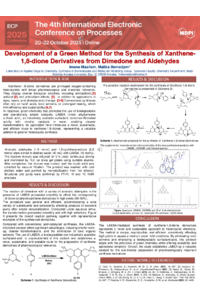
Xanthene-1,8-dione derivatives are of significant interest in pharmacology and materials chemistry due to their biological and optical properties. However, their traditional synthesis often involves toxic catalysts or environmentally harmful solvents. We propose a novel eco-friendly approach for synthesizing these compounds using green reaction conditions, avoiding hazardous organic solvents and minimizing unwanted byproducts.
The synthesis is carried out via condensation between dimedone and various aldehydes in the presence of linear alkylbenzene sulfonic acid (LABSA) as a biodegradable and cost-effective phase-transfer catalyst and under alternative activation methods such as ultrasound irradiation. The reaction is optimized to maximize yield while reducing environmental impact. LABSA, functioning both as a Brønsted acid and surfactant, is proposed to facilitate a multicomponent cascade process involving Knoevenagel condensation, Michael addition, and intramolecular cyclization
Xanthene-1,8-dione derivatives are obtained in high yields (88%-90%) with excellent purity. The method offers significant advantages, including reduced reaction time, atom economy, and easy purification. The products are characterized by spectroscopy (NMR, IR, MS) and chromatographic analysis. In IR strong carbonyl stretching bands observed near ~1623–1634 cm⁻¹ are characteristic of two conjugated carbonyl groups at positions 1 and 8 of the xanthene core.
This green strategy provides a sustainable alternative to conventional protocols, aligning with the principles of green chemistry. It opens new possibilities for the eco-friendly synthesis of heterocycles valuable in pharmaceuticals and fine chemistry.
Keywords
Green chemistry
Xanthene-1,8-dione
Sustainable catalysis
Dimedone
Organic solvent-free.
Poster
Chemical Processes and Systems-sciforum-139326.pdf
Biofabrication of ZnO and MgO Nanoparticles Using Dracaena trifasciata-Derived Reducing Agents and Their Antimicrobial Activity Against Pathogens
SYNTHESIS AND CHARACTERIZATION OF PANI/TiO2 COMPOSITE FOR PHOTOCATALYTIC ENVIRONMENTAL REMEDIATION