Event submissions
Published
This submission belongs to the session S2. Chemical Processes and Systems of the event The 4th International Electronic Conference on Processes
Published date
17 Oct, 2025
Academic Editor
'%3e%3cpath%20d='M12.6657%2010.9104C12.4185%2010.325%2012.0599%209.79327%2011.6097%209.34482C11.1609%208.89508%2010.6293%208.5365%2010.0442%208.28888C10.0389%208.28626%2010.0337%208.28495%2010.0285%208.28233C10.8446%207.69279%2011.3752%206.73249%2011.3752%205.64904C11.3752%203.8542%209.92103%202.39999%208.1262%202.39999C6.33136%202.39999%204.87715%203.8542%204.87715%205.64904C4.87715%206.73249%205.40774%207.69279%206.22393%208.28364C6.21869%208.28626%206.21345%208.28757%206.20821%208.29019C5.62129%208.5378%205.09463%208.89284%204.64265%209.34613C4.1929%209.79493%203.83432%2010.3266%203.58671%2010.9117C3.34345%2011.4845%203.21226%2012.0987%203.20023%2012.7209C3.19988%2012.7349%203.20233%2012.7488%203.20744%2012.7619C3.21255%2012.7749%203.22022%2012.7867%203.22998%2012.7968C3.23975%2012.8068%203.25142%2012.8147%203.26431%2012.8202C3.2772%2012.8256%203.29105%2012.8284%203.30504%2012.8284H4.09109C4.14874%2012.8284%204.19459%2012.7825%204.1959%2012.7262C4.2221%2011.7148%204.62823%2010.7676%205.34617%2010.0497C6.08899%209.30683%207.0755%208.89808%208.1262%208.89808C9.17689%208.89808%2010.1634%209.30683%2010.9062%2010.0497C11.6242%2010.7676%2012.0303%2011.7148%2012.0565%2012.7262C12.0578%2012.7838%2012.1037%2012.8284%2012.1613%2012.8284H12.9474C12.9613%2012.8284%2012.9752%2012.8256%2012.9881%2012.8202C13.001%2012.8147%2013.0126%2012.8068%2013.0224%2012.7968C13.0322%2012.7867%2013.0398%2012.7749%2013.0449%2012.7619C13.0501%2012.7488%2013.0525%2012.7349%2013.0522%2012.7209C13.0391%2012.0947%2012.9094%2011.4855%2012.6657%2010.9104ZM8.1262%207.9024C7.52486%207.9024%206.9589%207.6679%206.53312%207.24211C6.10733%206.81633%205.87283%206.25037%205.87283%205.64904C5.87283%205.0477%206.10733%204.48174%206.53312%204.05596C6.9589%203.63018%207.52486%203.39567%208.1262%203.39567C8.72753%203.39567%209.29349%203.63018%209.71927%204.05596C10.1451%204.48174%2010.3796%205.0477%2010.3796%205.64904C10.3796%206.25037%2010.1451%206.81633%209.71927%207.24211C9.29349%207.6679%208.72753%207.9024%208.1262%207.9024Z'%20fill='%235D1EE1'/%3e%3c/g%3e%3c/svg%3e) Blaž Likozar
Blaž LikozarCitation
Ahmed Mohammed Inuwa, Muhammad Alhassan Adam, Yakubu Musa Atiku, Umar Salim Ibrahim, Abubakar M A, Yunusa H A, Integrated Process Development and Optimization of Anaerobic Digestion of Septic Sludge for Renewable Biomethane Generation, in Proceedings of The 4th International Electronic Conference on Processes, 20 October–22 October 2025, MDPI: Basel, Switzerland
Share
Email
Facebook
Twitter
LinkedIn
Integrated Process Development and Optimization of Anaerobic Digestion of Septic Sludge for Renewable Biomethane Generation

Ahmed Mohammed Inuwa 1
'%3e%3cpath%20d='M12.6647%2010.9104C12.4176%2010.325%2012.0589%209.7933%2011.6088%209.34485C11.16%208.89511%2010.6283%208.53653%2010.0432%208.28891C10.038%208.28629%2010.0327%208.28498%2010.0275%208.28236C10.8437%207.69282%2011.3743%206.73252%2011.3743%205.64907C11.3743%203.85423%209.92005%202.40002%208.12522%202.40002C6.33038%202.40002%204.87618%203.85423%204.87618%205.64907C4.87618%206.73252%205.40677%207.69282%206.22296%208.28367C6.21772%208.28629%206.21248%208.2876%206.20724%208.29022C5.62031%208.53783%205.09365%208.89287%204.64167%209.34616C4.19192%209.79496%203.83334%2010.3266%203.58573%2010.9117C3.34247%2011.4846%203.21128%2012.0987%203.19925%2012.721C3.1989%2012.735%203.20135%2012.7489%203.20646%2012.7619C3.21157%2012.7749%203.21924%2012.7868%203.22901%2012.7968C3.23877%2012.8068%203.25045%2012.8148%203.26334%2012.8202C3.27623%2012.8256%203.29007%2012.8284%203.30406%2012.8284H4.09012C4.14776%2012.8284%204.19362%2012.7825%204.19493%2012.7262C4.22113%2011.7148%204.62726%2010.7676%205.34519%2010.0497C6.08802%209.30686%207.07452%208.89811%208.12522%208.89811C9.17592%208.89811%2010.1624%209.30686%2010.9052%2010.0497C11.6232%2010.7676%2012.0293%2011.7148%2012.0555%2012.7262C12.0568%2012.7839%2012.1027%2012.8284%2012.1603%2012.8284H12.9464C12.9604%2012.8284%2012.9742%2012.8256%2012.9871%2012.8202C13%2012.8148%2013.0117%2012.8068%2013.0214%2012.7968C13.0312%2012.7868%2013.0389%2012.7749%2013.044%2012.7619C13.0491%2012.7489%2013.0515%2012.735%2013.0512%2012.721C13.0381%2012.0947%2012.9084%2011.4856%2012.6647%2010.9104ZM8.12522%207.90243C7.52388%207.90243%206.95792%207.66793%206.53214%207.24215C6.10636%206.81636%205.87185%206.2504%205.87185%205.64907C5.87185%205.04773%206.10636%204.48177%206.53214%204.05599C6.95792%203.63021%207.52388%203.3957%208.12522%203.3957C8.72655%203.3957%209.29252%203.63021%209.7183%204.05599C10.1441%204.48177%2010.3786%205.04773%2010.3786%205.64907C10.3786%206.2504%2010.1441%206.81636%209.7183%207.24215C9.29252%207.66793%208.72655%207.90243%208.12522%207.90243Z'%20fill='%235D1EE1'/%3e%3c/g%3e%3c/svg%3e)
Muhammad Alhassan Adam 1
Yakubu Musa Atiku 1
Umar Salim Ibrahim 1
Abubakar M A 2
Yunusa H A 2
1. Department of Chemical Engineering, Abubakar Tafawa Balewa University, Bauchi 740272, Nigeria
2. Department of Mechanical Engineering Technology, Federal Polytechnic Bauchi, 740102, Bauchi, Nigeria
Abstract
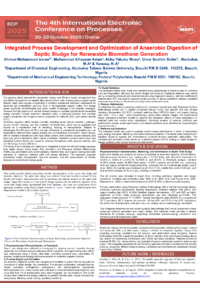
Septic tank sludge, rich in organic content, presents a valuable opportunity for renewable energy generation through anaerobic digestion. This study explores its potential for biomethane production by developing and optimizing a bioconversion system. Extensive experimental work began with the physicochemical characterization of the sludge, including proximate and ultimate analyses, which revealed a high heating value (HHV) of 14.324 MJ/kg and favorable elemental composition for energy recovery. Batch anaerobic digestion experiments were conducted under controlled conditions to assess system performance, with pH, volatile fatty acids (VFA), and total ammonia nitrogen (TAN) maintained within optimal ranges to ensure process stability. Simulation and process modeling were carried out using Aspen Plus, and the model was validated against experimental methane yield data, achieving an excellent fit (R² = 0.9917). Key operational parameters, including temperature, hydraulic retention time (HRT), and organic loading rate (OLR) were optimized using Response Surface Methodology (RSM). The analysis identified that a hydrolysis temperature of 35 °C, a digestion temperature of 60 °C, HRT of 35 days, and OLR of 37.907 L¹day¹ produced the highest biomethane output at 99.98%, with up to 96.67% degradation efficiency. These findings confirm that precise control and optimization of digestion conditions can significantly enhance biogas yield from septic tank sludge. The validated model and experimental insights contribute to the development of sustainable waste-to-energy solutions, offering a practical approach to mitigating environmental and public health challenges posed by improper sludge disposal.
Keywords
Anaerobic Digestion
Septic Sludge
Biomethane
Optimization
Poster
ECP_Poster.pdf
SYNTHESIS AND CHARACTERIZATION OF PANI/TiO2 COMPOSITE FOR PHOTOCATALYTIC ENVIRONMENTAL REMEDIATION
Evaluation of Copper Extraction on Low-Grade Oxide Ores Using Column Heap Leaching