Event submissions
Published
This submission belongs to the session S5. Materials Manufacturing and Sustainable Packaging of the event The 4th International Electronic Conference on Processes
Published date
17 Oct, 2025
Academic Editor
'%3e%3cpath%20d='M12.6657%2010.9104C12.4185%2010.325%2012.0599%209.79327%2011.6097%209.34482C11.1609%208.89508%2010.6293%208.5365%2010.0442%208.28888C10.0389%208.28626%2010.0337%208.28495%2010.0285%208.28233C10.8446%207.69279%2011.3752%206.73249%2011.3752%205.64904C11.3752%203.8542%209.92103%202.39999%208.1262%202.39999C6.33136%202.39999%204.87715%203.8542%204.87715%205.64904C4.87715%206.73249%205.40774%207.69279%206.22393%208.28364C6.21869%208.28626%206.21345%208.28757%206.20821%208.29019C5.62129%208.5378%205.09463%208.89284%204.64265%209.34613C4.1929%209.79493%203.83432%2010.3266%203.58671%2010.9117C3.34345%2011.4845%203.21226%2012.0987%203.20023%2012.7209C3.19988%2012.7349%203.20233%2012.7488%203.20744%2012.7619C3.21255%2012.7749%203.22022%2012.7867%203.22998%2012.7968C3.23975%2012.8068%203.25142%2012.8147%203.26431%2012.8202C3.2772%2012.8256%203.29105%2012.8284%203.30504%2012.8284H4.09109C4.14874%2012.8284%204.19459%2012.7825%204.1959%2012.7262C4.2221%2011.7148%204.62823%2010.7676%205.34617%2010.0497C6.08899%209.30683%207.0755%208.89808%208.1262%208.89808C9.17689%208.89808%2010.1634%209.30683%2010.9062%2010.0497C11.6242%2010.7676%2012.0303%2011.7148%2012.0565%2012.7262C12.0578%2012.7838%2012.1037%2012.8284%2012.1613%2012.8284H12.9474C12.9613%2012.8284%2012.9752%2012.8256%2012.9881%2012.8202C13.001%2012.8147%2013.0126%2012.8068%2013.0224%2012.7968C13.0322%2012.7867%2013.0398%2012.7749%2013.0449%2012.7619C13.0501%2012.7488%2013.0525%2012.7349%2013.0522%2012.7209C13.0391%2012.0947%2012.9094%2011.4855%2012.6657%2010.9104ZM8.1262%207.9024C7.52486%207.9024%206.9589%207.6679%206.53312%207.24211C6.10733%206.81633%205.87283%206.25037%205.87283%205.64904C5.87283%205.0477%206.10733%204.48174%206.53312%204.05596C6.9589%203.63018%207.52486%203.39567%208.1262%203.39567C8.72753%203.39567%209.29349%203.63018%209.71927%204.05596C10.1451%204.48174%2010.3796%205.0477%2010.3796%205.64904C10.3796%206.25037%2010.1451%206.81633%209.71927%207.24211C9.29349%207.6679%208.72753%207.9024%208.1262%207.9024Z'%20fill='%235D1EE1'/%3e%3c/g%3e%3c/svg%3e) Maria Josè Lo Faro
Maria Josè Lo FaroCitation
Heshani Indeewari Adikari, Pramod Bandara, BIODEGRADABLE SMART FILM USING JACKFRUIT (Artocarpus heterophyllus) SEED STARCH AND BEETROOT (Beta vulgaris) EXTRACT AS A FRESHNESS INDICATOR, in Proceedings of The 4th International Electronic Conference on Processes, 20 October–22 October 2025, MDPI: Basel, Switzerland
Share
Email
Facebook
Twitter
LinkedIn
BIODEGRADABLE SMART FILM USING JACKFRUIT (Artocarpus heterophyllus) SEED STARCH AND BEETROOT (Beta vulgaris) EXTRACT AS A FRESHNESS INDICATOR
'%3e%3cpath%20d='M12.6647%2010.9104C12.4176%2010.325%2012.0589%209.7933%2011.6088%209.34485C11.16%208.89511%2010.6283%208.53653%2010.0432%208.28891C10.038%208.28629%2010.0327%208.28498%2010.0275%208.28236C10.8437%207.69282%2011.3743%206.73252%2011.3743%205.64907C11.3743%203.85423%209.92005%202.40002%208.12522%202.40002C6.33038%202.40002%204.87618%203.85423%204.87618%205.64907C4.87618%206.73252%205.40677%207.69282%206.22296%208.28367C6.21772%208.28629%206.21248%208.2876%206.20724%208.29022C5.62031%208.53783%205.09365%208.89287%204.64167%209.34616C4.19192%209.79496%203.83334%2010.3266%203.58573%2010.9117C3.34247%2011.4846%203.21128%2012.0987%203.19925%2012.721C3.1989%2012.735%203.20135%2012.7489%203.20646%2012.7619C3.21157%2012.7749%203.21924%2012.7868%203.22901%2012.7968C3.23877%2012.8068%203.25045%2012.8148%203.26334%2012.8202C3.27623%2012.8256%203.29007%2012.8284%203.30406%2012.8284H4.09012C4.14776%2012.8284%204.19362%2012.7825%204.19493%2012.7262C4.22113%2011.7148%204.62726%2010.7676%205.34519%2010.0497C6.08802%209.30686%207.07452%208.89811%208.12522%208.89811C9.17592%208.89811%2010.1624%209.30686%2010.9052%2010.0497C11.6232%2010.7676%2012.0293%2011.7148%2012.0555%2012.7262C12.0568%2012.7839%2012.1027%2012.8284%2012.1603%2012.8284H12.9464C12.9604%2012.8284%2012.9742%2012.8256%2012.9871%2012.8202C13%2012.8148%2013.0117%2012.8068%2013.0214%2012.7968C13.0312%2012.7868%2013.0389%2012.7749%2013.044%2012.7619C13.0491%2012.7489%2013.0515%2012.735%2013.0512%2012.721C13.0381%2012.0947%2012.9084%2011.4856%2012.6647%2010.9104ZM8.12522%207.90243C7.52388%207.90243%206.95792%207.66793%206.53214%207.24215C6.10636%206.81636%205.87185%206.2504%205.87185%205.64907C5.87185%205.04773%206.10636%204.48177%206.53214%204.05599C6.95792%203.63021%207.52388%203.3957%208.12522%203.3957C8.72655%203.3957%209.29252%203.63021%209.7183%204.05599C10.1441%204.48177%2010.3786%205.04773%2010.3786%205.64907C10.3786%206.2504%2010.1441%206.81636%209.7183%207.24215C9.29252%207.66793%208.72655%207.90243%208.12522%207.90243Z'%20fill='%235D1EE1'/%3e%3c/g%3e%3c/svg%3e)
Heshani Indeewari Adikari 1
Pramod Bandara 1
1. Department of Food Science & Technology, Faculty of Applied Sciences, Sabaragamuwa University of Sri Lanka, Belihuloya, Sri Lanka
Abstract
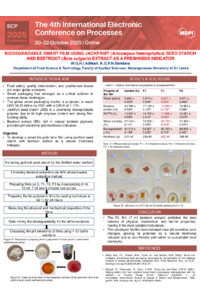
Food safety, quality deterioration and postharvest losses are growing issues and smart packaging has emerged as a critical solution to address these challenges. The global smart packaging market is currently valued at USD 24.28 billion and is projected to grow to USD 34.35 billion by 2030 with a compound annual growth rate (CAGR) of 7.12%. This study aimed to develop a biofilm based on jackfruit seed starch (JSS) incorporated with beetroot extract (BE) as a freshness indicator. Jackfruit seed starch was selected as the primary polymer matrix due to its high amylose content that enhances film-forming ability and structural integrity. Beetroot, which is rich in natural betalain color pigment, contributes to pH sensitivity. Four formulations of films were developed by the casting technique: Control without BE, F1 (10 ml BE), F2 (7 ml BE), and F3 (4 ml BE). The F2 formulation had a lower water activity value, moisture content value, and water vapor transmission rate, constituting (0.627 ± 0.003), (10.596 ± 0.106%), and (11.636 ± 0.082%), respectively, compared to F1, F3 and C. The lowest water solubility (33.33 ± 0.00%) was also shown by F2, compared to F1 and F3 films. Among all formulations, F2 had the highest hardness of 422.40 g. Thus, F2 showed more excellent physical and mechanical properties than F1 and F3. The F1 formulation exhibited the highest biodegradability (94.837 ± 0.552%), followed by C (91.513 ± 0.189%), F2 (92.0033 ± 0.1150%), and F3 (88.050 ± 0.437%). The pH sensitivity of the extract and film was confirmed using standard buffer solutions from pH 1 to 13. F1 showed reddish purple at (pH 1), red at (pH 6), and brownish yellow at (pH 13). Therefore, F1 had more pH sensitivity. Consequently, the developed biofilm serves as an eco-friendly, smart film for meat packaging, sustainable waste valorization and plastic reduction initiatives.
Keywords
beetroot extract
biodegradable film
jackfruit seed starch
pH sensitivity
smart film
sustainable packaging
Poster
MaterialsManufacturingandSustainablePackaging_24488_BIODEGRADABLE_SMART_FILM_USING_slidessciforum-138658.pdf
Electrospun Nanofibers from PAN and Bio-Based Polymer Blend for Potential Biomedical Applications
Assessing the Environmental Footprint of Industrial Packaging