Event submissions
Published
This submission belongs to the session S5. Materials Manufacturing and Sustainable Packaging of the event The 4th International Electronic Conference on Processes
Published date
17 Oct, 2025
Academic Editor
'%3e%3cpath%20d='M12.6657%2010.9104C12.4185%2010.325%2012.0599%209.79327%2011.6097%209.34482C11.1609%208.89508%2010.6293%208.5365%2010.0442%208.28888C10.0389%208.28626%2010.0337%208.28495%2010.0285%208.28233C10.8446%207.69279%2011.3752%206.73249%2011.3752%205.64904C11.3752%203.8542%209.92103%202.39999%208.1262%202.39999C6.33136%202.39999%204.87715%203.8542%204.87715%205.64904C4.87715%206.73249%205.40774%207.69279%206.22393%208.28364C6.21869%208.28626%206.21345%208.28757%206.20821%208.29019C5.62129%208.5378%205.09463%208.89284%204.64265%209.34613C4.1929%209.79493%203.83432%2010.3266%203.58671%2010.9117C3.34345%2011.4845%203.21226%2012.0987%203.20023%2012.7209C3.19988%2012.7349%203.20233%2012.7488%203.20744%2012.7619C3.21255%2012.7749%203.22022%2012.7867%203.22998%2012.7968C3.23975%2012.8068%203.25142%2012.8147%203.26431%2012.8202C3.2772%2012.8256%203.29105%2012.8284%203.30504%2012.8284H4.09109C4.14874%2012.8284%204.19459%2012.7825%204.1959%2012.7262C4.2221%2011.7148%204.62823%2010.7676%205.34617%2010.0497C6.08899%209.30683%207.0755%208.89808%208.1262%208.89808C9.17689%208.89808%2010.1634%209.30683%2010.9062%2010.0497C11.6242%2010.7676%2012.0303%2011.7148%2012.0565%2012.7262C12.0578%2012.7838%2012.1037%2012.8284%2012.1613%2012.8284H12.9474C12.9613%2012.8284%2012.9752%2012.8256%2012.9881%2012.8202C13.001%2012.8147%2013.0126%2012.8068%2013.0224%2012.7968C13.0322%2012.7867%2013.0398%2012.7749%2013.0449%2012.7619C13.0501%2012.7488%2013.0525%2012.7349%2013.0522%2012.7209C13.0391%2012.0947%2012.9094%2011.4855%2012.6657%2010.9104ZM8.1262%207.9024C7.52486%207.9024%206.9589%207.6679%206.53312%207.24211C6.10733%206.81633%205.87283%206.25037%205.87283%205.64904C5.87283%205.0477%206.10733%204.48174%206.53312%204.05596C6.9589%203.63018%207.52486%203.39567%208.1262%203.39567C8.72753%203.39567%209.29349%203.63018%209.71927%204.05596C10.1451%204.48174%2010.3796%205.0477%2010.3796%205.64904C10.3796%206.25037%2010.1451%206.81633%209.71927%207.24211C9.29349%207.6679%208.72753%207.9024%208.1262%207.9024Z'%20fill='%235D1EE1'/%3e%3c/g%3e%3c/svg%3e) Adina Magdalena Musuc
Adina Magdalena MusucCitation
Ana Luisa Grafia, Silvia Elena Barbosa, Hydrophobic-to-Hydrophilic Transition of Polyethylene Surfaces via Salicylic Acid Grafting, in Proceedings of The 4th International Electronic Conference on Processes, 20 October–22 October 2025, MDPI: Basel, Switzerland
Share
Email
Facebook
Twitter
LinkedIn
Hydrophobic-to-Hydrophilic Transition of Polyethylene Surfaces via Salicylic Acid Grafting
'%3e%3cpath%20d='M12.6647%2010.9104C12.4176%2010.325%2012.0589%209.7933%2011.6088%209.34485C11.16%208.89511%2010.6283%208.53653%2010.0432%208.28891C10.038%208.28629%2010.0327%208.28498%2010.0275%208.28236C10.8437%207.69282%2011.3743%206.73252%2011.3743%205.64907C11.3743%203.85423%209.92005%202.40002%208.12522%202.40002C6.33038%202.40002%204.87618%203.85423%204.87618%205.64907C4.87618%206.73252%205.40677%207.69282%206.22296%208.28367C6.21772%208.28629%206.21248%208.2876%206.20724%208.29022C5.62031%208.53783%205.09365%208.89287%204.64167%209.34616C4.19192%209.79496%203.83334%2010.3266%203.58573%2010.9117C3.34247%2011.4846%203.21128%2012.0987%203.19925%2012.721C3.1989%2012.735%203.20135%2012.7489%203.20646%2012.7619C3.21157%2012.7749%203.21924%2012.7868%203.22901%2012.7968C3.23877%2012.8068%203.25045%2012.8148%203.26334%2012.8202C3.27623%2012.8256%203.29007%2012.8284%203.30406%2012.8284H4.09012C4.14776%2012.8284%204.19362%2012.7825%204.19493%2012.7262C4.22113%2011.7148%204.62726%2010.7676%205.34519%2010.0497C6.08802%209.30686%207.07452%208.89811%208.12522%208.89811C9.17592%208.89811%2010.1624%209.30686%2010.9052%2010.0497C11.6232%2010.7676%2012.0293%2011.7148%2012.0555%2012.7262C12.0568%2012.7839%2012.1027%2012.8284%2012.1603%2012.8284H12.9464C12.9604%2012.8284%2012.9742%2012.8256%2012.9871%2012.8202C13%2012.8148%2013.0117%2012.8068%2013.0214%2012.7968C13.0312%2012.7868%2013.0389%2012.7749%2013.044%2012.7619C13.0491%2012.7489%2013.0515%2012.735%2013.0512%2012.721C13.0381%2012.0947%2012.9084%2011.4856%2012.6647%2010.9104ZM8.12522%207.90243C7.52388%207.90243%206.95792%207.66793%206.53214%207.24215C6.10636%206.81636%205.87185%206.2504%205.87185%205.64907C5.87185%205.04773%206.10636%204.48177%206.53214%204.05599C6.95792%203.63021%207.52388%203.3957%208.12522%203.3957C8.72655%203.3957%209.29252%203.63021%209.7183%204.05599C10.1441%204.48177%2010.3786%205.04773%2010.3786%205.64907C10.3786%206.2504%2010.1441%206.81636%209.7183%207.24215C9.29252%207.66793%208.72655%207.90243%208.12522%207.90243Z'%20fill='%235D1EE1'/%3e%3c/g%3e%3c/svg%3e)
Ana Luisa Grafia 1
Silvia Elena Barbosa 1
1. PLAPIQUI-CONICET-UNS, Bahía Blanca 8000, Argentina
Abstract
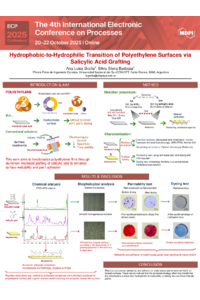
Polyethylene (PE) is one of the most widely used thermoplastics worldwide due to its excellent balance of cost, performance, and sustainability. However, its inherently hydrophobic and chemically inert surface limits its suitability for applications requiring adhesion, such as printing, painting, and lamination—particularly in flexible packaging. These limitations are especially pronounced with water-based paints, which are more environmentally friendly but less compatible with hydrophobic substrates. Plasma or corona treatments are commonly employed to improve surface wettability, but they often lack specificity, are difficult to control, and offer only temporary effects. In this study, we propose a surface functionalization method involving the grafting of salicylic acid (SA)—a polar, aromatic molecule—onto PE films via an aluminum-mediated alkylation approach that is compatible with continuous film processing systems.
Low-density PE films (15 × 15 cm; Dow 203) were surface-softened using infrared heating and then sequentially sprayed with a 155 mg AlCl₃ solution in 25 mL n-heptane and a 500 mg SA solution in 25 mL absolute ethanol using an airbrush (120° fan, 6 mL/min). Unreacted species were removed by ethanol sonication. The modified surfaces were characterized by Fourier Transform Infrared Spectroscopy (Nicolet 520) and optical microscopy (Andostar). Paintability was evaluated using red water-based paint.
Spectroscopic analysis confirmed the formation of aluminum salicylate complexes chemically anchored to the PE surface. Microscopy revealed uniform surface modification, and painting tests demonstrated a significant improvement in the wettability and adhesion of water-based paints. These results indicate that the proposed strategy effectively transforms the PE surface from hydrophobic to hydrophilic, enabling the use of eco-friendly paints.
Keywords
Polyethylene
surface modification
aluminum salicylate complexes
surface grafting
Poster
sciforum-131692.pdf
Development of 3D Printed Multifunctional Surgical retractor Integrated with Suction and IrrigationUsing 17-4ph and 316L stainless Steel
Adaptive Facades and Smart Building Skins for Energy Efficiency: A Study for Materials Performance and Sustainable Design Processes