Event submissions
Published
This submission belongs to the session S5. Materials Manufacturing and Sustainable Packaging of the event The 4th International Electronic Conference on Processes
Published date
17 Oct, 2025
Academic Editor
'%3e%3cpath%20d='M12.6657%2010.9104C12.4185%2010.325%2012.0599%209.79327%2011.6097%209.34482C11.1609%208.89508%2010.6293%208.5365%2010.0442%208.28888C10.0389%208.28626%2010.0337%208.28495%2010.0285%208.28233C10.8446%207.69279%2011.3752%206.73249%2011.3752%205.64904C11.3752%203.8542%209.92103%202.39999%208.1262%202.39999C6.33136%202.39999%204.87715%203.8542%204.87715%205.64904C4.87715%206.73249%205.40774%207.69279%206.22393%208.28364C6.21869%208.28626%206.21345%208.28757%206.20821%208.29019C5.62129%208.5378%205.09463%208.89284%204.64265%209.34613C4.1929%209.79493%203.83432%2010.3266%203.58671%2010.9117C3.34345%2011.4845%203.21226%2012.0987%203.20023%2012.7209C3.19988%2012.7349%203.20233%2012.7488%203.20744%2012.7619C3.21255%2012.7749%203.22022%2012.7867%203.22998%2012.7968C3.23975%2012.8068%203.25142%2012.8147%203.26431%2012.8202C3.2772%2012.8256%203.29105%2012.8284%203.30504%2012.8284H4.09109C4.14874%2012.8284%204.19459%2012.7825%204.1959%2012.7262C4.2221%2011.7148%204.62823%2010.7676%205.34617%2010.0497C6.08899%209.30683%207.0755%208.89808%208.1262%208.89808C9.17689%208.89808%2010.1634%209.30683%2010.9062%2010.0497C11.6242%2010.7676%2012.0303%2011.7148%2012.0565%2012.7262C12.0578%2012.7838%2012.1037%2012.8284%2012.1613%2012.8284H12.9474C12.9613%2012.8284%2012.9752%2012.8256%2012.9881%2012.8202C13.001%2012.8147%2013.0126%2012.8068%2013.0224%2012.7968C13.0322%2012.7867%2013.0398%2012.7749%2013.0449%2012.7619C13.0501%2012.7488%2013.0525%2012.7349%2013.0522%2012.7209C13.0391%2012.0947%2012.9094%2011.4855%2012.6657%2010.9104ZM8.1262%207.9024C7.52486%207.9024%206.9589%207.6679%206.53312%207.24211C6.10733%206.81633%205.87283%206.25037%205.87283%205.64904C5.87283%205.0477%206.10733%204.48174%206.53312%204.05596C6.9589%203.63018%207.52486%203.39567%208.1262%203.39567C8.72753%203.39567%209.29349%203.63018%209.71927%204.05596C10.1451%204.48174%2010.3796%205.0477%2010.3796%205.64904C10.3796%206.25037%2010.1451%206.81633%209.71927%207.24211C9.29349%207.6679%208.72753%207.9024%208.1262%207.9024Z'%20fill='%235D1EE1'/%3e%3c/g%3e%3c/svg%3e) Adina Magdalena Musuc
Adina Magdalena MusucCitation
Gaveshani Kavindya, Pramod Bandara, Development and Characterization of Biodegradable Packaging Material from Sugarcane Bagasse, Rice Straw, and Cogon Grass Leaves, in Proceedings of The 4th International Electronic Conference on Processes, 20 October–22 October 2025, MDPI: Basel, Switzerland
Share
Email
Facebook
Twitter
LinkedIn
Development and Characterization of Biodegradable Packaging Material from Sugarcane Bagasse, Rice Straw, and Cogon Grass Leaves
'%3e%3cpath%20d='M12.6647%2010.9104C12.4176%2010.325%2012.0589%209.7933%2011.6088%209.34485C11.16%208.89511%2010.6283%208.53653%2010.0432%208.28891C10.038%208.28629%2010.0327%208.28498%2010.0275%208.28236C10.8437%207.69282%2011.3743%206.73252%2011.3743%205.64907C11.3743%203.85423%209.92005%202.40002%208.12522%202.40002C6.33038%202.40002%204.87618%203.85423%204.87618%205.64907C4.87618%206.73252%205.40677%207.69282%206.22296%208.28367C6.21772%208.28629%206.21248%208.2876%206.20724%208.29022C5.62031%208.53783%205.09365%208.89287%204.64167%209.34616C4.19192%209.79496%203.83334%2010.3266%203.58573%2010.9117C3.34247%2011.4846%203.21128%2012.0987%203.19925%2012.721C3.1989%2012.735%203.20135%2012.7489%203.20646%2012.7619C3.21157%2012.7749%203.21924%2012.7868%203.22901%2012.7968C3.23877%2012.8068%203.25045%2012.8148%203.26334%2012.8202C3.27623%2012.8256%203.29007%2012.8284%203.30406%2012.8284H4.09012C4.14776%2012.8284%204.19362%2012.7825%204.19493%2012.7262C4.22113%2011.7148%204.62726%2010.7676%205.34519%2010.0497C6.08802%209.30686%207.07452%208.89811%208.12522%208.89811C9.17592%208.89811%2010.1624%209.30686%2010.9052%2010.0497C11.6232%2010.7676%2012.0293%2011.7148%2012.0555%2012.7262C12.0568%2012.7839%2012.1027%2012.8284%2012.1603%2012.8284H12.9464C12.9604%2012.8284%2012.9742%2012.8256%2012.9871%2012.8202C13%2012.8148%2013.0117%2012.8068%2013.0214%2012.7968C13.0312%2012.7868%2013.0389%2012.7749%2013.044%2012.7619C13.0491%2012.7489%2013.0515%2012.735%2013.0512%2012.721C13.0381%2012.0947%2012.9084%2011.4856%2012.6647%2010.9104ZM8.12522%207.90243C7.52388%207.90243%206.95792%207.66793%206.53214%207.24215C6.10636%206.81636%205.87185%206.2504%205.87185%205.64907C5.87185%205.04773%206.10636%204.48177%206.53214%204.05599C6.95792%203.63021%207.52388%203.3957%208.12522%203.3957C8.72655%203.3957%209.29252%203.63021%209.7183%204.05599C10.1441%204.48177%2010.3786%205.04773%2010.3786%205.64907C10.3786%206.2504%2010.1441%206.81636%209.7183%207.24215C9.29252%207.66793%208.72655%207.90243%208.12522%207.90243Z'%20fill='%235D1EE1'/%3e%3c/g%3e%3c/svg%3e)
Gaveshani Kavindya 1
Pramod Bandara 2
1. Sabaragamuwa University of Sri lanka, Belihuloya, Sri Lanka
2. Department of Food Science and Technology, Sabaragamuwa University of Sri Lanka, Belihuloya, Sri Lanka
Abstract
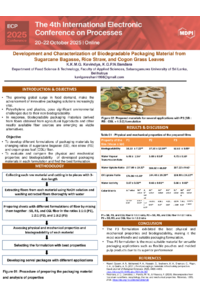
The rising global emphasis on sustainability has intensified the demand for eco-friendly packaging solutions. In response, biodegradable packaging materials derived from fibers sourced from agricultural byproducts and naturally abundant plants have emerged. The present study focused on the development of biodegradable packaging using fibers derived from sugarcane (Saccharum officinarum) bagasse (SB), rice (Oryza sativa) straw (RS), and cogon grass (Imperata cylindrica) leaf (CGL), an invasive weed. Using standardized alkali treatment for fiber extraction, three film formulations were prepared by blending SB, RS, and CGL fiber at ratios of 1:1:1 (P1), 1:2:1 (P2), and 1:3:2 (P3), and their biodegradability, water vapor transmission rate (WVTR), water uptake ratio (WUR), oil uptake ratio (OUR), water activity (WA), color metrics, and bonding structure were evaluated using FTIR analysis. These parameters were compared with those of commercially available biodegradable packaging to assess relative performance. Data were analyzed using one-way ANOVA, followed by Tukey’s test, using MINITAB 19.0 software at a significance level of p < 0.05. Among the analyzed formulations, P3 demonstrated the most favorable performance across multiple parameters. It possessed significantly higher biodegradability (63.63 ± 9.09%; p < 0.05), supporting environmental compatibility and significantly favorable barrier properties, and the lowest WVTR (4.72 ± 0.59%), WUR (197.22 ± 9.62%), and OUR (138.9 ± 24.1%; p < 0.05), indicating enhanced resistance to moisture and oil penetration. It showed the lowest WA (0.65 ± 0.01; p < 0.05), potentially contributing to reduced microbial growth. Optically, P3 had the highest color difference (ΔE) compared to commercial biodegradable packaging (17.74 ± 0.10), with lighter appearance (L* = -15.74 ± 0.06) and a red hue (a* = 7.48 ± 0.13), enhancing its visual appeal. FTIR analysis further confirmed favorable performances of P3 with improved bonding structure. Hence, this study underscores the potential of utilizing agricultural residues and abundant natural fibers for developing biodegradable packaging that mitigates environmental impacts while contributing to the circular economy.
Keywords
biodegradable packaging
byproduct utilization
Cogon grass (Imperata cylindrica)
Rice straw (Oryza sativa)
Sugarcane bagasse (Saccharum officinarum)
sustainability
Poster
sciforum-132065-K.K.M.G. Kavindya ECP2025.pdf
Adaptive Facades and Smart Building Skins for Energy Efficiency: A Study for Materials Performance and Sustainable Design Processes
Predictive Modeling of Biodegradable Material Degradation Using Deep Learning with Improved Regulatory and Liability-Aware Approach