Event submissions
Published
This submission belongs to the session S6. Pharmaceutical Processing and Particle Processes of the event The 4th International Electronic Conference on Processes
Published date
17 Oct, 2025
Academic Editor
'%3e%3cpath%20d='M12.6657%2010.9104C12.4185%2010.325%2012.0599%209.79327%2011.6097%209.34482C11.1609%208.89508%2010.6293%208.5365%2010.0442%208.28888C10.0389%208.28626%2010.0337%208.28495%2010.0285%208.28233C10.8446%207.69279%2011.3752%206.73249%2011.3752%205.64904C11.3752%203.8542%209.92103%202.39999%208.1262%202.39999C6.33136%202.39999%204.87715%203.8542%204.87715%205.64904C4.87715%206.73249%205.40774%207.69279%206.22393%208.28364C6.21869%208.28626%206.21345%208.28757%206.20821%208.29019C5.62129%208.5378%205.09463%208.89284%204.64265%209.34613C4.1929%209.79493%203.83432%2010.3266%203.58671%2010.9117C3.34345%2011.4845%203.21226%2012.0987%203.20023%2012.7209C3.19988%2012.7349%203.20233%2012.7488%203.20744%2012.7619C3.21255%2012.7749%203.22022%2012.7867%203.22998%2012.7968C3.23975%2012.8068%203.25142%2012.8147%203.26431%2012.8202C3.2772%2012.8256%203.29105%2012.8284%203.30504%2012.8284H4.09109C4.14874%2012.8284%204.19459%2012.7825%204.1959%2012.7262C4.2221%2011.7148%204.62823%2010.7676%205.34617%2010.0497C6.08899%209.30683%207.0755%208.89808%208.1262%208.89808C9.17689%208.89808%2010.1634%209.30683%2010.9062%2010.0497C11.6242%2010.7676%2012.0303%2011.7148%2012.0565%2012.7262C12.0578%2012.7838%2012.1037%2012.8284%2012.1613%2012.8284H12.9474C12.9613%2012.8284%2012.9752%2012.8256%2012.9881%2012.8202C13.001%2012.8147%2013.0126%2012.8068%2013.0224%2012.7968C13.0322%2012.7867%2013.0398%2012.7749%2013.0449%2012.7619C13.0501%2012.7488%2013.0525%2012.7349%2013.0522%2012.7209C13.0391%2012.0947%2012.9094%2011.4855%2012.6657%2010.9104ZM8.1262%207.9024C7.52486%207.9024%206.9589%207.6679%206.53312%207.24211C6.10733%206.81633%205.87283%206.25037%205.87283%205.64904C5.87283%205.0477%206.10733%204.48174%206.53312%204.05596C6.9589%203.63018%207.52486%203.39567%208.1262%203.39567C8.72753%203.39567%209.29349%203.63018%209.71927%204.05596C10.1451%204.48174%2010.3796%205.0477%2010.3796%205.64904C10.3796%206.25037%2010.1451%206.81633%209.71927%207.24211C9.29349%207.6679%208.72753%207.9024%208.1262%207.9024Z'%20fill='%235D1EE1'/%3e%3c/g%3e%3c/svg%3e) Paolo Trucillo
Paolo TrucilloCitation
Maria Reshetova, Pavel Markin, Svetlana Appolonova, Roman Maslennikov, Oxana Zolnikova, Vladimir Ivashkin, Metabolic Profile Alterations in the Progression of ALD- and NAFLD-Induced Liver Cirrhosis, in Proceedings of The 4th International Electronic Conference on Processes, 20 October–22 October 2025, MDPI: Basel, Switzerland
Share
Email
Facebook
Twitter
LinkedIn
Metabolic Profile Alterations in the Progression of ALD- and NAFLD-Induced Liver Cirrhosis
'%3e%3cpath%20d='M12.6647%2010.9104C12.4176%2010.325%2012.0589%209.7933%2011.6088%209.34485C11.16%208.89511%2010.6283%208.53653%2010.0432%208.28891C10.038%208.28629%2010.0327%208.28498%2010.0275%208.28236C10.8437%207.69282%2011.3743%206.73252%2011.3743%205.64907C11.3743%203.85423%209.92005%202.40002%208.12522%202.40002C6.33038%202.40002%204.87618%203.85423%204.87618%205.64907C4.87618%206.73252%205.40677%207.69282%206.22296%208.28367C6.21772%208.28629%206.21248%208.2876%206.20724%208.29022C5.62031%208.53783%205.09365%208.89287%204.64167%209.34616C4.19192%209.79496%203.83334%2010.3266%203.58573%2010.9117C3.34247%2011.4846%203.21128%2012.0987%203.19925%2012.721C3.1989%2012.735%203.20135%2012.7489%203.20646%2012.7619C3.21157%2012.7749%203.21924%2012.7868%203.22901%2012.7968C3.23877%2012.8068%203.25045%2012.8148%203.26334%2012.8202C3.27623%2012.8256%203.29007%2012.8284%203.30406%2012.8284H4.09012C4.14776%2012.8284%204.19362%2012.7825%204.19493%2012.7262C4.22113%2011.7148%204.62726%2010.7676%205.34519%2010.0497C6.08802%209.30686%207.07452%208.89811%208.12522%208.89811C9.17592%208.89811%2010.1624%209.30686%2010.9052%2010.0497C11.6232%2010.7676%2012.0293%2011.7148%2012.0555%2012.7262C12.0568%2012.7839%2012.1027%2012.8284%2012.1603%2012.8284H12.9464C12.9604%2012.8284%2012.9742%2012.8256%2012.9871%2012.8202C13%2012.8148%2013.0117%2012.8068%2013.0214%2012.7968C13.0312%2012.7868%2013.0389%2012.7749%2013.044%2012.7619C13.0491%2012.7489%2013.0515%2012.735%2013.0512%2012.721C13.0381%2012.0947%2012.9084%2011.4856%2012.6647%2010.9104ZM8.12522%207.90243C7.52388%207.90243%206.95792%207.66793%206.53214%207.24215C6.10636%206.81636%205.87185%206.2504%205.87185%205.64907C5.87185%205.04773%206.10636%204.48177%206.53214%204.05599C6.95792%203.63021%207.52388%203.3957%208.12522%203.3957C8.72655%203.3957%209.29252%203.63021%209.7183%204.05599C10.1441%204.48177%2010.3786%205.04773%2010.3786%205.64907C10.3786%206.2504%2010.1441%206.81636%209.7183%207.24215C9.29252%207.66793%208.72655%207.90243%208.12522%207.90243Z'%20fill='%235D1EE1'/%3e%3c/g%3e%3c/svg%3e)
Maria Reshetova 1
Pavel Markin 2
Svetlana Appolonova 2
Roman Maslennikov 1
Oxana Zolnikova 1
Vladimir Ivashkin 1
1. Department of Internal Medicine, Gastroenterology and Hepatology, I.M. Sechenov First Moscow State Medical University, 119435 Moscow, Russia
2. Centre of Biopharmaceutical Analysis and Metabolomics, I.M. Sechenov First Moscow State Medical University, 119435 Moscow, Russia
Abstract
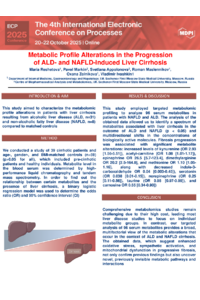
This study aimed to characterize the metabolomic profile alterations in patients with liver cirrhosis resulting from alcoholic liver disease (ALD, n=31) and non-alcoholic fatty liver disease (NAFLD, n=8) compared to matched controls.
Materials and methods: We conducted a study of 39 cirrhotic patients and age-, gender-, and BMI-matched controls (n=59) (p>0.05 for all), which included pre-cirrhotic patients and healthy individuals. Metabolite level in the blood serum was determined by high-performance liquid chromatography and tandem mass spectrometry. In order to find out the relationship between certain metabolites and the presence of liver cirrhosis, a binary logistic regression model was used to determine the odds ratio (OR) and 95% confidence interval (CI).
Results: This study employed targeted metabolomic profiling to analyze 96 serum metabolites in patients with NAFLD and ALD. The analysis of the obtained data allowed us to identify a spectrum of metabolites associated with liver cirrhosis in the outcome of ALD and NAFLD (p < 0.05) and multidirectional shifts in the concentrations of biologically active molecules. Fibrosis progression was associated with significant metabolite alterations: increased levels of kynurenine (OR 2.93 [1.56-5.51]), acetyl-carnitine (OR 1.08 [1.01-1.17]), epinephrine OR 26.5 [5.7-123.4], dimethylarginine OR 20.2 [2.5-164.8], and methionine OR 1.10 [1.05-1.16], along with decreased indole-3-carboxaldehyde OR 0.04 [0.003-0.45]), serotonin (OR 0.038 [0.01-0.15]), norepinephrine (OR 0.25 [0.11-0.56]), taurine (OR 0.98 [0.97-0.99]), and carnosine OR 0.55 [0.34-0.90]).
Conclusion: Comprehensive metabolomics studies remain challenging due to their high cost, leading most liver disease studies to focus on individual metabolite groups. In contrast, our targeted analysis of 96 serum metabolites provides a broad, multifactorial view of the metabolic alterations that occur in the context of ALD and NAFLD cirrhosis. The obtained data, which suggest enhanced oxidative stress, sympathetic activation, and mitochondrial dysfunction in progressive fibrosis, not only confirm previous findings but also uncover novel, previously invisible metabolic pathways and interactions.
Keywords
Metabolic profile
Liver Cirrhosis
ALD
NAFLD
Poster
Sciforum-138942.pdf
A comprehensive examination of catalysts enhancing effectiveness and innovation in thermal reactions
Bioanalytical methods and bioavailability study of modified oligosaccharides by ionic liquid as potential inhibitors against SARS-CoV-2