Event submissions
Published
This submission belongs to the session S6. Pharmaceutical Processing and Particle Processes of the event The 4th International Electronic Conference on Processes
Published date
17 Oct, 2025
Academic Editor
'%3e%3cpath%20d='M12.6657%2010.9104C12.4185%2010.325%2012.0599%209.79327%2011.6097%209.34482C11.1609%208.89508%2010.6293%208.5365%2010.0442%208.28888C10.0389%208.28626%2010.0337%208.28495%2010.0285%208.28233C10.8446%207.69279%2011.3752%206.73249%2011.3752%205.64904C11.3752%203.8542%209.92103%202.39999%208.1262%202.39999C6.33136%202.39999%204.87715%203.8542%204.87715%205.64904C4.87715%206.73249%205.40774%207.69279%206.22393%208.28364C6.21869%208.28626%206.21345%208.28757%206.20821%208.29019C5.62129%208.5378%205.09463%208.89284%204.64265%209.34613C4.1929%209.79493%203.83432%2010.3266%203.58671%2010.9117C3.34345%2011.4845%203.21226%2012.0987%203.20023%2012.7209C3.19988%2012.7349%203.20233%2012.7488%203.20744%2012.7619C3.21255%2012.7749%203.22022%2012.7867%203.22998%2012.7968C3.23975%2012.8068%203.25142%2012.8147%203.26431%2012.8202C3.2772%2012.8256%203.29105%2012.8284%203.30504%2012.8284H4.09109C4.14874%2012.8284%204.19459%2012.7825%204.1959%2012.7262C4.2221%2011.7148%204.62823%2010.7676%205.34617%2010.0497C6.08899%209.30683%207.0755%208.89808%208.1262%208.89808C9.17689%208.89808%2010.1634%209.30683%2010.9062%2010.0497C11.6242%2010.7676%2012.0303%2011.7148%2012.0565%2012.7262C12.0578%2012.7838%2012.1037%2012.8284%2012.1613%2012.8284H12.9474C12.9613%2012.8284%2012.9752%2012.8256%2012.9881%2012.8202C13.001%2012.8147%2013.0126%2012.8068%2013.0224%2012.7968C13.0322%2012.7867%2013.0398%2012.7749%2013.0449%2012.7619C13.0501%2012.7488%2013.0525%2012.7349%2013.0522%2012.7209C13.0391%2012.0947%2012.9094%2011.4855%2012.6657%2010.9104ZM8.1262%207.9024C7.52486%207.9024%206.9589%207.6679%206.53312%207.24211C6.10733%206.81633%205.87283%206.25037%205.87283%205.64904C5.87283%205.0477%206.10733%204.48174%206.53312%204.05596C6.9589%203.63018%207.52486%203.39567%208.1262%203.39567C8.72753%203.39567%209.29349%203.63018%209.71927%204.05596C10.1451%204.48174%2010.3796%205.0477%2010.3796%205.64904C10.3796%206.25037%2010.1451%206.81633%209.71927%207.24211C9.29349%207.6679%208.72753%207.9024%208.1262%207.9024Z'%20fill='%235D1EE1'/%3e%3c/g%3e%3c/svg%3e) Paolo Trucillo
Paolo TrucilloCitation
K ANJALI, T NANDHA GOPAL, T MEGALA, A ASHWIN, A YASOTHA, MODELLING RABIES TRANSMISSION WITH VACCINATION: INCORPORATING PHARMACEUTICAL AND PARTICLE PROCESSING FOR PRE-EXPOSURE PROPHYLAXIS OPTIMIZATION, in Proceedings of The 4th International Electronic Conference on Processes, 20 October–22 October 2025, MDPI: Basel, Switzerland
Share
Email
Facebook
Twitter
LinkedIn
MODELLING RABIES TRANSMISSION WITH VACCINATION: INCORPORATING PHARMACEUTICAL AND PARTICLE PROCESSING FOR PRE-EXPOSURE PROPHYLAXIS OPTIMIZATION
'%3e%3cpath%20d='M12.6647%2010.9104C12.4176%2010.325%2012.0589%209.7933%2011.6088%209.34485C11.16%208.89511%2010.6283%208.53653%2010.0432%208.28891C10.038%208.28629%2010.0327%208.28498%2010.0275%208.28236C10.8437%207.69282%2011.3743%206.73252%2011.3743%205.64907C11.3743%203.85423%209.92005%202.40002%208.12522%202.40002C6.33038%202.40002%204.87618%203.85423%204.87618%205.64907C4.87618%206.73252%205.40677%207.69282%206.22296%208.28367C6.21772%208.28629%206.21248%208.2876%206.20724%208.29022C5.62031%208.53783%205.09365%208.89287%204.64167%209.34616C4.19192%209.79496%203.83334%2010.3266%203.58573%2010.9117C3.34247%2011.4846%203.21128%2012.0987%203.19925%2012.721C3.1989%2012.735%203.20135%2012.7489%203.20646%2012.7619C3.21157%2012.7749%203.21924%2012.7868%203.22901%2012.7968C3.23877%2012.8068%203.25045%2012.8148%203.26334%2012.8202C3.27623%2012.8256%203.29007%2012.8284%203.30406%2012.8284H4.09012C4.14776%2012.8284%204.19362%2012.7825%204.19493%2012.7262C4.22113%2011.7148%204.62726%2010.7676%205.34519%2010.0497C6.08802%209.30686%207.07452%208.89811%208.12522%208.89811C9.17592%208.89811%2010.1624%209.30686%2010.9052%2010.0497C11.6232%2010.7676%2012.0293%2011.7148%2012.0555%2012.7262C12.0568%2012.7839%2012.1027%2012.8284%2012.1603%2012.8284H12.9464C12.9604%2012.8284%2012.9742%2012.8256%2012.9871%2012.8202C13%2012.8148%2013.0117%2012.8068%2013.0214%2012.7968C13.0312%2012.7868%2013.0389%2012.7749%2013.044%2012.7619C13.0491%2012.7489%2013.0515%2012.735%2013.0512%2012.721C13.0381%2012.0947%2012.9084%2011.4856%2012.6647%2010.9104ZM8.12522%207.90243C7.52388%207.90243%206.95792%207.66793%206.53214%207.24215C6.10636%206.81636%205.87185%206.2504%205.87185%205.64907C5.87185%205.04773%206.10636%204.48177%206.53214%204.05599C6.95792%203.63021%207.52388%203.3957%208.12522%203.3957C8.72655%203.3957%209.29252%203.63021%209.7183%204.05599C10.1441%204.48177%2010.3786%205.04773%2010.3786%205.64907C10.3786%206.2504%2010.1441%206.81636%209.7183%207.24215C9.29252%207.66793%208.72655%207.90243%208.12522%207.90243Z'%20fill='%235D1EE1'/%3e%3c/g%3e%3c/svg%3e)
K ANJALI 1
T NANDHA GOPAL 1
T MEGALA 1
A ASHWIN 1

A YASOTHA 2
1. Department of Mathematics, Sri Ramakrishna Mission Vidyalaya College of Arts and Science, Coimbatore 641020, Tamil Nadu, India
2. Department of Mathematics, United Institute of Technology, Coimbatore 641020, Tamil Nadu, India
Abstract
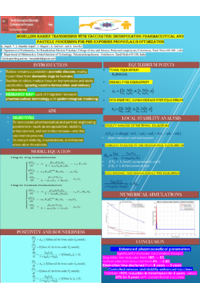
Rabies remains a persistent zoonotic threat, particularly in regions where domestic dogs are the main source of human and animal infections. This mathematical model studies the dynamics of rabies transmission between canine populations (dog-to-dog) and from canines to humans (dog-to-human). The model incorporates susceptible, infected, and vaccinated compartments for both species, with pre-exposure vaccination as the key control strategy. Processes such as encapsulation, stability enhancement, and controlled release are modelled as parameters influencing vaccination rates in both dogs and humans. Specifically, the model introduces processing-dependent vaccination functions that reflect improved bioavailability, immunogenicity, and delivery efficiency due to advanced formulation techniques.
This interdisciplinary approach bridges mathematical epidemiology and pharmaceutical technology. Earlier rabies models focus on transmission and static vaccination, often ignoring vaccine formulation and delivery. Our current work fills this gap by incorporating pharmaceutical and particle engineering parameters into the vaccination terms of the model, thereby providing a more comprehensive framework for optimizing rabies control strategies in endemic regions.
Positivity and boundedness analyses confirm that all model variables remain biologically feasible and bounded over time. Stability analysis identifies thresholds for disease elimination or persistence. Numerical simulations show that enhancing pharmaceutical parameters increases vaccination impact, reducing peak infection prevalence in dogs from 18% to 5% and in humans from 4% to 0.8%, and shortening elimination time from 8 years to 3 years. Formulations with controlled release and improved stability maintain over 90% reduction in transmission for more than 5 years, compared to 60% over 3 years for conventional vaccines. This will ensure that the model’s predictions are validated against realistic conditions and can effectively guide rabies control strategies.
Keywords
transmission
pharmaceutical
encapsulation
drug stability enhancement
controlled release
Poster
poster.pdf
Bioanalytical methods and bioavailability study of modified oligosaccharides by ionic liquid as potential inhibitors against SARS-CoV-2
Neferine suppresses cell migration and invasion by inhibiting EMT via the MAPK Pathway in human endometrial cancer