Event submissions
Published
This submission belongs to the session S1. Environmental and Green Processes of the event The 4th International Electronic Conference on Processes
Published date
17 Oct, 2025
Academic Editor
'%3e%3cpath%20d='M12.6657%2010.9104C12.4185%2010.325%2012.0599%209.79327%2011.6097%209.34482C11.1609%208.89508%2010.6293%208.5365%2010.0442%208.28888C10.0389%208.28626%2010.0337%208.28495%2010.0285%208.28233C10.8446%207.69279%2011.3752%206.73249%2011.3752%205.64904C11.3752%203.8542%209.92103%202.39999%208.1262%202.39999C6.33136%202.39999%204.87715%203.8542%204.87715%205.64904C4.87715%206.73249%205.40774%207.69279%206.22393%208.28364C6.21869%208.28626%206.21345%208.28757%206.20821%208.29019C5.62129%208.5378%205.09463%208.89284%204.64265%209.34613C4.1929%209.79493%203.83432%2010.3266%203.58671%2010.9117C3.34345%2011.4845%203.21226%2012.0987%203.20023%2012.7209C3.19988%2012.7349%203.20233%2012.7488%203.20744%2012.7619C3.21255%2012.7749%203.22022%2012.7867%203.22998%2012.7968C3.23975%2012.8068%203.25142%2012.8147%203.26431%2012.8202C3.2772%2012.8256%203.29105%2012.8284%203.30504%2012.8284H4.09109C4.14874%2012.8284%204.19459%2012.7825%204.1959%2012.7262C4.2221%2011.7148%204.62823%2010.7676%205.34617%2010.0497C6.08899%209.30683%207.0755%208.89808%208.1262%208.89808C9.17689%208.89808%2010.1634%209.30683%2010.9062%2010.0497C11.6242%2010.7676%2012.0303%2011.7148%2012.0565%2012.7262C12.0578%2012.7838%2012.1037%2012.8284%2012.1613%2012.8284H12.9474C12.9613%2012.8284%2012.9752%2012.8256%2012.9881%2012.8202C13.001%2012.8147%2013.0126%2012.8068%2013.0224%2012.7968C13.0322%2012.7867%2013.0398%2012.7749%2013.0449%2012.7619C13.0501%2012.7488%2013.0525%2012.7349%2013.0522%2012.7209C13.0391%2012.0947%2012.9094%2011.4855%2012.6657%2010.9104ZM8.1262%207.9024C7.52486%207.9024%206.9589%207.6679%206.53312%207.24211C6.10733%206.81633%205.87283%206.25037%205.87283%205.64904C5.87283%205.0477%206.10733%204.48174%206.53312%204.05596C6.9589%203.63018%207.52486%203.39567%208.1262%203.39567C8.72753%203.39567%209.29349%203.63018%209.71927%204.05596C10.1451%204.48174%2010.3796%205.0477%2010.3796%205.64904C10.3796%206.25037%2010.1451%206.81633%209.71927%207.24211C9.29349%207.6679%208.72753%207.9024%208.1262%207.9024Z'%20fill='%235D1EE1'/%3e%3c/g%3e%3c/svg%3e) Young-Cheol Chang
Young-Cheol ChangCitation
Abdullatif Musa, Gadri Al-Glale, Magdi Hassn B. Mussa, Interface Engineering in Hybrid Energy Systems: A Case Study of Enhancing the Efficiency of a PEM Fuel Cell With Gas Turbine Integration, in Proceedings of The 4th International Electronic Conference on Processes, 20 October–22 October 2025, MDPI: Basel, Switzerland
Share
Email
Facebook
Twitter
LinkedIn
Interface Engineering in Hybrid Energy Systems: A Case Study of Enhancing the Efficiency of a PEM Fuel Cell With Gas Turbine Integration
'%3e%3cpath%20d='M12.6647%2010.9104C12.4176%2010.325%2012.0589%209.7933%2011.6088%209.34485C11.16%208.89511%2010.6283%208.53653%2010.0432%208.28891C10.038%208.28629%2010.0327%208.28498%2010.0275%208.28236C10.8437%207.69282%2011.3743%206.73252%2011.3743%205.64907C11.3743%203.85423%209.92005%202.40002%208.12522%202.40002C6.33038%202.40002%204.87618%203.85423%204.87618%205.64907C4.87618%206.73252%205.40677%207.69282%206.22296%208.28367C6.21772%208.28629%206.21248%208.2876%206.20724%208.29022C5.62031%208.53783%205.09365%208.89287%204.64167%209.34616C4.19192%209.79496%203.83334%2010.3266%203.58573%2010.9117C3.34247%2011.4846%203.21128%2012.0987%203.19925%2012.721C3.1989%2012.735%203.20135%2012.7489%203.20646%2012.7619C3.21157%2012.7749%203.21924%2012.7868%203.22901%2012.7968C3.23877%2012.8068%203.25045%2012.8148%203.26334%2012.8202C3.27623%2012.8256%203.29007%2012.8284%203.30406%2012.8284H4.09012C4.14776%2012.8284%204.19362%2012.7825%204.19493%2012.7262C4.22113%2011.7148%204.62726%2010.7676%205.34519%2010.0497C6.08802%209.30686%207.07452%208.89811%208.12522%208.89811C9.17592%208.89811%2010.1624%209.30686%2010.9052%2010.0497C11.6232%2010.7676%2012.0293%2011.7148%2012.0555%2012.7262C12.0568%2012.7839%2012.1027%2012.8284%2012.1603%2012.8284H12.9464C12.9604%2012.8284%2012.9742%2012.8256%2012.9871%2012.8202C13%2012.8148%2013.0117%2012.8068%2013.0214%2012.7968C13.0312%2012.7868%2013.0389%2012.7749%2013.044%2012.7619C13.0491%2012.7489%2013.0515%2012.735%2013.0512%2012.721C13.0381%2012.0947%2012.9084%2011.4856%2012.6647%2010.9104ZM8.12522%207.90243C7.52388%207.90243%206.95792%207.66793%206.53214%207.24215C6.10636%206.81636%205.87185%206.2504%205.87185%205.64907C5.87185%205.04773%206.10636%204.48177%206.53214%204.05599C6.95792%203.63021%207.52388%203.3957%208.12522%203.3957C8.72655%203.3957%209.29252%203.63021%209.7183%204.05599C10.1441%204.48177%2010.3786%205.04773%2010.3786%205.64907C10.3786%206.2504%2010.1441%206.81636%209.7183%207.24215C9.29252%207.66793%208.72655%207.90243%208.12522%207.90243Z'%20fill='%235D1EE1'/%3e%3c/g%3e%3c/svg%3e)
Abdullatif Musa 1
Gadri Al-Glale 1
Magdi Hassn B. Mussa 2,3
1. Department of Marine Engineering; Faculty of Engineering; University of Tripoli; Tripoli; Libya
2. The Institute of Marine Engineering, Science And Technology, London, UK
3. School of Engineering and Built Environment, Sheffield Hallam University, Sheffield, UK
Abstract
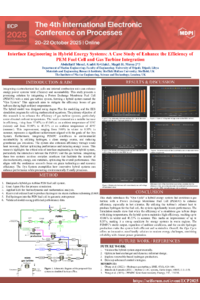
Integrating electrochemical fuel cells and internal combustion units can enhance energy power systems' total efficiency and sustainability. This study presents a promising solution by integrating a Proton Exchange Membrane Fuel Cell (PEMFC) with a mini gas turbine system, forming a hybrid system named the "Oya System." This approach aims to mitigate the efficiency losses of gas turbines during high ambient temperatures.
The hybrid model is designed using Aspen Plus for modeling and the EES simulation program for solving mathematical equations. The primary objective of this research is to enhance the efficiency of gas turbine systems, particularly under elevated ambient temperatures. The results demonstrate a notable increase in efficiency, rising from 37.97% to 43.06% at an ambient temperature of 10°C (winter) and from 31.98% to 40.33% at an ambient temperature of 40°C (summer). This improvement, ranging from 5.09% in winter to 8.35% in summer, represents a significant achievement aligned with the goals of the Oya System. Furthermore, integrating PEMFC contributes to environmental sustainability by utilizing hydrogen, a clean energy source, and reducing greenhouse gas emissions. The system also enhances efficiency through waste heat recovery, further optimizing performance and reducing energy losses. This research highlights the critical role of interface engineering in the hybrid system, particularly the interaction between the PEMFC and the gas turbine. Integrating these two systems involves complex interfaces that facilitate the transfer of electrochemistry, energy, and materials, optimizing the overall performance. This aligns with the conference session's focus on green technologies and resource efficiency. The Oya System exemplifies how innovative hybrid systems can enhance performance while promoting environmentally friendly processes.
Keywords
Proton Exchange Membrane Fuel Cell
hybrid systems
Gas Turbine System
Environmental Sustainability
Green Technologies
Resource Efficiency
Waste Heat Recovery
Interface Engineering
Poster
poster presentation 4th proc. conference .pdf
Integrating Pharmaceutical Processing into Hepatitis Virus Treatment Model: Optimizing Drug Release and Therapeutic Response
Isolation and Purification of Lectin-like Protein from Terminalia catappa Seeds Using Combination of Chromatographic Techniques