Event submissions
Published
This submission belongs to the session S1. Environmental and Green Processes of the event The 4th International Electronic Conference on Processes
Published date
17 Oct, 2025
Academic Editor
'%3e%3cpath%20d='M12.6657%2010.9104C12.4185%2010.325%2012.0599%209.79327%2011.6097%209.34482C11.1609%208.89508%2010.6293%208.5365%2010.0442%208.28888C10.0389%208.28626%2010.0337%208.28495%2010.0285%208.28233C10.8446%207.69279%2011.3752%206.73249%2011.3752%205.64904C11.3752%203.8542%209.92103%202.39999%208.1262%202.39999C6.33136%202.39999%204.87715%203.8542%204.87715%205.64904C4.87715%206.73249%205.40774%207.69279%206.22393%208.28364C6.21869%208.28626%206.21345%208.28757%206.20821%208.29019C5.62129%208.5378%205.09463%208.89284%204.64265%209.34613C4.1929%209.79493%203.83432%2010.3266%203.58671%2010.9117C3.34345%2011.4845%203.21226%2012.0987%203.20023%2012.7209C3.19988%2012.7349%203.20233%2012.7488%203.20744%2012.7619C3.21255%2012.7749%203.22022%2012.7867%203.22998%2012.7968C3.23975%2012.8068%203.25142%2012.8147%203.26431%2012.8202C3.2772%2012.8256%203.29105%2012.8284%203.30504%2012.8284H4.09109C4.14874%2012.8284%204.19459%2012.7825%204.1959%2012.7262C4.2221%2011.7148%204.62823%2010.7676%205.34617%2010.0497C6.08899%209.30683%207.0755%208.89808%208.1262%208.89808C9.17689%208.89808%2010.1634%209.30683%2010.9062%2010.0497C11.6242%2010.7676%2012.0303%2011.7148%2012.0565%2012.7262C12.0578%2012.7838%2012.1037%2012.8284%2012.1613%2012.8284H12.9474C12.9613%2012.8284%2012.9752%2012.8256%2012.9881%2012.8202C13.001%2012.8147%2013.0126%2012.8068%2013.0224%2012.7968C13.0322%2012.7867%2013.0398%2012.7749%2013.0449%2012.7619C13.0501%2012.7488%2013.0525%2012.7349%2013.0522%2012.7209C13.0391%2012.0947%2012.9094%2011.4855%2012.6657%2010.9104ZM8.1262%207.9024C7.52486%207.9024%206.9589%207.6679%206.53312%207.24211C6.10733%206.81633%205.87283%206.25037%205.87283%205.64904C5.87283%205.0477%206.10733%204.48174%206.53312%204.05596C6.9589%203.63018%207.52486%203.39567%208.1262%203.39567C8.72753%203.39567%209.29349%203.63018%209.71927%204.05596C10.1451%204.48174%2010.3796%205.0477%2010.3796%205.64904C10.3796%206.25037%2010.1451%206.81633%209.71927%207.24211C9.29349%207.6679%208.72753%207.9024%208.1262%207.9024Z'%20fill='%235D1EE1'/%3e%3c/g%3e%3c/svg%3e) Young-Cheol Chang
Young-Cheol ChangCitation
Isabel Pestana Paixão Cansado, Paulo A.M. Mourão, José Eduardo F. Castanheiro, Pedro F. Geraldo, Screening of raw materials from agricultural and forestry activities for application in the removal of dyes from water, in Proceedings of The 4th International Electronic Conference on Processes, 20 October–22 October 2025, MDPI: Basel, Switzerland
Share
Email
Facebook
Twitter
LinkedIn
Screening of raw materials from agricultural and forestry activities for application in the removal of dyes from water

Isabel Pestana Paixão Cansado 1

Paulo A.M. Mourão 1

José Eduardo F. Castanheiro 1
'%3e%3cpath%20d='M12.6647%2010.9104C12.4176%2010.325%2012.0589%209.7933%2011.6088%209.34485C11.16%208.89511%2010.6283%208.53653%2010.0432%208.28891C10.038%208.28629%2010.0327%208.28498%2010.0275%208.28236C10.8437%207.69282%2011.3743%206.73252%2011.3743%205.64907C11.3743%203.85423%209.92005%202.40002%208.12522%202.40002C6.33038%202.40002%204.87618%203.85423%204.87618%205.64907C4.87618%206.73252%205.40677%207.69282%206.22296%208.28367C6.21772%208.28629%206.21248%208.2876%206.20724%208.29022C5.62031%208.53783%205.09365%208.89287%204.64167%209.34616C4.19192%209.79496%203.83334%2010.3266%203.58573%2010.9117C3.34247%2011.4846%203.21128%2012.0987%203.19925%2012.721C3.1989%2012.735%203.20135%2012.7489%203.20646%2012.7619C3.21157%2012.7749%203.21924%2012.7868%203.22901%2012.7968C3.23877%2012.8068%203.25045%2012.8148%203.26334%2012.8202C3.27623%2012.8256%203.29007%2012.8284%203.30406%2012.8284H4.09012C4.14776%2012.8284%204.19362%2012.7825%204.19493%2012.7262C4.22113%2011.7148%204.62726%2010.7676%205.34519%2010.0497C6.08802%209.30686%207.07452%208.89811%208.12522%208.89811C9.17592%208.89811%2010.1624%209.30686%2010.9052%2010.0497C11.6232%2010.7676%2012.0293%2011.7148%2012.0555%2012.7262C12.0568%2012.7839%2012.1027%2012.8284%2012.1603%2012.8284H12.9464C12.9604%2012.8284%2012.9742%2012.8256%2012.9871%2012.8202C13%2012.8148%2013.0117%2012.8068%2013.0214%2012.7968C13.0312%2012.7868%2013.0389%2012.7749%2013.044%2012.7619C13.0491%2012.7489%2013.0515%2012.735%2013.0512%2012.721C13.0381%2012.0947%2012.9084%2011.4856%2012.6647%2010.9104ZM8.12522%207.90243C7.52388%207.90243%206.95792%207.66793%206.53214%207.24215C6.10636%206.81636%205.87185%206.2504%205.87185%205.64907C5.87185%205.04773%206.10636%204.48177%206.53214%204.05599C6.95792%203.63021%207.52388%203.3957%208.12522%203.3957C8.72655%203.3957%209.29252%203.63021%209.7183%204.05599C10.1441%204.48177%2010.3786%205.04773%2010.3786%205.64907C10.3786%206.2504%2010.1441%206.81636%209.7183%207.24215C9.29252%207.66793%208.72655%207.90243%208.12522%207.90243Z'%20fill='%235D1EE1'/%3e%3c/g%3e%3c/svg%3e)
Pedro F. Geraldo 1
1. Mediterranean Institute for Agriculture, Environment and Development & Change – Global Change and Sustainability Institute, Departamento de Química e Bioquímica, Escola de Ciências e Tecnologia, Universidade de Évora, Rua Romão Ramalho nº 59, 7000-671 Évo
Abstract
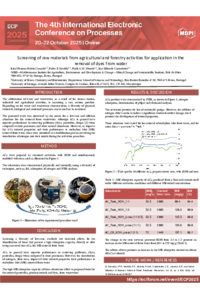
The presented work was motivated by the search for a low-cost and efficient adsorbent for dye removal from wastewater [1]. Raw materials from agricultural and forestry activities, such as coconut shells, olive stones, almond shells, and cork residues, were used, as collected from the field, for dye removal from wastewater. These raw materials also served as precursors for the production of activated carbon (ACs), using KOH as an activating agent, at 973 K. The adsorbents were characterized physically and texturally. It was observed that natural adsorbents have lower carbon content, surface area, and porous volume and higher acidic surfaces than their respective ACs.
Although ACs in general have superior performance in removing pollutants (dyes, pesticides, drugs) when compared to their precursors, to improve the properties of ACs and their performance in methylene blue (MB) removal from water, these were subjected to a modification process involving the introduction of nitrogen into their matrix during the activation procedure.
Screening a diversity of low-cost, available raw materials allows for the identification of those that present a high adsorption capacity, directly or after being converted into ACs, for MB removal from water. These were proposed for use in pollutant removal from water used for human consumption, especially in developing countries, where wastewater is taken from lakes, wells, and rivers and consumed without any previous treatment. This work allows us to valorize subproducts from agricultural and forestry activities, removing them from landfills and obtaining adsorbent materials that are successfully used in the treatment of water that can even be used for consumption, thus closing the cycle of the circular economy.
[1] Cansado, I.P.P., Geraldo, P.F., Mourão, P.A.M., Castanheiro, J.E., Carreiro, E.P., and Suhas. Utilization of Biomass Waste at Water Treatment. Resources, vol. 13, no. 3, Mar. 2024, doi: 10.3390/resources13030037.
Keywords
Dye
Adsorbent
Activated carbon
Chemical activation
Poster
ECP2025 - Isabel_Pedro.pdf
Photocatalytic Activity of ZnFe₂O₄ Nanoparticles for the Degradation of Fast Green FCF and Orange II Dyes
Effect of Ga2O3 content on the activity of Al2O3-supported catalysts for the CO2-assisted oxidative dehydrogenation of propane