Event submissions
Published
This submission belongs to the session S1. Environmental and Green Processes of the event The 4th International Electronic Conference on Processes
Published date
17 Oct, 2025
Academic Editor
'%3e%3cpath%20d='M12.6657%2010.9104C12.4185%2010.325%2012.0599%209.79327%2011.6097%209.34482C11.1609%208.89508%2010.6293%208.5365%2010.0442%208.28888C10.0389%208.28626%2010.0337%208.28495%2010.0285%208.28233C10.8446%207.69279%2011.3752%206.73249%2011.3752%205.64904C11.3752%203.8542%209.92103%202.39999%208.1262%202.39999C6.33136%202.39999%204.87715%203.8542%204.87715%205.64904C4.87715%206.73249%205.40774%207.69279%206.22393%208.28364C6.21869%208.28626%206.21345%208.28757%206.20821%208.29019C5.62129%208.5378%205.09463%208.89284%204.64265%209.34613C4.1929%209.79493%203.83432%2010.3266%203.58671%2010.9117C3.34345%2011.4845%203.21226%2012.0987%203.20023%2012.7209C3.19988%2012.7349%203.20233%2012.7488%203.20744%2012.7619C3.21255%2012.7749%203.22022%2012.7867%203.22998%2012.7968C3.23975%2012.8068%203.25142%2012.8147%203.26431%2012.8202C3.2772%2012.8256%203.29105%2012.8284%203.30504%2012.8284H4.09109C4.14874%2012.8284%204.19459%2012.7825%204.1959%2012.7262C4.2221%2011.7148%204.62823%2010.7676%205.34617%2010.0497C6.08899%209.30683%207.0755%208.89808%208.1262%208.89808C9.17689%208.89808%2010.1634%209.30683%2010.9062%2010.0497C11.6242%2010.7676%2012.0303%2011.7148%2012.0565%2012.7262C12.0578%2012.7838%2012.1037%2012.8284%2012.1613%2012.8284H12.9474C12.9613%2012.8284%2012.9752%2012.8256%2012.9881%2012.8202C13.001%2012.8147%2013.0126%2012.8068%2013.0224%2012.7968C13.0322%2012.7867%2013.0398%2012.7749%2013.0449%2012.7619C13.0501%2012.7488%2013.0525%2012.7349%2013.0522%2012.7209C13.0391%2012.0947%2012.9094%2011.4855%2012.6657%2010.9104ZM8.1262%207.9024C7.52486%207.9024%206.9589%207.6679%206.53312%207.24211C6.10733%206.81633%205.87283%206.25037%205.87283%205.64904C5.87283%205.0477%206.10733%204.48174%206.53312%204.05596C6.9589%203.63018%207.52486%203.39567%208.1262%203.39567C8.72753%203.39567%209.29349%203.63018%209.71927%204.05596C10.1451%204.48174%2010.3796%205.0477%2010.3796%205.64904C10.3796%206.25037%2010.1451%206.81633%209.71927%207.24211C9.29349%207.6679%208.72753%207.9024%208.1262%207.9024Z'%20fill='%235D1EE1'/%3e%3c/g%3e%3c/svg%3e) Young-Cheol Chang
Young-Cheol ChangCitation
Alexandra Florou, Georgios Bampos, Panagiota D. Natsi, Aliki Kokka, Paraskevi Panagiotopoulou, Effect of Ga₂O₃ content on the activity of Al₂O₃-supported catalysts for the CO₂-assisted oxidative dehydrogenation of propane, in Proceedings of The 4th International Electronic Conference on Processes, 20 October–22 October 2025, MDPI: Basel, Switzerland
Share
Email
Facebook
Twitter
LinkedIn
Effect of Ga2O3 content on the activity of Al2O3-supported catalysts for the CO2-assisted oxidative dehydrogenation of propane
'%3e%3cpath%20d='M12.6647%2010.9104C12.4176%2010.325%2012.0589%209.7933%2011.6088%209.34485C11.16%208.89511%2010.6283%208.53653%2010.0432%208.28891C10.038%208.28629%2010.0327%208.28498%2010.0275%208.28236C10.8437%207.69282%2011.3743%206.73252%2011.3743%205.64907C11.3743%203.85423%209.92005%202.40002%208.12522%202.40002C6.33038%202.40002%204.87618%203.85423%204.87618%205.64907C4.87618%206.73252%205.40677%207.69282%206.22296%208.28367C6.21772%208.28629%206.21248%208.2876%206.20724%208.29022C5.62031%208.53783%205.09365%208.89287%204.64167%209.34616C4.19192%209.79496%203.83334%2010.3266%203.58573%2010.9117C3.34247%2011.4846%203.21128%2012.0987%203.19925%2012.721C3.1989%2012.735%203.20135%2012.7489%203.20646%2012.7619C3.21157%2012.7749%203.21924%2012.7868%203.22901%2012.7968C3.23877%2012.8068%203.25045%2012.8148%203.26334%2012.8202C3.27623%2012.8256%203.29007%2012.8284%203.30406%2012.8284H4.09012C4.14776%2012.8284%204.19362%2012.7825%204.19493%2012.7262C4.22113%2011.7148%204.62726%2010.7676%205.34519%2010.0497C6.08802%209.30686%207.07452%208.89811%208.12522%208.89811C9.17592%208.89811%2010.1624%209.30686%2010.9052%2010.0497C11.6232%2010.7676%2012.0293%2011.7148%2012.0555%2012.7262C12.0568%2012.7839%2012.1027%2012.8284%2012.1603%2012.8284H12.9464C12.9604%2012.8284%2012.9742%2012.8256%2012.9871%2012.8202C13%2012.8148%2013.0117%2012.8068%2013.0214%2012.7968C13.0312%2012.7868%2013.0389%2012.7749%2013.044%2012.7619C13.0491%2012.7489%2013.0515%2012.735%2013.0512%2012.721C13.0381%2012.0947%2012.9084%2011.4856%2012.6647%2010.9104ZM8.12522%207.90243C7.52388%207.90243%206.95792%207.66793%206.53214%207.24215C6.10636%206.81636%205.87185%206.2504%205.87185%205.64907C5.87185%205.04773%206.10636%204.48177%206.53214%204.05599C6.95792%203.63021%207.52388%203.3957%208.12522%203.3957C8.72655%203.3957%209.29252%203.63021%209.7183%204.05599C10.1441%204.48177%2010.3786%205.04773%2010.3786%205.64907C10.3786%206.2504%2010.1441%206.81636%209.7183%207.24215C9.29252%207.66793%208.72655%207.90243%208.12522%207.90243Z'%20fill='%235D1EE1'/%3e%3c/g%3e%3c/svg%3e)
Alexandra Florou 1

Georgios Bampos 2
Panagiota D. Natsi 2
Aliki Kokka 1

Paraskevi Panagiotopoulou 3
1. School of Chemical and Environmental Engineering, Technical University of Crete, Chania, Greece
2. Department of Chemical Engineering, University of Patras, Patras, Greece
3. School of Chemical and Environmental Engineering, Technical University of Crete, Chania, Greece ; Institute of Geoenergy, Foundation for Research and Technology- Hellas (IG/FORTH), Chania, Greece
Abstract
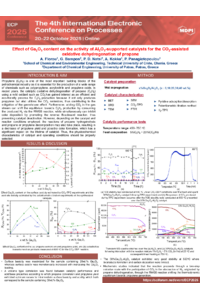
Propylene production through the CO₂-assisted oxidative dehydrogenation of propane is considered an effective route for addressing the ever-increasing demand for propylene and simultaneously utilizing CO₂. In this study, a series of alumina-supported gallium oxide catalysts with variable Ga₂O₃ loadings was synthesized, characterized, and evaluated with respect to their activity for the oxidative dehydrogenation of propane with CO₂. Surface basicity was measured through CO₂-TPD experiments using mass spectrometry (MS) and in situ FTIR spectroscopy techniques, while surface acidity was determined by employing potentiometric titration and pyridine adsorption/desorption experiments. XRD, BET, and SEM-EDS techniques were also applied for the determination of the catalysts’ physicochemical and morphological properties. The results showed that surface basicity was maximized for the sample containing 20 wt.% Ga₂O₃, whereas surface acidity monotonically increased with an increasing Ga₂O₃ loading. Catalytic activity was found to be strongly influenced by the Ga2O3 concentration and optimized for the 30%Ga2O3-Al2O3 catalyst, which was characterized by moderate surface acidity and basicity. This catalyst was not only able to enhance propane's conversion into propylene, which reached 59% at ~600 oC with a corresponding propylene yield of 39%, but also to limit the undesired reactions of propane hydrogenolysis and propane/propylene decomposition, which were responsible for the formation of C2H4, CH4, C2H6, and coke. Time-on-stream stability tests showed that the 30%Ga₂O₃–Al₂O₃ catalyst exhibited very good stability at 550 °C for 12 h, where byproduct formation and carbon deposition were limited, whereas it was gradually deactivated with the time on stream when the reaction occurred at elevated temperatures (>600 °C). Mechanistic studies conducted using in situ FTIR and transient-MS techniques indicated that the reaction proceeded through a two-step oxidative route, with the participation of CO₂ in the abstraction of H₂, originated by propane dehydrogenation, through the RWGS reaction, shifting the thermodynamic equilibrium towards propylene generation.
Keywords
CO2-assisted oxidative dehydrogenation of propane
propylene production
surface basicity/acidity
Ga2O3-Al2O3 catalysts
Ga2O3 loading
reaction mechanism
Poster
Sciforum-131599-ECP2025-Poster.pdf
Screening of raw materials from agricultural and forestry activities for application in the removal of dyes from water
Α Leptolyngbya-dominated consortium for the optimized biological treatment of mixed agro-industrial effluents