Event submissions
Published
This submission belongs to the session S1. Environmental and Green Processes of the event The 4th International Electronic Conference on Processes
Published date
17 Oct, 2025
Academic Editor
'%3e%3cpath%20d='M12.6657%2010.9104C12.4185%2010.325%2012.0599%209.79327%2011.6097%209.34482C11.1609%208.89508%2010.6293%208.5365%2010.0442%208.28888C10.0389%208.28626%2010.0337%208.28495%2010.0285%208.28233C10.8446%207.69279%2011.3752%206.73249%2011.3752%205.64904C11.3752%203.8542%209.92103%202.39999%208.1262%202.39999C6.33136%202.39999%204.87715%203.8542%204.87715%205.64904C4.87715%206.73249%205.40774%207.69279%206.22393%208.28364C6.21869%208.28626%206.21345%208.28757%206.20821%208.29019C5.62129%208.5378%205.09463%208.89284%204.64265%209.34613C4.1929%209.79493%203.83432%2010.3266%203.58671%2010.9117C3.34345%2011.4845%203.21226%2012.0987%203.20023%2012.7209C3.19988%2012.7349%203.20233%2012.7488%203.20744%2012.7619C3.21255%2012.7749%203.22022%2012.7867%203.22998%2012.7968C3.23975%2012.8068%203.25142%2012.8147%203.26431%2012.8202C3.2772%2012.8256%203.29105%2012.8284%203.30504%2012.8284H4.09109C4.14874%2012.8284%204.19459%2012.7825%204.1959%2012.7262C4.2221%2011.7148%204.62823%2010.7676%205.34617%2010.0497C6.08899%209.30683%207.0755%208.89808%208.1262%208.89808C9.17689%208.89808%2010.1634%209.30683%2010.9062%2010.0497C11.6242%2010.7676%2012.0303%2011.7148%2012.0565%2012.7262C12.0578%2012.7838%2012.1037%2012.8284%2012.1613%2012.8284H12.9474C12.9613%2012.8284%2012.9752%2012.8256%2012.9881%2012.8202C13.001%2012.8147%2013.0126%2012.8068%2013.0224%2012.7968C13.0322%2012.7867%2013.0398%2012.7749%2013.0449%2012.7619C13.0501%2012.7488%2013.0525%2012.7349%2013.0522%2012.7209C13.0391%2012.0947%2012.9094%2011.4855%2012.6657%2010.9104ZM8.1262%207.9024C7.52486%207.9024%206.9589%207.6679%206.53312%207.24211C6.10733%206.81633%205.87283%206.25037%205.87283%205.64904C5.87283%205.0477%206.10733%204.48174%206.53312%204.05596C6.9589%203.63018%207.52486%203.39567%208.1262%203.39567C8.72753%203.39567%209.29349%203.63018%209.71927%204.05596C10.1451%204.48174%2010.3796%205.0477%2010.3796%205.64904C10.3796%206.25037%2010.1451%206.81633%209.71927%207.24211C9.29349%207.6679%208.72753%207.9024%208.1262%207.9024Z'%20fill='%235D1EE1'/%3e%3c/g%3e%3c/svg%3e) Young-Cheol Chang
Young-Cheol ChangCitation
Vasiliki Patrinou, Dimitris V. Vayenas, Athanasia G. Tekerlekopoulou, Α Leptolyngbya-dominated consortium for the optimized biological treatment of mixed agro-industrial effluents, in Proceedings of The 4th International Electronic Conference on Processes, 20 October–22 October 2025, MDPI: Basel, Switzerland
Share
Email
Facebook
Twitter
LinkedIn
Α Leptolyngbya-dominated consortium for the optimized biological treatment of mixed agro-industrial effluents

Vasiliki Patrinou 1

Dimitris V. Vayenas 2

Athanasia G. Tekerlekopoulou 1
1. Department of Sustainable Agriculture, University of Patras, 30100, Agrinio, Greece
2. Department of Chemical Engineering, University of Patras, 26500, Rio-Patras, Greece
Abstract
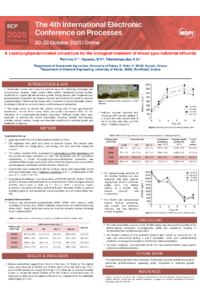
Wastewater streams are a low-cost nutrient source for cultivating microalgae and cyanobacteria. However, single streams often exhibit imbalanced nutrient profiles, insufficient to support optimal microbial growth. Mixing streams with complementary physicochemical properties can balance nutrients and eliminate the need for external supplementation. Optimizing the mixing ratio is essential to achieve favorable carbon-to-nitrogen (C:N) ratios, enhance biomass and biocompound production, and improve culture conditions such as turbidity and pH. This study aimed to identify the optimal mixing ratio of two agro-industrial wastewaters, second cheese whey (SCW) and poultry wastewater (PW), for the cultivation of a Leptolyngbya-dominated consortium. SCW had higher organic and lower inorganic nutrient content than PW. Increasing the SCW proportion raised the C:N ratio and induced N and P limitations, conditions known to promote lipid accumulation. Four SCW:PW ratios (50:50%, 60:40%, 70:30% and 85:15%) were examined based on the initial dissolved chemical oxygen demand (d-COD) concentration of 3000 mg L−1. The 60:40% and 70:30% SCW:PW ratios yielded the highest biomass productivities (276.6 and 268.3 mg L−1 d−1, respectively), while the 50:50% resulted in the lowest productivity (174.6 mg L−1 d−1), likely due to turbidity. A progressive enhancement in pollutant removal efficiency was observed with increasing SCW proportions. The 70:30% ratio achieved the highest d-COD (89.2%), total nitrogen (64%) and PO43--P (60%) removal, as well as the highest lipid content (14.0% d.w.). This ratio was identified as optimal. The 85:15% ratio also demonstrated enhanced lipid content (11.9% d.w.), attributed to the reduced turbidity and consequent improved light penetration, favoring the proliferation of lipid-producing autotrophic microorganisms within the consortium.
Keywords
Leptolyngbya sp
agro-industrial effluents
optimization of mixing ratio
microbial lipids
Poster
EnvironmentalandGreenProcesses_24539_Alpha_Leptolyngbya_dominated_sciforum-131749.pdf
Effect of Ga2O3 content on the activity of Al2O3-supported catalysts for the CO2-assisted oxidative dehydrogenation of propane
Natural zeolites supported green-synthesized CeО2@Polybenzimidazole hybrid materials for dye degradation