Event submissions
Published
This submission belongs to the session S1. Environmental and Green Processes of the event The 4th International Electronic Conference on Processes
Published date
17 Oct, 2025
Academic Editor
'%3e%3cpath%20d='M12.6657%2010.9104C12.4185%2010.325%2012.0599%209.79327%2011.6097%209.34482C11.1609%208.89508%2010.6293%208.5365%2010.0442%208.28888C10.0389%208.28626%2010.0337%208.28495%2010.0285%208.28233C10.8446%207.69279%2011.3752%206.73249%2011.3752%205.64904C11.3752%203.8542%209.92103%202.39999%208.1262%202.39999C6.33136%202.39999%204.87715%203.8542%204.87715%205.64904C4.87715%206.73249%205.40774%207.69279%206.22393%208.28364C6.21869%208.28626%206.21345%208.28757%206.20821%208.29019C5.62129%208.5378%205.09463%208.89284%204.64265%209.34613C4.1929%209.79493%203.83432%2010.3266%203.58671%2010.9117C3.34345%2011.4845%203.21226%2012.0987%203.20023%2012.7209C3.19988%2012.7349%203.20233%2012.7488%203.20744%2012.7619C3.21255%2012.7749%203.22022%2012.7867%203.22998%2012.7968C3.23975%2012.8068%203.25142%2012.8147%203.26431%2012.8202C3.2772%2012.8256%203.29105%2012.8284%203.30504%2012.8284H4.09109C4.14874%2012.8284%204.19459%2012.7825%204.1959%2012.7262C4.2221%2011.7148%204.62823%2010.7676%205.34617%2010.0497C6.08899%209.30683%207.0755%208.89808%208.1262%208.89808C9.17689%208.89808%2010.1634%209.30683%2010.9062%2010.0497C11.6242%2010.7676%2012.0303%2011.7148%2012.0565%2012.7262C12.0578%2012.7838%2012.1037%2012.8284%2012.1613%2012.8284H12.9474C12.9613%2012.8284%2012.9752%2012.8256%2012.9881%2012.8202C13.001%2012.8147%2013.0126%2012.8068%2013.0224%2012.7968C13.0322%2012.7867%2013.0398%2012.7749%2013.0449%2012.7619C13.0501%2012.7488%2013.0525%2012.7349%2013.0522%2012.7209C13.0391%2012.0947%2012.9094%2011.4855%2012.6657%2010.9104ZM8.1262%207.9024C7.52486%207.9024%206.9589%207.6679%206.53312%207.24211C6.10733%206.81633%205.87283%206.25037%205.87283%205.64904C5.87283%205.0477%206.10733%204.48174%206.53312%204.05596C6.9589%203.63018%207.52486%203.39567%208.1262%203.39567C8.72753%203.39567%209.29349%203.63018%209.71927%204.05596C10.1451%204.48174%2010.3796%205.0477%2010.3796%205.64904C10.3796%206.25037%2010.1451%206.81633%209.71927%207.24211C9.29349%207.6679%208.72753%207.9024%208.1262%207.9024Z'%20fill='%235D1EE1'/%3e%3c/g%3e%3c/svg%3e) Young-Cheol Chang
Young-Cheol ChangCitation
Katerina Zaharieva, Silvia Dimova, Hristo Penchev, Natural zeolites supported green-synthesized CeО₂@Polybenzimidazole hybrid materials for dye degradation, in Proceedings of The 4th International Electronic Conference on Processes, 20 October–22 October 2025, MDPI: Basel, Switzerland
Share
Email
Facebook
Twitter
LinkedIn
Natural zeolites supported green-synthesized CeО2@Polybenzimidazole hybrid materials for dye degradation

Katerina Zaharieva 1
'%3e%3cpath%20d='M12.6647%2010.9104C12.4176%2010.325%2012.0589%209.7933%2011.6088%209.34485C11.16%208.89511%2010.6283%208.53653%2010.0432%208.28891C10.038%208.28629%2010.0327%208.28498%2010.0275%208.28236C10.8437%207.69282%2011.3743%206.73252%2011.3743%205.64907C11.3743%203.85423%209.92005%202.40002%208.12522%202.40002C6.33038%202.40002%204.87618%203.85423%204.87618%205.64907C4.87618%206.73252%205.40677%207.69282%206.22296%208.28367C6.21772%208.28629%206.21248%208.2876%206.20724%208.29022C5.62031%208.53783%205.09365%208.89287%204.64167%209.34616C4.19192%209.79496%203.83334%2010.3266%203.58573%2010.9117C3.34247%2011.4846%203.21128%2012.0987%203.19925%2012.721C3.1989%2012.735%203.20135%2012.7489%203.20646%2012.7619C3.21157%2012.7749%203.21924%2012.7868%203.22901%2012.7968C3.23877%2012.8068%203.25045%2012.8148%203.26334%2012.8202C3.27623%2012.8256%203.29007%2012.8284%203.30406%2012.8284H4.09012C4.14776%2012.8284%204.19362%2012.7825%204.19493%2012.7262C4.22113%2011.7148%204.62726%2010.7676%205.34519%2010.0497C6.08802%209.30686%207.07452%208.89811%208.12522%208.89811C9.17592%208.89811%2010.1624%209.30686%2010.9052%2010.0497C11.6232%2010.7676%2012.0293%2011.7148%2012.0555%2012.7262C12.0568%2012.7839%2012.1027%2012.8284%2012.1603%2012.8284H12.9464C12.9604%2012.8284%2012.9742%2012.8256%2012.9871%2012.8202C13%2012.8148%2013.0117%2012.8068%2013.0214%2012.7968C13.0312%2012.7868%2013.0389%2012.7749%2013.044%2012.7619C13.0491%2012.7489%2013.0515%2012.735%2013.0512%2012.721C13.0381%2012.0947%2012.9084%2011.4856%2012.6647%2010.9104ZM8.12522%207.90243C7.52388%207.90243%206.95792%207.66793%206.53214%207.24215C6.10636%206.81636%205.87185%206.2504%205.87185%205.64907C5.87185%205.04773%206.10636%204.48177%206.53214%204.05599C6.95792%203.63021%207.52388%203.3957%208.12522%203.3957C8.72655%203.3957%209.29252%203.63021%209.7183%204.05599C10.1441%204.48177%2010.3786%205.04773%2010.3786%205.64907C10.3786%206.2504%2010.1441%206.81636%209.7183%207.24215C9.29252%207.66793%208.72655%207.90243%208.12522%207.90243Z'%20fill='%235D1EE1'/%3e%3c/g%3e%3c/svg%3e)
Silvia Dimova 2

Hristo Penchev 2
1. Institute of Mineralogy and Crystallography “Аkad. I. Kostov”, Bulgarian Academy of Sciences, “Akad. G. Bonchev” St., Bl. 107, Sofia 1113, Bulgaria
2. Institute of Polymers, Bulgarian Academy of Sciences, Akad. G. Bonchev St., Bl. 103A, Sofia 1113, Bulgaria
Abstract
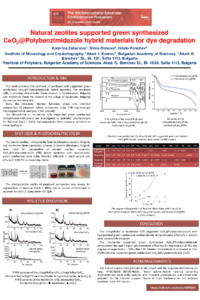
Natural zeolites, clinoptilolite from the Golobradovo deposit, Bulgaria, and mordenite from the Lyaskovets deposit in Eastern Rhodopes, Bulgaria, were used for the preparation of natural-zeolite-supported CeО2@Polybenzimidazole (PBI) hybrid materials with green-synthesized ceria incorporated using Veronica officinalis L. plant extract. In order to prepare hybrid composite powders of the natural zeolites/green-synthesized CeО2, the surface was impregnated with the use of ethanolic KOH solution of meta-polybenzimidazole as dispersant media. The chemical and phase composition, structure, and thermal behavior of the obtained composite materials were investigated through X-ray fluorescence analyses, powder X-ray diffraction, Fourier-transform infrared spectroscopy, and thermogravimetric analysis. The presence of CeO2 (33.1 mass % and 32 mass %) in the prepared clinoptilolite- or mordenite-supported green-synthesized CeО2@Polybenzimidazole was determined using X-ray fluorescence analysis. The photocatalytic properties of the synthesized hybrid materials were tested in the reaction of oxidative photocatalytic degradation of 5 ppm Reactive Black 5 (RB5) dye as a model pollutant under UV light irradiation. The photocatalytic results show that the RB5 dye demonstrates a higher degree of degradation (98%) with 120 minutes of UV irradiation in the presence of mordenite-supported/CeO2@PBI as the photocatalyst compared to that with the clinoptilolite-supported/CeO2@PBI (14%).
Acknowledgments: The authors express their gratitude to the project with the Bulgarian National Science Fund, KP-06-N69/8 (КП-06-Н69/8), “Novel polymer-hybrid materials containing (bio)synthesized metal oxide particles with improved photocatalytic and antimicrobial potential”, for the financial support. The authors acknowledge the technical support from the project PERIMED BG05M2OP001-1.002-0005 /29.03.2018 (2018–2023). Thanks to Liliya Tsvetanova for her technical assistance in the XRF analysis.
Keywords
clinoptilolite
mordenite
CeO2
green synthesis
polybenzimidazole
hybrid materials
photocatalytic degradation
dye
Poster
Poster.pdf
Α Leptolyngbya-dominated consortium for the optimized biological treatment of mixed agro-industrial effluents
Biotreatment of Second Cheese Whey in Pilot-Scale Photobioreactors Using Cyanobacteria-based Consortia for Lipid Production